Ministry, Academia and Industry Launch Water-Energy Convergence Forum
The government will establish an integrated management system for water and energy to simultaneously pursue responses to the climate crisis and the creation of new industries.
The Ministry of Climate, Energy and Environment announced that on the 25th it held an inauguration ceremony for the "Water-Energy Convergence Forum" at the Korea Hydro & Nuclear Power Vision Hall in Jung District, Seoul, with participation from public institutions, academia, and industry, and began discussions on 12 key tasks that combine water and energy functions. This forum is a collaboration platform designed to incorporate the concept of the "Water-Energy Nexus," which views water and energy as a single circular system, into policies and projects.
Public institutions such as Korea Electric Power Corporation, Korea Hydro & Nuclear Power, Korea Water Resources Corporation, Korea Environment Corporation, Korea Energy Agency, and Korea District Heating Corporation, as well as academic societies in the electricity, energy, and water resources sectors and climate tech companies, are participating in the forum. By combining the expertise of each institution, the forum plans to review mid- to long-term cooperation directions and operate task forces (TFs) for each project in parallel.
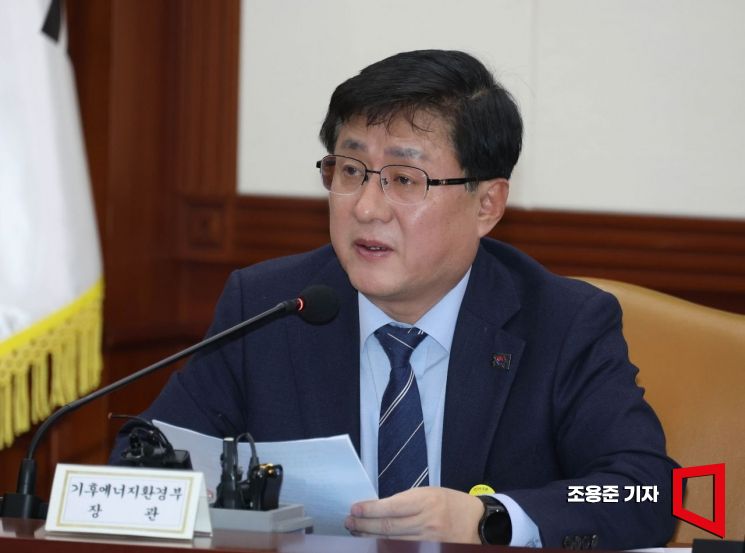 Kim Seonghwan, Minister of Climate, is attending and speaking at the Economic Ministers' Meeting, which also served as the Meeting on Strengthening Industrial Competitiveness, held at the Government Complex Seoul in Jongno-gu, Seoul on February 25, 2026. Photo by Jo Yongjun
The government plans to move away from the conventional approach of managing water and energy separately and instead organically link policies, technologies, and resources to deliver tangible results that people can feel. It explained that the need for integrated management has grown because water underpins power generation, cooling, and hydrogen production, while energy is essential at every stage of water intake, purification, transmission, and treatment.
Key tasks include expanding "water battery"-type pumped-storage power generation that uses existing dams as lower reservoirs to reduce environmental impact and costs; utilizing water-source heat energy with expanded supply at the apartment complex and city levels; and pursuing joint overseas project bids that link hydropower generation with power grids. The government will also promote everyday life-focused projects such as expanding solar power at sewage treatment plants, linking data center locations, and building safety services by integrating the use of electricity and water meters.
The forum will reflect on-the-ground ideas in policy through contests for young people and promote the spread of a convergence-industry ecosystem through collaboration with climate tech companies. After the inauguration ceremony, working-level meetings will be held for each task to flesh out implementation schedules and cooperation plans.
Kim Seonghwan, Minister of Climate, said, "Water and energy are core resources that support people's daily lives and industries," adding, "Through convergence, we will simultaneously achieve responses to the climate crisis and the strengthening of industrial competitiveness, and deliver outcomes that people can truly feel."
© The Asia Business Daily(www.asiae.co.kr). All rights reserved.
![Clutching a Stolen Dior Bag, Saying "I Hate Being Poor but Real"... The Grotesque Con of a "Human Knockoff" [Slate]](https://cwcontent.asiae.co.kr/asiaresize/183/2026021902243444107_1771435474.jpg)
















