Examining ESG Institutionalization and Climate Finance Activation Plans
Emphasis on Stable Implementation with Grace Periods and Initial Safe Harbor to Ease Corporate Burden
Releasing 790 Trillion Won to Mitigate Green Transition Shocks While Providing Parallel Support
The government's ESG (environment, social, and governance) disclosure roadmap, released on February 25, is characterized by its focus on "calibrating the pace": it mandates Scope 3 (emissions across the entire value chain) in line with international standards, but in consideration of the burden on companies, it allows a three-year grace period and initial safe harbor provisions. At the same time, the government clearly conveyed its intention to combine regulation with support by presenting a plan to supply climate finance totaling 790 trillion won.
The core of this institutionalization of ESG is that it seeks a balance between "international alignment" and "practical feasibility." Based on the standards of the International Sustainability Standards Board (ISSB), the government is preparing disclosure standards, while designing the scope and method of ESG disclosure in stages. Starting in 2028 with KOSPI-listed companies that have consolidated assets of 30 trillion won or more, the coverage will gradually be expanded. In the initial phase, disclosures will be filed through the stock exchange, and the use of estimates will be protected under a safe harbor. This is being evaluated as a measure that places more weight on the stable establishment of the system. The decision to exclude domestic and overseas subsidiaries whose share of consolidated assets or sales is less than 10% in the first year of disclosure from the disclosure scope is also seen as a step to ensure a smooth, soft landing of the system.
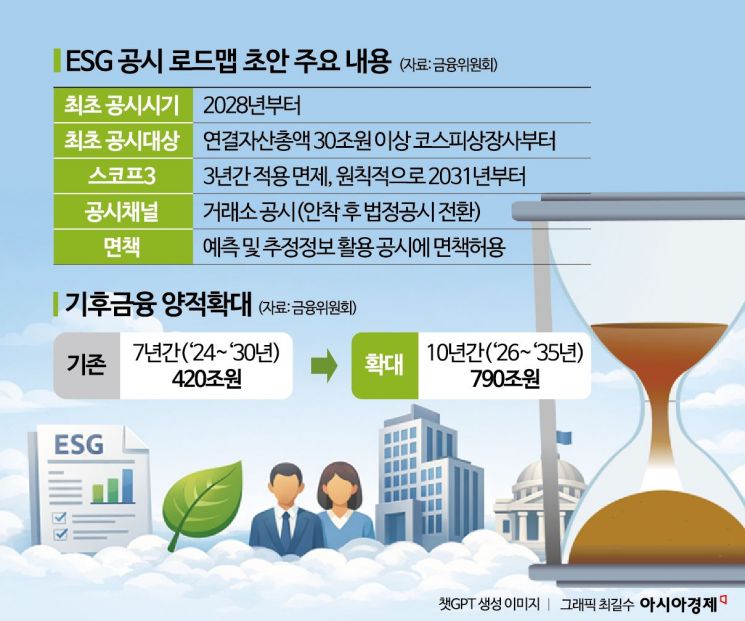
The particularly notable point is the three-year grace period for Scope 3, which the business community has been concerned about. For companies that first disclose in 2028, the obligation will effectively begin in 2031. Since Scope 3 goes beyond direct and indirect emissions to cover the entire supply chain, there have been ongoing concerns that calculation is highly complex and that the burden can increase significantly depending on how prepared suppliers are. This is also why the ESG roadmap, which was originally supposed to be released in 2024, was delayed until now. A business community representative said, "It will take time to manage data systematically all the way down to small and medium-sized partner companies," adding, "Infrastructure building must proceed in parallel during the grace period."
However, contrary to the concerns of the business community, there are also expectations in the market that the introduction of ESG disclosure will help attract investment. Previously, the Asia Investor Group on Climate Change (AIGCC) urged mandatory ESG disclosures in line with global trends, warning that if companies fail to respond adequately to climate change, it could lead to issues of transparency and credibility and ultimately affect their ability to attract investment. The government also plans to provide incentives, such as designating "exemplary disclosure companies," to firms that voluntarily implement disclosures going forward.
Domestic ESG experts view the new measures as a "realistic compromise," while pointing out that there are still many areas that need improvement. Oh Seungjae, CEO of Sustinvest, said, "This will serve as a starting point for the domestic ESG ecosystem to make a leap forward," but also noted, "To enhance the effectiveness of the system, disclosure regimes targeting financial institutions, such as the European Union's Sustainable Finance Disclosure Regulation (SFDR), must be implemented in parallel, going beyond corporate disclosure alone." The explanation is that only when disclosures by financial institutions, which determine the flow of capital, are linked in, can the tangible incentive of reducing companies' funding costs actually function.
An ESG expert who requested anonymity also assessed the mandatory disclosure as positive, but expressed concern that "because the scope of application is excessively narrow, the overall effectiveness falls short of expectations." He said, "The inclusion of Scope 3 from 2031 is a considerable step back from the level originally discussed," and added, "Given the long grace period, there must be simultaneous, thorough refinement of guidelines for measurement methodologies and disclosure standards so that this period can be used to build a substantive foundation for preparation."
Another ESG expert likewise said, "Adjusting the pace was unavoidable, but if data reliability and verification systems are not significantly strengthened during the grace period, the effectiveness of the system could be weakened." Some observers also point out that, because policy disclosure items were excluded from the final disclosure standards, there needs to be continued discussion on improving the social and governance areas going forward. Although the decision prioritized alignment with international standards, there is a view that disclosures in the non-environmental areas of ESG may be relatively weakened.
The government's climate finance activation plan, also announced on the same day, to supply 790 trillion won between 2026 and 2035, has a strong character as a "support package" that is closely linked to this mandatory disclosure. Both the duration and the amount have been significantly expanded compared with the previous plan (420 trillion won from 2024 to 2030). In particular, more than 50% of these funds will be concentrated in regional areas outside the capital region, and more than 70% will be directed to small and medium-sized enterprises and mid-sized companies. This is interpreted as an attempt to mitigate potential industrial shocks arising during the green transition.
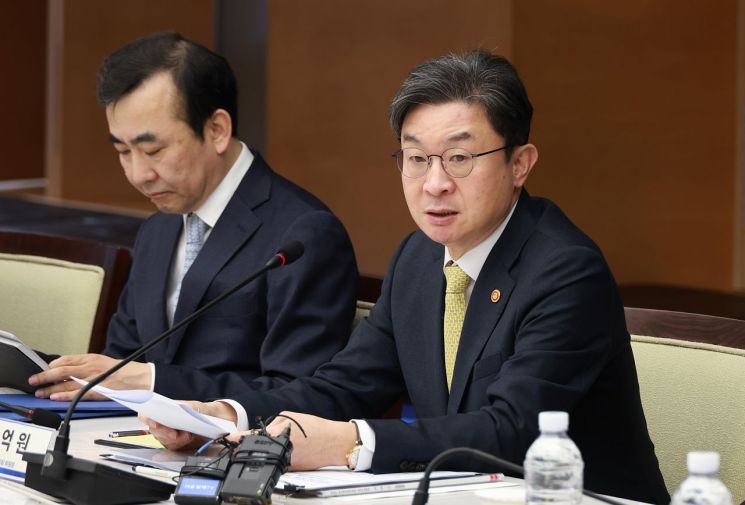
Lee Eokwon, Vice Chairman of the Financial Services Commission, stressed, "By having policy finance participate preemptively in climate finance, which requires high-risk, long-term capital, we will reduce the investment burden on industry and induce active inflows of private capital, thereby creating an opportunity for climate finance to spread across the entire financial sector." However, opinions are divided on whether the expansion of policy finance will actually translate into incentives for private investment. A financial industry insider said, "If policy finance is to play a priming role, it must be backed by clear standards and consistent implementation," adding, "Simply increasing the supply of funds will not be sufficient."
The successful establishment of the so-called "Korean-style transition finance" is another variable. The intent is to support the low-carbon transition of high-emission sectors such as steel and chemicals through regulated finance, but if the transition criteria are too loose, it could become embroiled in "greenwashing" controversy. Conversely, if the criteria are excessively strict, there are concerns that companies' access to capital could be constrained. The government's transition finance guidelines encompass two types: transition finance based on the K-Taxonomy (under the climate ministry), which benchmarks the EU's conceptual framework, and transition finance based on sector-specific carbon reduction implementation roadmaps (under the industry ministry), similar to the Japanese model.
© The Asia Business Daily(www.asiae.co.kr). All rights reserved.


















