As the U.S. Supreme Court has ruled that tariffs imposed by President Trump under the International Emergency Economic Powers Act (IEEPA) were unlawful, an opinion has emerged that it is necessary to review the possibility of refunds for tariffs already paid.
On the 25th, Samjong KPMG published a report titled "Implications of the U.S. Supreme Court Ruling on IEEPA-Based Tariffs and Customs Refund Strategies for Korean Companies," which organizes the impact of this issue on Korean exporting companies and practical response tasks. The report is structured in a Q&A format.
The report stressed that, in order to review whether tariffs already paid can be refunded, it is first necessary to understand U.S.-specific practices. Unlike Korea, the United States actively uses Delivery Duty Paid (DDP) terms, under which the Korean exporter, rather than the U.S. importer, performs tariff payment and import declaration. For each initial import declaration (Entry), liquidation is generally completed within about 314 days after the declaration. Before liquidation, there is a system that allows corrections to the declaration via a Post Summary Correction (PSC).
For example, if the exporter has paid the tariffs under DDP terms, any tariff refund will also be attributed to the exporter. Therefore, exporters must directly prepare the procedures and documents required for tariff refunds. It should also be noted that the refund procedure itself may differ depending on whether liquidation has taken place.
The U.S. Customs and Border Protection has not yet announced specific refund guidelines. However, based on what has been confirmed so far, entries for which liquidation has been completed will need to contest the possibility of a refund through a protest or litigation. In contrast, for entries where 314 days have not elapsed since the import declaration and liquidation has not been completed, the possibility of a refund will be reviewed through a PSC.
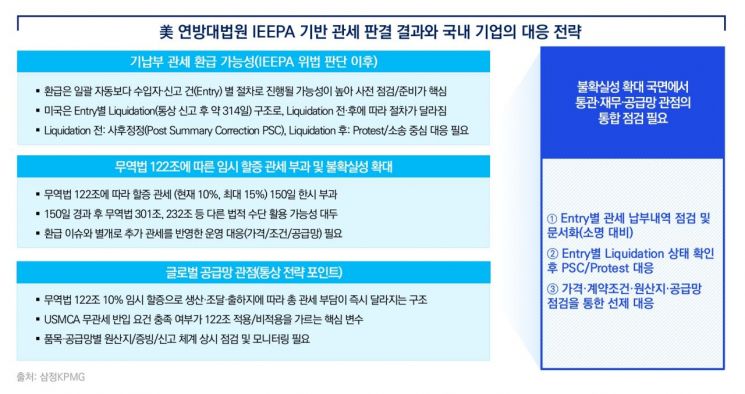
Meanwhile, the Trump administration's tariff policy is being applied worldwide. The report urged Korean exporters with global supply chains to establish trade strategies by building supply chains that factor in tariff impacts. For example, goods exported to the United States that meet the preferential treatment requirements of the United States-Mexico-Canada Agreement (USMCA) are not subject to tariffs under Section 122 of the Trade Act, thereby securing price competitiveness. Accordingly, it is necessary to establish and monitor trade strategies that take this into account.
Samjong KPMG emphasized that companies should avoid passively waiting for tariff refunds based solely on the fact that a ruling has been issued. Some projections suggest that it may actually take several years until refunds are made. This is because it is highly likely that the U.S. Customs and Border Protection will not process refunds uniformly for all tariff payers, but will instead decide on refunds after individually reviewing, by importer and by entry, both the appropriateness of tariffs already paid and whether the procedural requirements necessary for refunds have been met.
Accordingly, Korean exporters should review tariff payment records by import declaration entry for entries after April 2025, and carry out documentation work in preparation for possible information requests from U.S. Customs and Border Protection. They should also review the necessary actions (PSC or protest) depending on whether liquidation has proceeded for each entry. If the Korean exporter bore the tariff burden but the U.S. importer filed the customs declaration, the tariff refund will also be attributed to the U.S. importer. Therefore, in order to prevent disputes between the parties, it is necessary to establish a prior agreement on the actual party entitled to the refund.
Taejoo Kim, Executive Director and Leader of the Customs and Trade Advisory practice at Samjong KPMG, said, "From the perspective of companies, this is a complex situation in which the possibility of refunds and the risk of additional tariff burdens coexist," adding, "Companies need to proactively address this uncertainty by simultaneously organizing customs clearance data, preparing responses for each procedure, and reviewing origin and supply chains."
© The Asia Business Daily(www.asiae.co.kr). All rights reserved.
![Clutching a Stolen Dior Bag, Saying "I Hate Being Poor but Real"... The Grotesque Con of a "Human Knockoff" [Slate]](https://cwcontent.asiae.co.kr/asiaresize/183/2026021902243444107_1771435474.jpg)
















