Ministry of Health and Welfare and National Fire Agency launch pilot project to innovate emergency transport system in Gwangju, Jeonnam, and Jeonbuk
Securing the "golden hour" through real-time information sharing among ambulance crews, hospitals, and
To resolve the so-called "emergency room merry-go-round" problem, in which emergency patients wander from place to place because they cannot find a hospital that can treat them, the government is moving to innovate a community-based emergency transport system.
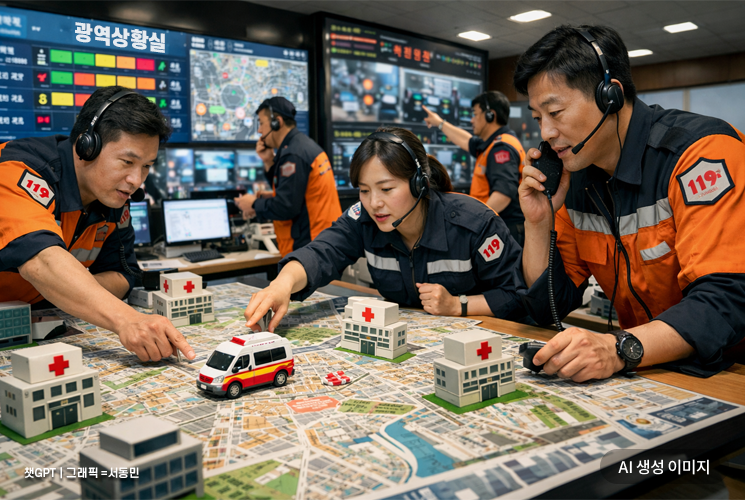
The Ministry of Health and Welfare and the National Fire Agency announced on the 25th that they will conduct a three-month "Pilot Project for Innovation of the Emergency Patient Transport System" starting next month in three regions: Gwangju Metropolitan City, Jeonbuk Special Self-Governing Province, and Jeollanam-do, in order to ensure the rapid transport of emergency patients and the efficient operation of the medical system.
The core of this pilot project is to clearly define who decides the destination hospital according to the patient’s condition (severity), and to make cooperation among related institutions mandatory.
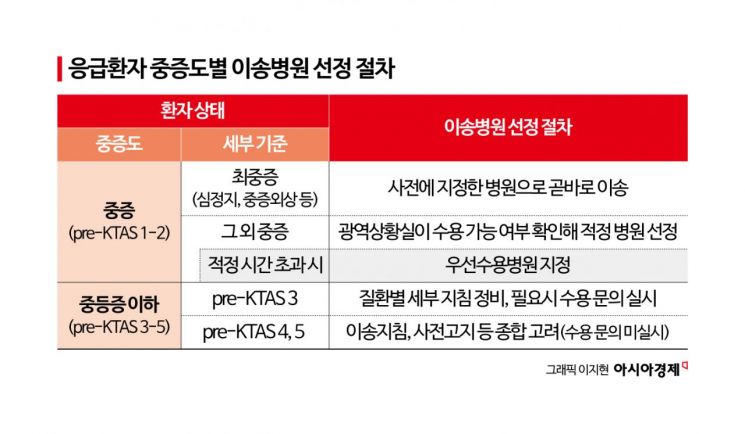
First, when a severe emergency patient (pre-KTAS levels 1 to 2) occurs, the 119 emergency medical service (EMS) team shares the patient’s information with the Regional Emergency Medical Information Center (regional control center). The regional control center then checks whether hospitals can accept the patient, directly selects the destination hospital, and guides the field crew. If transport is delayed, the regional control center can, by referring to the status of medical resources at hospitals, select a priority receiving hospital capable of providing stabilization treatment and have the patient accepted there.
However, patients requiring immediate emergency care, such as those in cardiac arrest, are transported directly to designated hospitals according to the guidelines. In addition, among severe emergency patients transported by 119 EMS teams, if a patient needs to be moved to another hospital for definitive treatment after initial stabilization or treatment, the 119 EMS team will support the patient’s subsequent transfer.
Emergency patients with moderate or lower severity (pre-KTAS levels 3 to 5) will, as before, be transported immediately by the 119 EMS team in accordance with pre-agreed transport guidelines and after checking the status of medical resources at hospitals, while patient information will be shared in advance with the receiving medical institution to help it prepare for admission.
In addition, for special conditions such as replantation of severed digits or limbs, pediatric cases, and deliveries, the list of hospitals to which patients will be transported for each situation and symptom will be updated by taking into account medical resources not only within the region but also in neighboring cities and provinces.
To ensure that the innovation of the transport system functions effectively, information sharing among related institutions such as 119 EMS teams, hospitals, regional control centers, and 119 emergency dispatch control centers will also be strengthened. 119 EMS personnel will transmit patient information in real time to hospitals and control centers through the "119 Emergency Smart System," while hospitals will periodically update the status of intensive care units and operating rooms, as well as the operating status of major equipment such as MRI and CT scanners, to support rapid decision-making by EMS teams.
For systematic management of this pilot project, the government will also establish an operations committee that will include officials from the Ministry of Health and Welfare, the National Fire Agency, the National Emergency Medical Center, and local governments in charge of emergency medical services. The committee will regularly review the progress of the project and, based on performance analysis, will prepare a standard model in the second half of the year for nationwide rollout.
Minister of Health and Welfare Jung Eun-kyeong said, "In order to develop solutions tailored to the characteristics of each community, the community itself must above all be the main actor in the discussion," adding, "To resolve the problem of emergency rooms refusing to accept patients, local communities, the Ministry of Health and Welfare, and the National Fire Agency will all operate this pilot project with a shared sense of responsibility."
© The Asia Business Daily(www.asiae.co.kr). All rights reserved.
![Clutching a Stolen Dior Bag, Saying "I Hate Being Poor but Real"... The Grotesque Con of a "Human Knockoff" [Slate]](https://cwcontent.asiae.co.kr/asiaresize/183/2026021902243444107_1771435474.jpg)

















