Demonstration and Research & Development of Physical AI Specialized for Medical Settings
Hallym University Sacred Heart Hospital is partnering with the robotics company Blue Robin to develop humanoid robots specialized for medical settings. Building on its experience operating medical service robots, the hospital plans to conduct proof-of-concept projects and research and development for physical artificial intelligence (AI) optimized for the hospital environment.
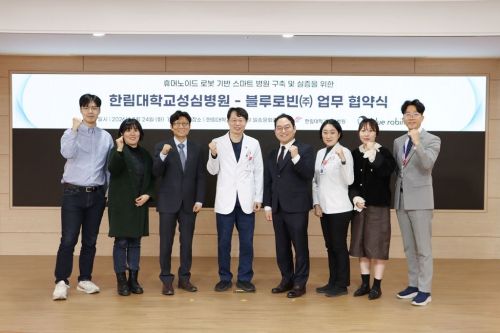 Representatives from Blue Robin at Hallym University Sacred Heart Hospital are taking a commemorative photo at the memorandum of understanding signing ceremony for the "Construction and Demonstration of a Humanoid Robot-based Smart Hospital," held on the 24th at Ilsong Culture Hall on the 5th floor of Annex 2. Hallym University Sacred Heart Hospital
Hallym University Sacred Heart Hospital announced on the 25th that it has signed a memorandum of understanding with Blue Robin for the "Construction and Demonstration of a Humanoid Robot-Based Smart Hospital."
This agreement is being promoted in connection with the "M.AX Alliance" project, in which the Ministry of Trade, Industry and Energy and the Korea Chamber of Commerce and Industry, among others, are participating. The two sides are jointly carrying out a development project for humanoid robots tailored to medical and home environments by applying an AI foundation model.
As the lead institution, Blue Robin is responsible for building the humanoid platform and developing core technologies for applying the AI foundation model. Based on its experience in operating medical service robots, Hallym University Sacred Heart Hospital will design hospital-specific service scenarios and establish an environment for collecting data from medical settings.
The two institutions plan to jointly design demonstration scenarios that reflect hospital and home environments, and to advance physical AI technologies by utilizing actual operational data. They also intend to build a system to verify the feasibility of applying these technologies to medical services.
To utilize humanoid robots in medical institutions, multiple requirements must be met, including spatial routing and movement paths, the workflow of medical staff, patient safety, and infection control. Hospital environments are considered a high-difficulty domain that demands a higher level of precision and stability than general industrial sites.
Hallym University Medical Center has experience in large-scale operation of service robots, centered on its dedicated robotics organization, the Command Center. Based on this operational data, the hospital plans to further refine application scenarios that reflect the entire clinical environment and to enhance step-by-step verification systems.
Meanwhile, since August 2022, the hospital has introduced and operated 77 medical service robots of 11 different types, which are used for transporting pharmaceuticals and specimens, delivering supplies to wards, providing hospital guidance, and educating patients. As of January 2026, the cumulative number of uses was tallied at 80,667.
© The Asia Business Daily(www.asiae.co.kr). All rights reserved.
![Clutching a Stolen Dior Bag, Saying "I Hate Being Poor but Real"... The Grotesque Con of a "Human Knockoff" [Slate]](https://cwcontent.asiae.co.kr/asiaresize/183/2026021902243444107_1771435474.jpg)
















