"Reflects Both Sides' Willingness to Expand Cooperation and People-to-People Exchanges"
Chinese state-run media have assessed the recent route expansion plans to China announced by Korean airlines as investments aimed at achieving "Korea-China economic integration."
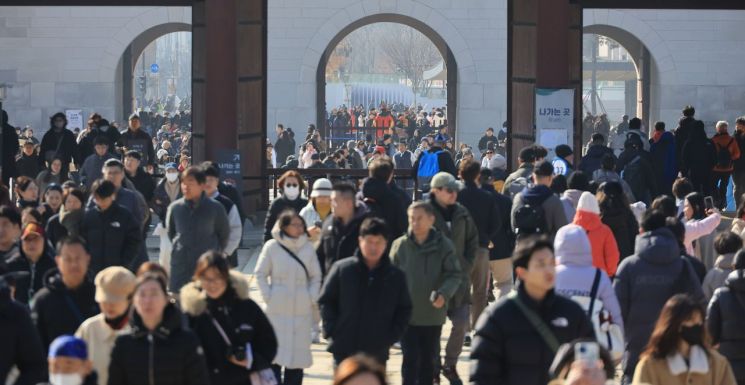 During the Lunar New Year holiday, the four grand palaces, including Gyeongbokgung Palace, Jongmyo Shrine, and the Joseon Royal Tombs, were opened free of charge. On the 18th, Gyeongbokgung Palace in Seoul was packed with visitors, including tourists, creating a sea of people. Yonhap News
On the 24th, the Chinese state-run media outlet Global Times stated in an editorial titled "Korean Airlines' Route Expansion to China Points to Broader Cooperation" that "the plans by some Korean airlines to expand their routes to China can be interpreted as reflecting a broad trend of expanding cooperation between the two countries."
It went on to say, "As China, Korea's largest trading partner, continues to see its annual trade volume with Korea exceed 300 billion dollars (about 432.75 trillion won), and as Korea also maintains its status as a key partner for China, the complementarity between the two countries' industries has become more pronounced," adding, "As Korean companies expand investment into China's digital and green economy and financial and service-sector cooperation deepens, people-to-people exchanges have now become an essential element."
Jeju Air has announced plans to expand its routes to China by newly operating the Incheon-Yichang and Daegu-Guilin routes starting in April. Asiana Airlines has stated that it will increase its summer-season routes to China by 20% compared with the winter season.
Global Times commented, "Because the frequency of people-to-people exchanges directly determines the level of cooperation in areas such as the economy, trade, and culture, the decisions by Korean airlines mean more than just a business response to rising demand," and added, "They reflect the deepening economic ties between Korea and China and demonstrate both sides' willingness to expand cooperation and people-to-people exchanges."
It further analyzed, "In recent months, the visa-exemption policies between the two countries have increased mutual visitors for tourism and business purposes and have provided strong support for airlines in expanding their services." According to Ministry of Justice statistics cited by Xinhua News Agency, people-to-people exchanges between the two countries from January to November last year reached 7.28 million, up 24.7% from a year earlier, showing a recovery trend.
Global Times reported, "In addition to visa exemptions, the government continues to ensure that economic dialogue mechanisms and other institutional frameworks play a role in removing barriers to cooperation and reducing costs," and added, "The synergy between such policy guidance and market demand is turning enthusiasm for people-to-people exchanges into deeper economic cooperation and providing companies with a predictable business environment."
Lastly, it stated, "With the continued implementation of these policies, exchanges and cooperation between the two countries in tourism, the economy, trade, culture, and science and technology will inevitably expand in scope, depth, and quality," adding, "This will foster a more comprehensive and mutually beneficial development model for Korea-China relations."
© The Asia Business Daily(www.asiae.co.kr). All rights reserved.
![Clutching a Stolen Dior Bag, Saying "I Hate Being Poor but Real"... The Grotesque Con of a "Human Knockoff" [Slate]](https://cwcontent.asiae.co.kr/asiaresize/183/2026021902243444107_1771435474.jpg)
















