Climate Ministry Unveils "Nakdong River Water Quality Improvement Measures"
Blocking Daily Inflow of 12 Tons of Total Phosphorus from Green Algae and Nonpoint Source Pollution
470,000 Tons of Industrial Wastewater Per Day Under 24-Hour Monitoring
The government has unveiled a comprehensive plan to raise the water quality of the Nakdong River, which supplies drinking water to 13 million people in the Yeongnam region, to Grade 1 level by 2030. The plan aims to reduce total phosphorus (TP) emissions, the key cause of green algae, by 30% and to preemptively manage trace pollutants in industrial wastewater to enhance the safety of drinking water.
On February 25, at the Government Complex Seoul, the Ministry of Climate, Energy and Environment finalized and announced these “Nakdong River Water Quality Improvement Measures” at a joint meeting of the Ministers for Economic Affairs and the Ministers for Industrial Competitiveness Enhancement.
According to the plan, over the past 30 years, the concentration of total phosphorus (Total Phosphorus, the sum of phosphorus compounds) in the Nakdong River has improved by 70.9%, from 0.158 mg/L (0.158 milligrams per 1 liter of water) to 0.046 mg/L, thanks to the expansion of public sewage treatment facilities. Biological Oxygen Demand (BOD) has improved by 58.3%, from 4.8 mg/L to 2.0 mg/L. Nevertheless, over the past five years, about 80% of the 781 days on which green algae alerts were issued nationwide occurred in the Nakdong River, and key water quality indicators still lag behind those of the Han River. Total phosphorus refers to the total amount of phosphorus contained in water and is used as a representative indicator to assess eutrophication, such as algal blooms, and the level of water pollution.
In particular, while approximately 6.6 million people draw water directly from the main stream of the Nakdong River, satisfaction levels regarding the safety of tap water as drinking water remain low, at 20.6% in Busan and 31.0% in South Gyeongsang Province, leaving public anxiety unresolved. Past water quality accidents, such as phenol and dioxane leaks, have accumulated, and concerns over industrial wastewater remain high.
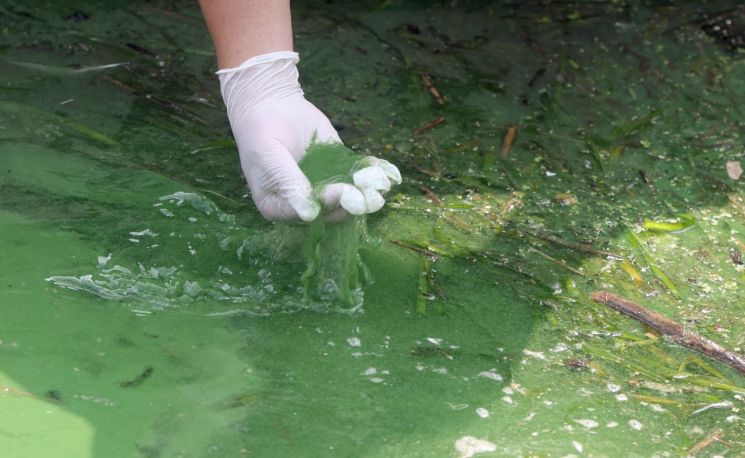 Environmental groups including Nakdong River Network, the Korean Society of River Science, and the Korean Federation for Environmental Movements held the "2024 Nakdong River Vigilante On-site Investigation Press Conference" at Daedong Ferry Terminal, Daedong-myeon, Gimhae, Gyeongsangnam-do on the morning of August 19, 2024, where they checked the green algae in the Nakdong River. Yonhap News.
Green Algae and Nonpoint Source Pollution Under Intensive Control... Blocking Daily Inflow of 12 Tons of Total Phosphorus
The government will focus on managing total phosphorus, the decisive factor in the proliferation of green algae. As of 2023, a total of 12,498 kg (about 12 tons) of total phosphorus flows into the Nakdong River system each day, with 45.6% originating from land such as farmland, 39.9% from livestock manure, and 12.2% from domestic sewage. This is due to the structural characteristic that nonpoint sources account for 82% of total pollution, exceeding point sources. Nonpoint source pollution refers to pollution that cannot be traced to a single specific source and flows into rivers and lakes over a wide area, as in the case where fertilizers and pesticides from farmland are washed away by rain.
The government will first tighten total phosphorus standards for effluent from public sewage treatment facilities and expand the installation of village-type sewage retention facilities in rural areas. In farmland, it will expand appropriate fertilization based on soil testing and disseminate best management practices, such as the use of controlled-release fertilizers (fertilizers that release nutrients gradually over time) and the installation of field dikes, to reduce fertilizer runoff. Through improved management of paddy water, it also expects to achieve up to a 12% reduction in agricultural water use.
The key for livestock manure is conversion to energy. Currently, 85% of livestock manure is spread on farmland in compost or liquid fertilizer form, and half of the excess application will be converted into energy sources such as solid fuel and biogas. This is expected to reduce annual greenhouse gas emissions by about 620,000 tons and generate 706 GWh (gigawatt-hours) of electricity, enough to supply power to approximately 66,000 people.
Through these measures, the government has set a goal of lowering total phosphorus concentrations at major intake points to 0.037 mg/L or less even during the summer and reducing green algae occurrences by more than 50%. At a briefing the previous day, Kim Eunkyeong, Director-General for Water Environment Policy at the Ministry of Climate, Energy and Environment, explained, “We plan to gradually implement projects at 32 sewage treatment plants in the Nakdong River system (5 new plants and 27 expansions) and about 33 village sewage systems.”
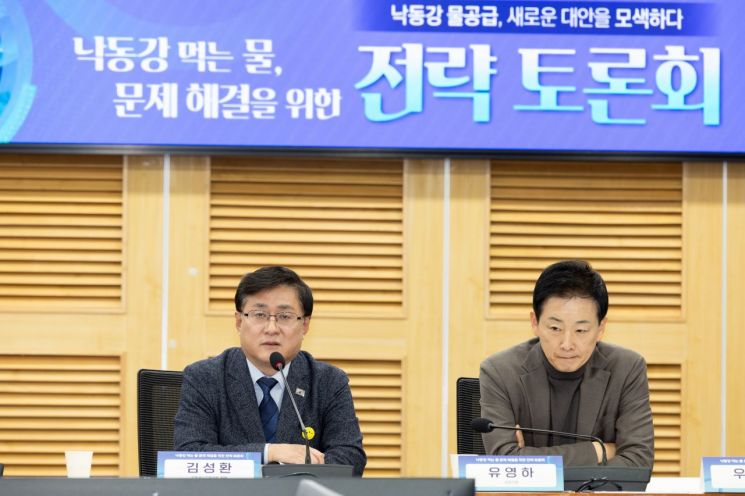 Kim Seonghwan, Minister of Climate, Energy and Environment, is delivering remarks at the Nakdong River Clean Water Supply Strategy Forum held on the 23rd of last month at the National Assembly Members' Office Building in Yeouido, Seoul. Ministry of Climate, Energy and Environment. Yonhap News
Stronger Management for 470,000 Tons of Industrial Wastewater... Establishing a 24-Hour Monitoring System
The government will completely overhaul the management system for industrial wastewater. Approximately 470,000 tons of industrial wastewater flow into the Nakdong River each day, 60% of which is generated in Gumi City and the Daegu area. A total of 81% of this wastewater is treated through public treatment facilities.
The government will introduce an “ultra-advanced treatment” process that combines ozone and activated carbon at public sewage and wastewater treatment facilities where more than 10,000 tons of wastewater flow in per day. The Ministry of Climate, Energy and Environment estimates that this process can remove more than 90% of trace pollutants, such as per- and polyfluoroalkyl substances (PFAS), allowing for precision treatment of 62% of the wastewater flowing into the Nakdong River.
The number of monitoring sites for unregulated and trace substances will also be expanded from the current 38 to about 70. Additional automatic water quality monitoring networks will be installed downstream of industrial complexes to build a dual monitoring system linked with remote monitoring (TMS) of discharge outlets at business sites. Currently, 96% of wastewater in the Nakdong River system is under 24-hour real-time monitoring.
In addition, buffer retention facilities have been installed at 32 industrial complexes, allowing contaminated water to be temporarily stored and then transferred to treatment facilities in the event of an accident. An integrated water pollution control center will be established by 2028 to operate a standing response system.
The government expects that, if these measures are implemented without delay, total phosphorus and total organic carbon at major intake points along the main stream of the Nakdong River can be improved to Grade 1 levels. Minister of Climate, Energy and Environment Kim Seonghwan said, “These measures go beyond a reactive approach to pollution and represent fundamental measures that structurally reduce pollution from the stage at which it is generated.”
© The Asia Business Daily(www.asiae.co.kr). All rights reserved.
![Clutching a Stolen Dior Bag, Saying "I Hate Being Poor but Real"... The Grotesque Con of a "Human Knockoff" [Slate]](https://cwcontent.asiae.co.kr/asiaresize/183/2026021902243444107_1771435474.jpg)

















