Financial Services Vice Chairman hosts Conference on the Great Transformation toward Productive Finance
ESG disclosure standards and roadmap unveiled
"Corporate burden" Scope 3 to be deferred for three years
Quantitative expansion of climate finance...790 trillion won over 10 years
The government will begin mandating ESG (Environmental, Social, and Governance) disclosures starting in 2028 for KOSPI-listed companies with total consolidated assets of at least 30 trillion won. However, it has decided to grant a three-year grace period for the application of Scope 3 (value chain-wide emissions), which would otherwise impose a heavy burden on companies. It also unveiled a plan to supply climate finance by injecting 790 trillion won in policy finance over 10 years to achieve the 2035 Nationally Determined Contribution (NDC) greenhouse gas reduction target.
On the morning of the 25th, Vice Chairman Lee Eok-won of the Financial Services Commission chaired the "4th Conference on the Great Transformation toward Productive Finance" at the Chamber Lounge of the Korea Chamber of Commerce and Industry and announced the "Institutionalization of ESG Disclosure" and "Measures to Promote Climate Finance." In his opening remarks, Vice Chairman Lee stressed, "Recently, the government has presented the 2035 NDC to achieve carbon neutrality and is pursuing the Korean-style green transition (K-GX)," adding, "Active responses to climate and other ESG factors are essential for companies' sustainable growth."
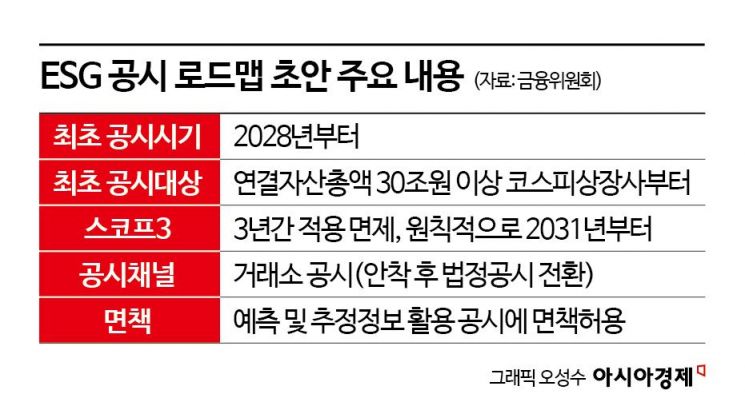
First introduced in 2028 via the stock exchange...Roadmap to be finalized in April
The ESG disclosure roadmap released by the government on this day sets out the previously delayed implementation timeline and scope of entities subject to disclosure. To enhance effectiveness based on international standards, the roadmap applies up to Scope 3, while also reflecting corporate burdens by including provisions such as grace periods and safe-harbor exemptions.
The first implementation date and targets are KOSPI-listed companies with consolidated assets of at least 30 trillion won in 2028. The scope will then be gradually expanded to include, for example, KOSPI-listed companies with total assets of at least 10 trillion won starting in 2029. The Financial Services Commission explained that this decision took into account the Japanese case, where industrial structures at home and abroad are similar. However, in the first year of disclosure, domestic and overseas subsidiaries whose asset or revenue share on a consolidated basis is less than 10% will be excluded from the disclosure requirement to ensure a smooth soft landing of the system.
Scope 3 disclosure, which companies have long complained about due to its burden, will be exempted for three years in light of its impact on small and medium-sized partner companies. For companies whose first ESG disclosure year is 2028, their Scope 3 disclosure obligations will begin in 2031. Scope 3 covers a much broader range of emissions than Scope 1 (direct emissions) and Scope 2 (indirect emissions from energy consumption), and companies have repeatedly raised concerns because it is difficult to accurately calculate the amount of emissions.
Accordingly, the government will exempt value chains that are both small enterprises under the Framework Act on Small and Medium Enterprises and not high-carbon-emitting industries from disclosure, and will later review the exemption scope again once the system is stabilized and converted into statutory disclosure under the Capital Markets Act. In addition, companies that voluntarily comply with disclosure will be granted incentives such as designation as excellent disclosure entities.
The ESG disclosure channel will initially operate through stock exchange disclosures and will be converted into statutory disclosure once the system is stabilized. In the early stage of the system, the government will allow a safe harbor for disclosures that utilize forward-looking or estimated information, and will focus on guidance rather than sanctions in operating the regime. The draft of the disclosure roadmap will be finalized in April after collecting public comments.
The ESG disclosure standards released on the same day were prepared based on the standards established by the International Sustainability Standards Board (ISSB). Taking into account the specific characteristics of Korea's industrial structure, where manufacturing accounts for a high proportion, the standards allow optional disclosure for non-climate-related items, internal carbon pricing per ton, and sector-specific indicators. Policy-related disclosures (such as family-friendly management), which were included in the initial draft, were excluded from the final version in consideration of alignment with international standards.
Supplying 790 trillion won in climate finance...Introducing Korean-style transition finance
The government also announced measures to promote climate finance to drive Korea's green transformation. To support the achievement of the enhanced 2035 NDC, it plans to inject a total of 790 trillion won in policy finance funds over 10 years starting in 2026. This represents a substantial expansion in both period and amount compared to the previously announced plan of 420 trillion won for 2024-2030.

In particular, more than 50% of these funds will be allocated to regional areas outside the capital region, and more than 70% will be concentrated on small and medium-sized enterprises and mid-sized companies. Vice Chairman Lee emphasized, "By having policy finance take the lead in climate finance, which requires high-risk, long-term capital, we will reduce the investment burden on industry and induce active inflows of private capital, thereby creating an opportunity for climate finance to spread across the entire financial sector."
The government will also introduce so-called "Korean-style transition finance." Because carbon reduction in high-carbon manufacturing sectors such as steel and chemicals, which account for a large share of national emissions, is essential to reduce overall national emissions, the government aims to actively support these sectors. The European Union (EU), Japan, and Singapore have already introduced such transition finance tailored to their respective economic and industrial conditions. The transition finance guidelines presented by the financial authorities encompass two types: transition finance based on K-Taxonomy (under the Ministry of Environment for climate), which benchmarks the EU's conceptual framework, and transition finance based on "sector-by-sector carbon reduction implementation roadmaps" (under the Ministry of Trade, Industry and Energy), similar to Japan's approach.
At the same time, the government will upgrade information infrastructure to promote climate finance. It will build a "climate finance web portal" that integrates widely dispersed climate finance-related information and provides it in real time, helping companies in the field quickly verify whether their processes, technologies, and projects meet green or transition finance criteria. It will also establish a "financial emissions platform" to manage the carbon performance of financial institutions' portfolios.
Vice Chairman Lee stressed, "The climate crisis is directly linked to the sustainable growth of our economy and the lives of our people," adding, "We will strive to ensure that finance serves as a central enabler of K-GX, driving carbon neutrality in our economy and industries as well as the growth of new green industries."
© The Asia Business Daily(www.asiae.co.kr). All rights reserved.
![Clutching a Stolen Dior Bag, Saying "I Hate Being Poor but Real"... The Grotesque Con of a "Human Knockoff" [Slate]](https://cwcontent.asiae.co.kr/asiaresize/183/2026021902243444107_1771435474.jpg)

















