Secondhand memory trading up eightfold... price premiums emerging
Surging demand from generative AI cuts into commodity DRAM production
Supply crunch expected to persist... overheating in secondhand market likely to continue
"They are selling used DDR5 16GB RAM sticks for 360,000 won each."
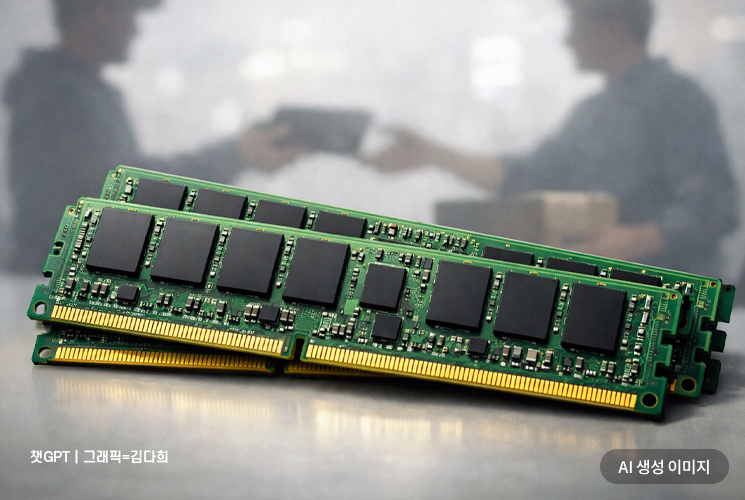
A 30-something office worker, Mr. Cho, was recently browsing a secondhand trading application and was shocked. He had planned to sell unused RAM to make a bit of pocket money, but instead came face-to-face with the intensity of the "RAM-tech (RAM + investment)" boom. Prices for 32GB products were hovering in the 600,000 won range. He said, "I am not in a hurry to sell, and it does not seem too late to sell when the market price goes up further, so I am still thinking it over."
Amid a shortage in memory semiconductor supply, "RAM-tech" transactions, where people buy and sell RAM in the secondhand market, have recently become widespread. Some people remove memory modules from unused secondhand PCs or laptops and resell them, while others are professional purchasing companies that buy in advance in anticipation of price hikes and then resell to capture the price difference.
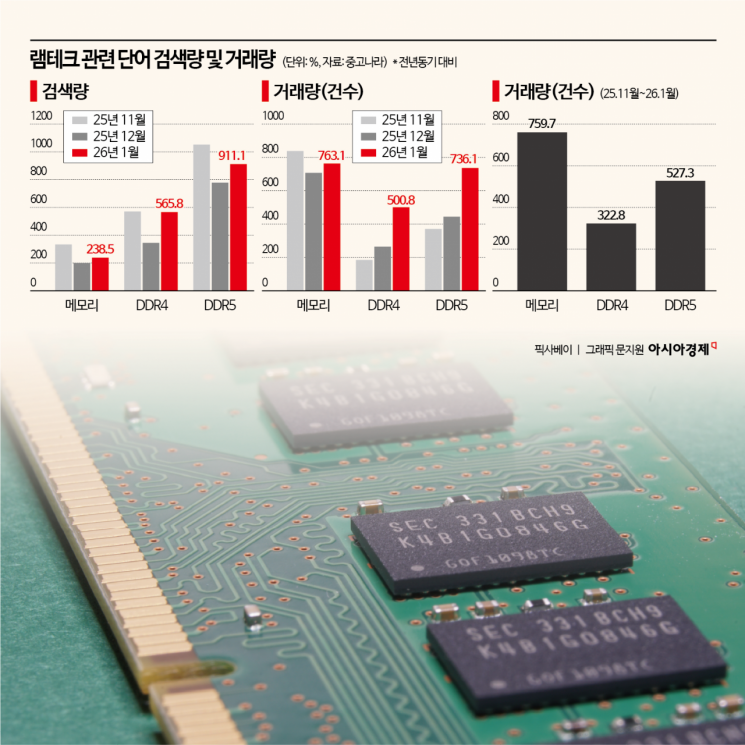
As of February 25, according to industry sources, the number of memory-related transactions on secondhand trading platforms has surged by several hundred percent year-on-year. An analysis by Junggonara of transaction data for the most recent three months (from November 2025 to January 2026) showed that total transaction volume involving the keyword "memory" increased by 759.7% compared with the same period a year earlier, more than an eightfold jump. By month, volumes rose 837.8% in November last year, 707.2% in December, and 763.1% in January this year, respectively. During the same period, transactions involving the "DDR4" keyword increased by 322.8%, and those involving "DDR5" increased by 527.4%.
The steep price spike is also evident in actual transaction cases. As of February, the highest price for a Samsung Electronics DDR5 32GB RAM product sold via a secure payment method was 520,000 won. According to the price comparison site Danawa, the lowest price for a new "Samsung Electronics DDR5-5600 (32GB)" product on this date was in the 700,000 won range. Considering that in the same month a year earlier it was around 130,000 won, a substantial price premium has formed in a short period even for used products.
Industry insiders point to changes in the global semiconductor supply structure as the cause of this phenomenon. With the spread of generative artificial intelligence (AI), demand for server memory has surged, while major manufacturers such as Samsung Electronics and SK Hynix have increased the share of high bandwidth memory (HBM) in their production, pushing the production of commodity DRAM such as DDR4 relatively down the priority list.
As the supply of commodity memory became constrained, "chipflation" (chips + inflation) began in earnest, with production costs rising across IT products, and analysts say the impact has spilled over into the secondhand trading market. On top of this, professional purchasing companies that advertise "same-day highest-price purchase" have joined in, further heating up demand for memory aimed at capturing price spreads. With RAM shortages creating a structure that fuels speculative demand, industry observers believe the "RAM-tech" boom is likely to continue for the time being.
The expectation is that the supplier-dominant phase will likely persist for a while. Ryu Hyunggeun, a researcher at Daishin Securities, said, "Even if we conservatively strip out inflated demand, we are still in an environment where supply cannot keep up with demand," adding, "With suppliers’ bargaining power over prices strengthened, there is a high possibility that the short-term price increase will surpass the highest levels in history."
© The Asia Business Daily(www.asiae.co.kr). All rights reserved.


















