KDCA Unveils Third Antimicrobial Resistance Management Plan
Full-Scale ASP Rollout to Tighten Monitoring in Medical Institutions
Overhauling Antibiotic Use Standards in Livestock to Support Disease Prevention
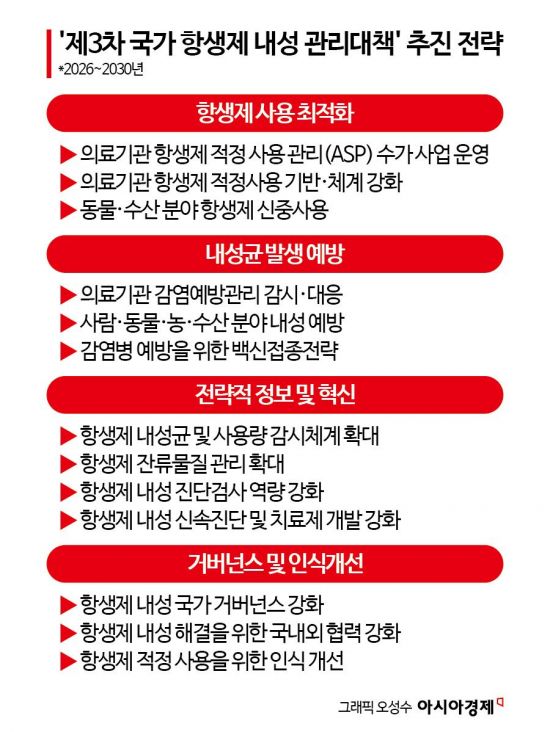
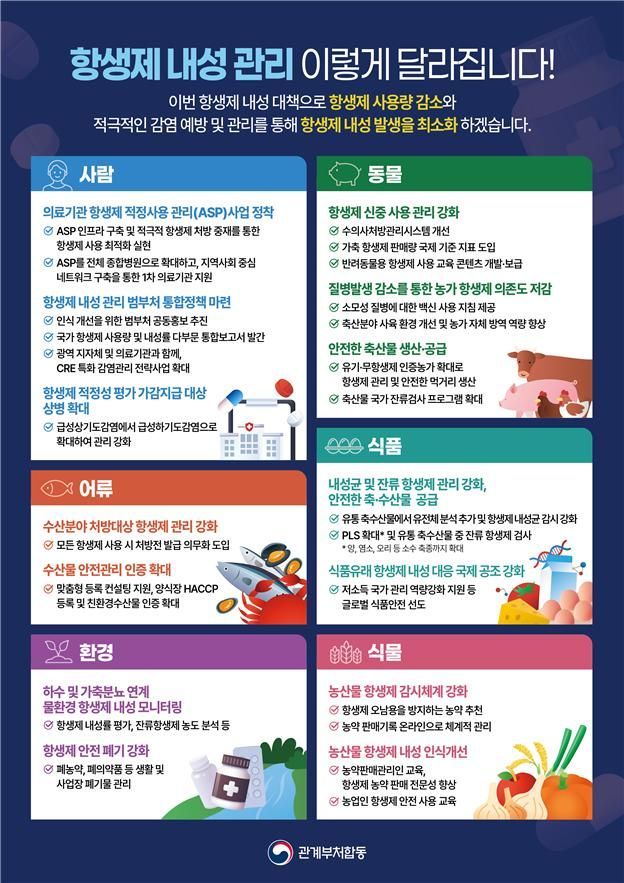
The government is launching a pan-ministerial response to curb the spread of antimicrobial resistance. It will strengthen management systems so that antibiotics are prescribed appropriately and only when necessary in hospitals. It also plans to support research on resistance diagnostics and adjunctive therapeutic agents, with the aim of reducing antibiotic use and minimizing the emergence of resistance.
The Korea Disease Control and Prevention Agency (KDCA) announced on the 25th that, together with seven related ministries and agencies (the Ministry of Health and Welfare, the Ministry of Food and Drug Safety, the Ministry of Agriculture, Food and Rural Affairs, the Ministry of Climate, Energy and Environment, the Ministry of Oceans and Fisheries, and the Rural Development Administration), it has established the “Third National Antimicrobial Resistance Management Plan (2026-2030)” through the Antimicrobial Resistance Expert Committee and the Infectious Disease Control Committee.
Korea Ranks High in Both Antibiotic Use and Resistance Rates
Antibiotics are pharmaceuticals used to treat infectious diseases caused by microorganisms such as bacterial infections. However, once antimicrobial resistance develops, the number of effective treatment options decreases, and in cases of so-called “superbug” infections, treatment with antibiotics can become difficult.
As antimicrobial resistance worsens worldwide, Korea’s levels of both antibiotic use and resistance rates are higher than those of major advanced countries. In 2023, daily antibiotic consumption per 1,000 population was 31.8 DID, about 1.6 times higher than the OECD average of 19.5. The resistance rate of methicillin-resistant Staphylococcus aureus (MRSA), a major resistant bacterium, also stood at 45.2% in 2023, significantly exceeding the global average of 27.1%.
The third plan was drawn up after reviewing the achievements and limitations of the second plan (2021-2025), which focused on building institutional foundations, and reflecting the current situation of resistance spread. The core goal is to reduce antibiotic use to preserve treatment efficacy and to strengthen infection prevention so as to minimize the occurrence of antimicrobial resistance itself.
Stronger Oversight of Hospital Prescriptions to Block Infection Spread
To promote appropriate use of antibiotics in medical institutions, the government will activate Antimicrobial Stewardship Programs (ASP). By next year, it will conduct a pilot project covering all general hospitals with 301 or more beds (170 institutions) and then push for legal revisions to make ASP implementation mandatory in medical institutions, transitioning the project to a full-scale program. Under ASP, a dedicated team consisting of infectious disease specialists, pharmacists, and others monitors and intervenes in antibiotic prescribing.
The government will also strengthen measures to reduce infections themselves. To block the spread of carbapenem-resistant Enterobacterales (CRE) infections, it will operate a local-government-led infection control response system, and it plans to reduce the need for antibiotic use by building herd immunity through national immunization programs.
Overhauling Prescription Systems in Livestock and Fisheries, Monitoring Residues and Emissions
Antibiotic use management in the agricultural, livestock, and fisheries sectors will also be further strengthened. The system will be revised so that all antibiotics are used only under prescriptions issued by veterinarians or aquatic animal disease control officers, and the veterinary prescription management system will be improved to establish a foundation for systematically calculating antibiotic consumption. Usage standards will also be tightened through re-evaluation of the safety and efficacy of existing veterinary antibiotics.
In the livestock sector, the government will provide guidelines on vaccine use for wasting diseases such as porcine epidemic diarrhea and expand support for related vaccine development. It will improve rearing environments and strengthen disease prevention by supporting the modernization of livestock facilities. The scope of the Positive List System (PLS) for managing lists of permissible residue substances will be expanded to include veterinary medicines used for other livestock and aquatic products such as sheep and ducks. It will also manage sales recordkeeping for pesticides (including antibiotics) used in crop production and continue to monitor the discharge of resistant bacteria from wastewater treatment plants and into rivers nationwide.
Supporting R&D on Rapid Diagnostics to Strengthen Response Capacity
The government will also bolster response capacity through the development of innovative technologies. It will support the development of rapid diagnostic tests for antibiotic-resistant bacteria so that appropriate antibiotics can be selected quickly in clinical settings, and it will promote research on adjunctive therapeutic agents such as new antibiotics and beta-lactamase inhibitors.
In addition, artificial intelligence (AI) and big data will be used to predict trends in the emergence of resistant bacteria and to develop systems that optimize antibiotic prescriptions by pathogen and infectious disease. By quantifying the disease burden of antimicrobial resistance in Korea and forecasting its future incidence, the government also aims to reinforce the scientific basis for policy.
The government plans to regularly operate the “Pan-Ministerial Working Group on Antimicrobial Resistance” and the “Antimicrobial Resistance Expert Committee” to review implementation of the plan and maintain policy consistency.
© The Asia Business Daily(www.asiae.co.kr). All rights reserved.
![Clutching a Stolen Dior Bag, Saying "I Hate Being Poor but Real"... The Grotesque Con of a "Human Knockoff" [Slate]](https://cwcontent.asiae.co.kr/asiaresize/183/2026021902243444107_1771435474.jpg)

















