Decided at the 3rd Urban and Architecture Joint Committee
The Seoul Metropolitan Government announced on the 25th that it had approved with amendments the "Bongcheon District Center District Unit Planning Area and Plan Change Proposal" at the 3rd Urban and Architecture Joint Committee meeting held on the 24th.
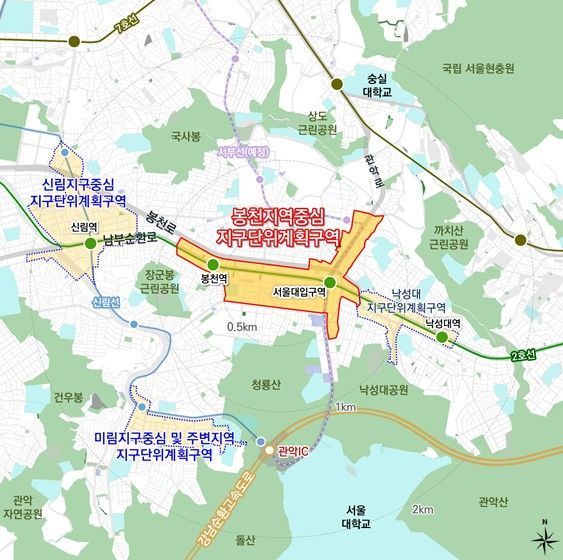
The area in question stretches east to west along Nambu Beltway and encompasses Bongcheon Station (Line 2) and Seoul National University Entrance Station (Line 2). From north to south, Gwanak-ro runs through it, making it a key central area of Gwanak District and a major hub for metropolitan transportation. Around Seoul National University Entrance Station, transportation and commercial districts have formed around the station area, with approximately 90,000 passengers boarding and alighting there on an average day. It is also a neighborhood where the population in their 20s and the number of single-person households continue to increase every year.
This reorganization of the district unit plan was promoted to take into account changes in local conditions since 2016 and to lay the groundwork for low-rise, aging buildings to be redeveloped in line with the status of a central station area. The area along Nambu Beltway will be developed into a complex hub for job creation, while the area around Seoul National University Entrance Station will be fostered as a mixed-use hub for work and commerce. The area along Gwanak-ro is expected to be reborn as a strategic business hub in line with the planned Seobu Line.
The proposed changes to the district unit plan include: ▲restructuring the floor area ratio system within the district unit plan (from 600% along arterial roads and 450% in back areas in general commercial zones to a uniform 800%, etc.) ▲relaxing maximum building height limits (from 60 to 80 meters along arterial roads in general commercial zones to 150 meters, etc.) ▲reducing the scope of designated and recommended joint development areas ▲abolishing the maximum development size ▲and introducing designated uses along arterial roads to activate street-level frontages.
Ahn Daehee, Director-General of the Urban Space Planning Bureau of the Seoul Metropolitan Government, said, "Through the reorganization of the Bongcheon District Center district unit plan, we expect to induce mixed-use development centered on the station area and, through street activation, enable it to rise as the central axis of Gwanak."
© The Asia Business Daily(www.asiae.co.kr). All rights reserved.

















