U.S. reciprocal and fentanyl tariffs lose effect
China's Ministry of Commerce hints at rolling back retaliatory measures
'Conciliatory message' amid talk of a Trump visit to China
The Chinese government has demanded that the administration of U.S. President Donald Trump refrain from imposing additional tariffs and stated that it is prepared to engage in candid discussions at the upcoming bilateral trade talks. At the same time, China signaled a conciliatory gesture by suggesting that it would roll back its corresponding retaliatory measures related to the reciprocal tariffs and the fentanyl tariffs (tariffs imposed on China, Mexico, and Canada, citing insufficient cooperation in preventing the inflow of the narcotic fentanyl into the United States), which have lost their effect due to a ruling by the U.S. Supreme Court.
On the 24th, a spokesperson for China's Ministry of Commerce said on its website that there had been a reporter's question regarding the Trump administration's imposition of a 10% "global tariff" on all exports to the United States worldwide, based on Section 122 of the Trade Act, and then announced China's position.
The spokesperson stressed, "China has consistently opposed all forms of unilateral tariff measures and urges the United States to roll back its unilateral tariffs and refrain from imposing additional ones," adding, "Repeated practice has proven that when China and the United States cooperate, both sides benefit, and when they fight, both sides get hurt."
The spokesperson went on to say, "China is willing to conduct frank negotiations with the United States at the Sixth China-U.S. Economic and Trade Consultation, which will be held in the near future."
The spokesperson added, "We hope that the United States and China will face each other and jointly uphold the common understanding (agreement) reached at the summit between the two heads of state in Busan and in their February 4 phone call. On the basis of mutual respect and equal-footing negotiations, we hope to resolve each side's concerns, properly manage differences, and safeguard the sound, stable, and sustainable development of China-U.S. economic and trade relations."
Right after the outbreak of the "tariff war," the United States and China held high-level trade talks in Geneva, Switzerland, in May last year and agreed to a "90-day truce," including cutting their reciprocal tariffs by 115 percentage points each.
Despite reciprocal export controls and sanctions, the two countries held a total of five rounds of high-level talks to manage the situation: in London, the United Kingdom (June), Stockholm, Sweden (July), Madrid, Spain (September), and Kuala Lumpur, Malaysia (October). Subsequently, at the summit held in Busan in October last year, the two sides agreed to refrain from further escalation, with China granting a one-year grace period on its export controls on rare earths and resuming imports of U.S. soybeans, and the United States cutting its "fentanyl tariffs" by 10 percentage points (from 20% to 10%).
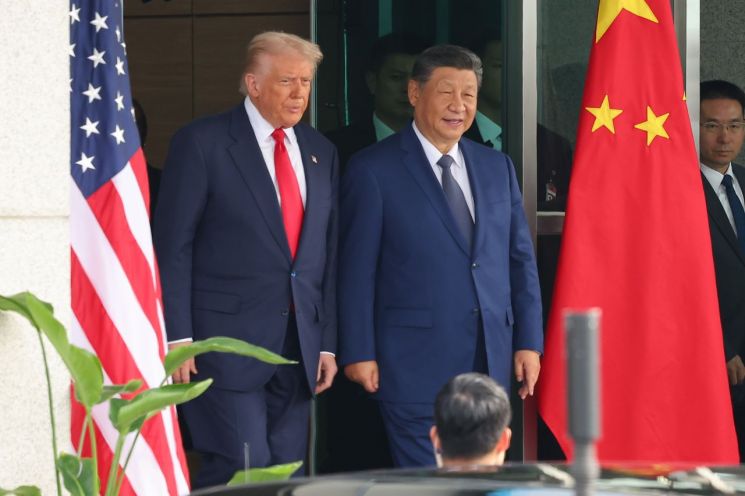
With President Trump's visit to China in April being discussed, the Chinese Ministry of Commerce's reference on this day to a "sixth round of trade talks" has fueled expectations that a high-level bilateral trade meeting is imminent.
The U.S.-China trade conflict reached another turning point on the 20th (local time), when the U.S. Supreme Court ruled that the authority to impose and collect reciprocal tariffs and fentanyl tariffs under the International Emergency Economic Powers Act (IEEPA) had not been granted to the president.
The spokesperson for China's Ministry of Commerce explained that in early February and early April last year, the United States, invoking the IEEPA, imposed a 10% fentanyl tariff and a 34% reciprocal tariff on Chinese goods, but that 24 percentage points of the reciprocal tariff had been suspended, so the United States' actual additional tariff on China was at the level of 20%.
The spokesperson said that the imposition of the remaining reciprocal tariffs had also been halted in accordance with the U.S. Supreme Court ruling, but noted that, starting from this day, the U.S. government had added a further 10% tariff and that the United States had repeatedly stated it would use investigative tools such as Sections 301 and 232 of the Trade Act to levy tariffs.
The spokesperson further stated, "China is closely monitoring the relevant U.S. measures and will conduct a comprehensive assessment," adding, "In the future, depending on how the situation develops, China will decide, at an appropriate time, on adjustments to its countermeasures (retaliatory measures) against the existing U.S. fentanyl tariffs and reciprocal tariffs."
© The Asia Business Daily(www.asiae.co.kr). All rights reserved.
![Clutching a Stolen Dior Bag, Saying "I Hate Being Poor but Real"... The Grotesque Con of a "Human Knockoff" [Slate]](https://cwcontent.asiae.co.kr/asiaresize/183/2026021902243444107_1771435474.jpg)















