Possibility of Expanding Sanctions on Companies Mentioned
"Shift from Direct Pressure to Indirect Pressure"
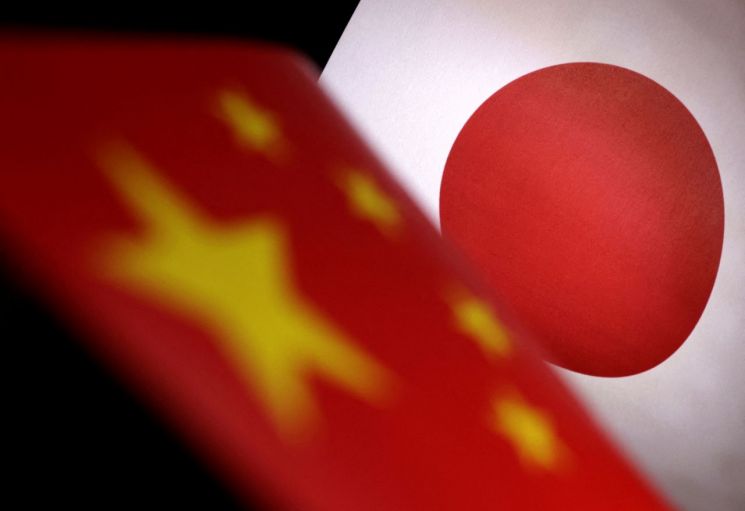
China has raised the level of pressure on Japan by placing 20 Japanese companies and institutions, including Mitsubishi shipbuilding entities, on its export control list for dual-use items such as rare earths (materials that can be used for both military and civilian purposes).
On the 24th, According to China's Ministry of Commerce, 20 companies and institutions in Japan will be added to its export control management list.
The entities on the list include five Mitsubishi Group companies related to shipbuilding, aircraft engines, and marine machinery, as well as six IHI Group companies in the aerospace and engine sectors. Institutions such as the National Defense Academy of Japan and the Japan Aerospace Exploration Agency (JAXA) are also included. These companies and institutions are involved in Japan's military research, development, and production.
According to China's Ministry of Commerce, 20 companies and institutions, including Subaru, Fuji Aerospace, Eneos, Yusoki, Itochu Aviation, Tokyo University of Science, and Sumitomo Heavy Industries, have been placed on a watch list on the grounds that the ministry cannot verify their dual-use end users and end uses.
Companies and institutions on the watch list will no longer be able to export dual-use items through ordinary procedures via Chinese exporters. The Ministry of Commerce explained that exporters must submit a risk assessment report and a written pledge that the dual-use items will not be used to enhance Japan's military capabilities in order to apply for export licenses.
A spokesperson for China's Ministry of Commerce stated, "For Japanese companies that are not on the list, exports of dual-use items will be prohibited if the end users or end uses involve Japanese military users, military purposes, or any other final uses that help strengthen Japan's military capabilities," signaling that the measures could be expanded.
The spokesperson went on to say, "The aim of this measure is to curb Japan's 'remilitarization' and its attempt to possess nuclear weapons, which is entirely justified, reasonable, and lawful," adding, "Listing entities in accordance with Chinese law targets only a small number of Japanese companies, and this measure is limited to dual-use items. It does not affect normal economic and trade exchanges between China and Japan. Japanese companies that faithfully comply with the law have nothing at all to worry about."
Since last November, China has been ramping up pressure on Japan in an effort to undermine the political base of Japanese Prime Minister Sanae Takaichi, after she made remarks to the effect that Japan would "intervene in the event of a Taiwan contingency." On January 6, China banned exports of all dual-use items destined for Japan's "military users," "military purposes," and "other final uses that help enhance Japan's military capabilities." However, on February 8, Prime Minister Takaichi consolidated her political base by winning a landslide victory in Japan's House of Representatives election, securing more seats than the threshold needed to initiate a constitutional amendment.
The South China Morning Post (SCMP) in Hong Kong, citing experts, explained that the latest move shows China is further strengthening and more finely calibrating its export control regime in order to exert strategic pressure on Japan.
Minoru Nogimori, senior researcher at the Japan Research Institute, analyzed that by targeting specific companies, the Chinese government has shifted its focus from direct pressure to indirect pressure, thereby heightening corporate concerns over profits. He said, "It is highly likely that the Chinese government has realized that directly pressuring the Takaichi Cabinet would only serve to boost the cabinet's approval ratings."
Xu Tianchen, lead economist at the Economist Intelligence Unit, pointed out that while Japan has built its own supply chain for light rare earths, it still depends on China for medium and heavy rare earths and has few alternative suppliers. He noted, "Fortunately, this round of export controls does not deal a major blow to the private sector, because most of the sanctioned entities are defense-related institutions," but added, "If Prime Minister Takaichi takes bold steps to strengthen Japan's military capabilities, China still has options to target private companies."
James Downs, director of the non-profit think tank Center for Explanation-Based Learning and Scientific Forecasting, said the measures are exerting targeted pressure on Japan's defense industry by using regulatory tools as leverage, while avoiding disruption of broad trade flows. He added that affected sectors in Japan, "such as aerospace, automobiles, and semiconductors, will face supply chain delays and rising costs."
© The Asia Business Daily(www.asiae.co.kr). All rights reserved.
![Clutching a Stolen Dior Bag, Saying "I Hate Being Poor but Real"... The Grotesque Con of a "Human Knockoff" [Slate]](https://cwcontent.asiae.co.kr/asiaresize/183/2026021902243444107_1771435474.jpg)















