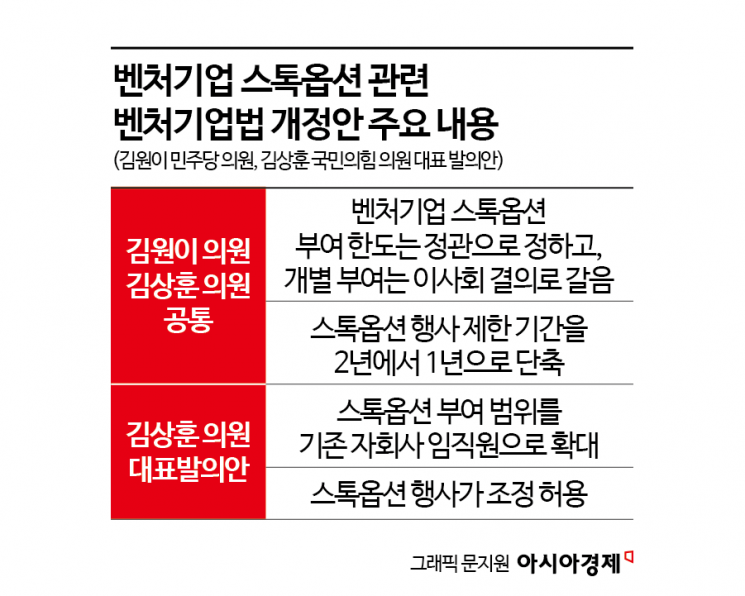
Delegating stock option grants to board resolutions
Adjusting the exercise restriction period from 2 years to 1 year
A bill to ease the requirements for granting stock options, which venture companies use to attract outstanding talent, has been proposed successively by both the ruling and opposition parties. If the bill passes, stock options could be granted with only a board resolution, and the vesting (exercise restriction) period would be reduced to one year.
According to political circles and the venture industry on the 24th, Kim Sanghoon, a lawmaker from the People Power Party, the previous day sponsored an amendment to the Special Act on the Promotion of Venture Businesses that includes these measures. As Kim Woni, a lawmaker from the Democratic Party of Korea, also sponsored a similar amendment on January 27, related discussions are expected to accelerate. These amendments are expected to be tabled at a plenary session of the Trade, Industry, Energy, SMEs, and Startups Committee, the competent standing committee, within the first half of the year.
Stock options are a system that grants employees and executives who have contributed to growth the right to purchase the company’s shares. High-growth ventures and startups can use them as a tool to attract talent, but most companies find it difficult to use the system because legal procedures are complex and tax benefits are limited. The Korea Venture Business Association has found that only 14.7% of all venture companies are using this system.
The amendments proposed by the two lawmakers commonly include the following: allowing stock options to be granted by a board resolution, and easing the stock option exercise restriction period from two years to one year. Under current law, the granting of stock options must go through a special resolution at the general meeting of shareholders, and there have been continuous calls for improvement. In the United States, the limit on stock option grants is set by agreement among shareholders, and grants within that limit are decided by the board of directors.
Analysts say the amendments could create synergy with the Silicon Valley-style stock option system introduction plan that the Ministry of SMEs and Startups announced at the end of last year in its "Comprehensive Plan for Leapfrogging into the World’s Top Four Venture Powerhouses." Among the measures announced by the ministry, the expansion of the issuance limit for below-market-price stock options from 500 million won to 2 billion won has already taken effect this month through a revision to the government’s enforcement decree.
The amendment sponsored by lawmaker Kim Sanghoon also includes measures to add employees and executives of subsidiaries to the eligible recipients of stock options and to have the board of directors adopt resolutions on adjustments to exercise prices. Under current law, the recipients of stock options are limited to employees and executives of venture companies and of acquired companies in which a venture company holds more than a 30% stake, so employees and executives of companies established as subsidiaries from the outset cannot be granted stock options.
An official at the Ministry of SMEs and Startups explained, "While employees and executives of acquired companies can receive stock options, employees and executives of companies that have been subsidiaries from the beginning have difficulty receiving stock options. This is seen as inconsistent both in terms of corporate growth strategy and in terms of fairness, so institutional improvement is needed," adding, "We will review opinions on issues such as the scope of subsidiaries and consult with the National Assembly."
© The Asia Business Daily(www.asiae.co.kr). All rights reserved.
![Clutching a Stolen Dior Bag, Saying "I Hate Being Poor but Real"... The Grotesque Con of a "Human Knockoff" [Slate]](https://cwcontent.asiae.co.kr/asiaresize/183/2026021902243444107_1771435474.jpg)
















