Government Announces 5th Comprehensive Cancer Control Plan...Expanded Lung Cancer Screening Eligibility
Building a Regionally Integrated System by Strengthening Capabilities of Regional Cancer Centers
Accelerating Advanced Cancer Research Using AI and Multi-modal Data by 2030
The government has decided to expand eligibility for the national lung cancer screening program, which had previously been limited to high-risk groups with a long history of smoking, and to introduce colonoscopy into the national colorectal cancer screening program, which has so far prioritized fecal occult blood tests. By strengthening cancer control at the national level for cancer, the leading cause of death among Koreans, the government will fully launch a "full-cycle cancer control" system that takes responsibility not only for prevention and early detection, but also for the lives of survivors after complete recovery and for a dignified end of life.
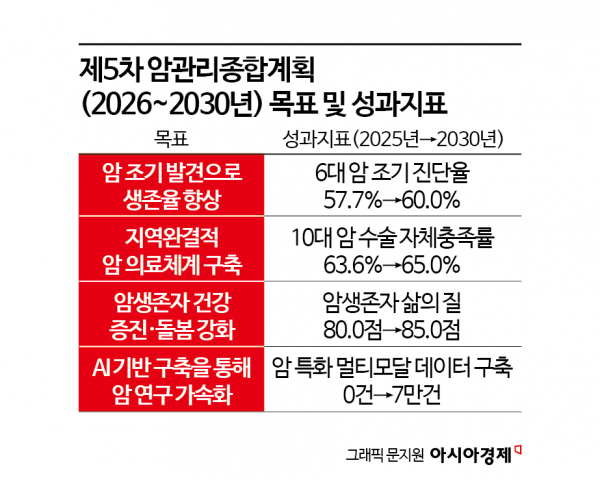
On the 24th, the Ministry of Health and Welfare convened the National Cancer Control Committee and deliberated and approved the "5th Comprehensive Cancer Control Plan (2026-2030)," which sets out cancer control policies for the next five years.
The key goals of this comprehensive plan are: ▲ improving survival rates through early detection of cancer ▲ establishing a regionally integrated cancer care system ▲ enhancing the health and care of cancer survivors ▲ and accelerating cancer research through the establishment of an artificial intelligence (AI)-based infrastructure.
First, the national colorectal cancer screening method will be changed, as participation rates have been low and there has been strong demand for improving the screening approach. Currently, people aged 50 and older first undergo a fecal occult blood test, and only those with positive results can receive a colonoscopy. However, starting in 2028, the government plans to introduce colonoscopy as the primary screening method for adults aged 45 to 74.
For lung cancer, which is the leading cause of cancer deaths, the government will significantly expand the screening target population to match the level of major countries, in order to promote early detection. Korea currently provides low-dose chest CT scans only to people aged 54 to 74 who have a smoking history of at least 30 pack-years (one pack per day for 30 years). By contrast, in the United States, screening starts at age 50 for those with at least 20 pack-years, and in Germany, for those aged 50 to 75 with at least 25 pack-years.
Cancer prevention policies will also be strengthened. The "National Cancer Prevention Guidelines," established in 2016, will be revised to reflect social and environmental changes, and the national human papillomavirus (HPV) vaccination program for cervical cancer prevention, which has targeted females aged 12 to 26, will be expanded to include 12-year-old boys. The government also plans to develop tailored clinical practice guidelines that reflect the characteristics of early-onset cancers in people under 50 and cancers in older adults, both of which have been rising rapidly in recent years.
To ease the concentration of cancer patients in the Seoul metropolitan area and to enhance competitiveness in cancer care, the government will upgrade outdated facilities and equipment at "regional cancer centers" and support the introduction of state-of-the-art diagnostic and treatment equipment. Their name will also be changed to "regional hub cancer centers" to clearly reflect their functions and roles.
In particular, the government will build a research consortium between the National Cancer Center and regional cancer centers to promote joint growth in clinical and research capabilities. It also plans to increase the number of pediatric and adolescent cancer base hospitals from five to six nationwide so that children and adolescents with cancer can receive stable treatment close to where they live.
For new anticancer drugs that place a heavy financial burden on cancer patients, the government will continue to review and promote their inclusion under the national health insurance. It also plans to analyze the impact of next-generation sequencing (NGS) on diagnosis and treatment in order to realize precision oncology using genomic analysis.
Supporting return to daily life after cure and a dignified end of life
As of 2023, the number of patients who have survived more than five years after a cancer diagnosis is approaching 1.7 million, and post-treatment follow-up services will be further advanced in response. The government will operate integrated support programs for cancer survivors that reflect the characteristics of each cancer type and life stage, and will develop linkage models with primary care institutions to support health management in daily life.
End-of-life care services will also be improved by moving up the timing for drawing up advance directives for life-sustaining treatment from the current "terminal" stage to the "point at which the terminal stage is anticipated," so that patients can fully reflect their own wishes. In addition, the reimbursement rates for home-based hospice care will be adjusted to realistic levels, and a standard service package that includes symptom management, psychological and social support, family education, and end-of-life care will be established to continuously expand hospice infrastructure.
In the field of cancer research, the government will accelerate digital transformation by building more than 70,000 cases of "multi-modal data" that combine different types of data, such as genomic, pathological, and imaging data, and will develop AI foundation models specialized in cancer trained on this data.
To ensure that research is not constrained by data security concerns, the government will create an infrastructure that enables joint research without sharing raw data and will expand secure utilization centers where remote analysis is possible. Through this, it plans to accelerate the development of personalized diagnostic and treatment methods, as well as research into technologies to overcome resistance to cancer therapies.
Through this plan, the government has set as its core performance indicators the following targets to be achieved by 2030: raising the early diagnosis rate of the six major cancers to 60%, increasing the self-sufficiency rate of cancer surgeries within each region to 65%, and achieving a quality-of-life score of 85 points for cancer survivors.
Lee Hyung-hoon, Second Vice Minister of Health and Welfare and chair of the National Cancer Control Committee, emphasized, "This comprehensive plan is intended to enhance the effectiveness of cancer control policies by strengthening cancer prevention and early diagnosis and by establishing a system in which post-treatment management and cancer research are organically linked," adding, "We will implement cancer control policies without fail so that every citizen can feel their impact and so that no one falls into blind spots in cancer care."
© The Asia Business Daily(www.asiae.co.kr). All rights reserved.
![Clutching a Stolen Dior Bag, Saying "I Hate Being Poor but Real"... The Grotesque Con of a "Human Knockoff" [Slate]](https://cwcontent.asiae.co.kr/asiaresize/183/2026021902243444107_1771435474.jpg)
















