Decision to Reduce Capital via Treasury Share Cancellation..."Enhancing Shareholder Value"
EPS Improvement Effect Extremely Limited
Lack of Earnings Rebound Momentum...Also Seen as a Signal to Appease Shareholders
LG Household & Health Care has decided to reduce its capital by cancelling treasury shares, drawing attention from the market. The company appears to be taking a preemptive step ahead of the National Assembly’s passage of an amendment to the Commercial Act that centers on mandatory cancellation of treasury shares. Although the company, which is set to hold its regular general shareholders’ meeting next month, explained the move as an effort to "enhance shareholder value," some point out that, given the limited scale of the capital reduction, the actual improvement effect on earnings per share (EPS) will not be significant.
According to the cosmetics and securities industries on the 25th, LG Household & Health Care announced on the 23rd via a regulatory filing that it had decided on a capital reduction through the cancellation of treasury shares. The target is treasury shares that the company acquired and has held since it purchased fractional shares (11,197 common shares and 3,438 other shares) generated at the time of the company split in April 2001. There will be no change in the shares held by ordinary shareholders. The par value per share is 5,000 won.
The capital stock of 88,589,470,000 won before the capital reduction will decrease by about 73,180,000 won to 88,516,295,000 won after the reduction. The number of issued common shares will decline from 15,302,459 to 15,291,262, and the number of other shares will fall from 2,099,697 to 2,096,259. The reduction ratio is 0.07% for common shares and 0.16% for other shares. The resulting EPS improvement effect is estimated at around 0.08%.
An LG Household & Health Care official said, "This capital reduction is part of a mid- to long-term plan to enhance corporate value, which includes cancelling all treasury shares held between 2025 and 2027," adding, "Last year as well, we cancelled 33% of our treasury shares (approximately 306.7 billion won)."
Previously, LG Household & Health Care announced a "corporate value enhancement plan," under which it would cancel all 961,850 treasury shares (958,412 common shares and 3,438 preferred shares) held between 2025 and 2027.
This decision is also in line with changes in the capital market system. On this day, the National Assembly is expected to pass the "third amendment to the Commercial Act," which will in principle mandate the cancellation of treasury shares held by companies, at a plenary session. The amendment stipulates that, in principle, when a company acquires its own shares, it must cancel them within one year. However, exceptions are allowed when certain reasons are recognized, such as employee compensation or operation of employee stock ownership plans, and when a holding and disposal plan signed and sealed by all directors is approved at the general shareholders’ meeting each year.
With institutional changes looming over the long-standing practice of holding treasury shares for extended periods, LG Household & Health Care’s latest cancellation is also being interpreted in connection with this policy shift. However, as the scale of the capital reduction is not large, the prevailing view is that, separate from responding to the制度 change, the financial impact will be limited.
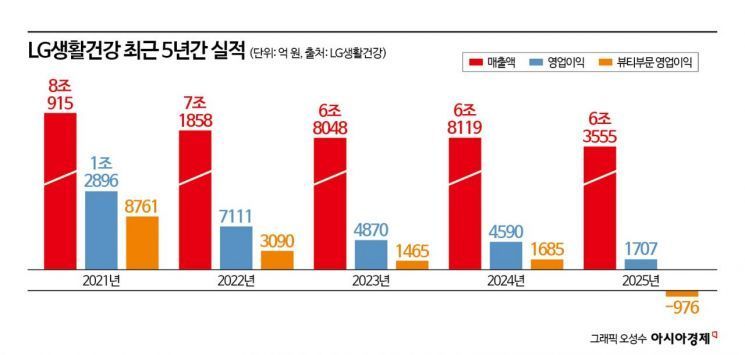
In particular, the earnings trend has been far from favorable. LG Household & Health Care posted sales of 6.3555 trillion won and operating profit of 170.7 billion won last year. Operating profit has declined for four consecutive years since 2021. Notably, the company’s flagship beauty business recorded a loss for the first time since its founding last year. Total operating profit has shrunk to about one-tenth of its 2021 level.
The share price has also been on a downward trajectory. LG Household & Health Care, once dubbed a "premium stock" trading at over 1 million won per share, is now around 270,000 won per share (as of the closing price on the 24th). Compared with its all-time high of 1,784,000 won on July 1, 2021, the price has fallen to roughly one-sixth. This contrasts with the broader market, where most stocks have risen as the KOSPI index surpassed the 6,000-point level for the first time in history.
Kwon Woojeong, an analyst at Kyobo Securities, said, "While the K-beauty industry has recently shown some signs of improvement, LG Household & Health Care continues to suffer from weak earnings," adding, "The company has decided to overhaul its cosmetics business across the board, but it will take time before this leads to an improvement in results."
Because this capital policy comes at a time when there is no clear momentum for an earnings rebound, some interpret the capital reduction as a merely symbolic measure. From an accounting standpoint, a capital reduction improves the financial structure, but it does not change the company’s intrinsic value. Essentially, without a recovery in earnings power, it will be difficult for the move to translate into a rebound in the share price.
An investment banking industry official commented, "Given that the capital reduction decision comes amid both slowing earnings and a weak share price, it appears to have at least some character of a share-price defense measure," adding, "Because the scale is minimal, the actual impact on EPS and the share price will be limited, but by cancelling treasury shares that have been held for a long time, the company can alleviate concerns about a potential overhang and send a low-intensity signal to appease shareholders."
© The Asia Business Daily(www.asiae.co.kr). All rights reserved.
![Clutching a Stolen Dior Bag, Saying "I Hate Being Poor but Real"... The Grotesque Con of a "Human Knockoff" [Slate]](https://cwcontent.asiae.co.kr/asiaresize/183/2026021902243444107_1771435474.jpg)

















