National Assembly Special Committee on U.S. Investment Stalls from Subcommittee Formation
Ruling and Opposition Parties Launch Blame Game
The ruling and opposition parties are trading accusations of responsibility as the Special Committee on the Special Act on Investment in the United States (Special Committee on U.S. Investment), established in the National Assembly to respond to U.S. tariff measures, has fallen into disarray. The ruling party criticized, saying, "Do not hold the country's future hostage for political reasons," while the opposition countered that "the government and the ruling party pushed ahead with an unconstitutional bill and turned their backs on bipartisan cooperation."
On the 24th, the Special Committee on U.S. Investment held its second plenary meeting at the National Assembly and conducted a public hearing. The committee had originally planned to form a subcommittee and formally introduce the bill at the meeting, but the session was adjourned after only the morning public hearing was held.
The Special Act on Investment in the United States is aimed at supporting expanded U.S.-bound investment by domestic companies in response to moves by the United States to impose high tariffs, and at establishing a legal framework to minimize trade risks. Given that trade issues between South Korea and the United States are delicately intertwined, calls have been made for bipartisan cooperation.
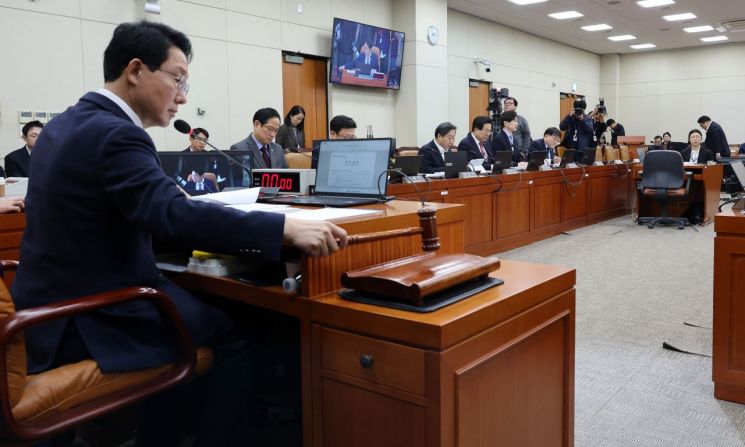 Kim Sanghun, chairman of the Special Committee for the passage of the Special Act on Investment in the United States, is striking the gavel at a plenary meeting held at the National Assembly on the 24th. Photo by Yonhap News
As this meeting, which was supposed to be the first step toward cooperation, failed to proceed as scheduled, the ruling and opposition parties immediately began a blame game. The Democratic Party of Korea stated that, since the Special Committee on U.S. Investment is a body established to respond to U.S. tariffs, political controversies should be excluded and discussions should proceed on a bipartisan basis. The People Power Party countered that it is contradictory for the ruling party to talk about cooperation while forcing through the three judicial reform bills.
The Democratic Party of Korea said, "They ultimately refused to accept even our request to at least introduce the bill and instead adjourned the plenary meeting," adding, "We express strong regret over this unilateral breach of the agreement."
The party went on to stress, "Handling the Special Act on Investment in the United States is not merely a matter of National Assembly procedure, but an issue that affects trust between South Korea and the United States and the nation's trade and security interests," and added, "If they are a responsible political force, they should separate domestic political issues from the discussion on the special act and approach it in a bipartisan manner." It also argued that "delaying discussions on the special act for political reasons places a burden on the country's future," and urged the prompt resumption of talks.
The People Power Party, on the other hand, protested, saying, "The Democratic Party of Korea has chosen 'saving President Lee Jaemyung' over the Republic of Korea."
The People Power Party argued, "The opposition party's position is to cooperate on a bipartisan basis on the issue of U.S. tariffs, but it is inconsistent for the ruling party to talk about cooperation while unilaterally pushing through the unconstitutional 'three judicial reform bills.'"
The party further stated, "It is a double standard for the government and the ruling party to push ahead with legislation that undermines democracy and the separation of powers, even as they invoke the national interest," and demanded, "At least until March 9, when the special committee's activities are set to end, they must halt unilateral legislation and demonstrate a willingness to cooperate."
The People Power Party also raised doubts about the effectiveness of the bill, saying, "The government has failed to clearly explain how the passage of the special act would directly lead to tariff reductions."
As the Special Committee on U.S. Investment has faced difficulties from the outset amid political conflict, it has become uncertain whether the bill can be passed by the originally suggested deadline of March 9. Attention is now focused on whether the ruling and opposition parties will be able to find common ground in future negotiations at a time when potential changes in U.S. tariff policy are being discussed.
© The Asia Business Daily(www.asiae.co.kr). All rights reserved.

















