Feb. 24 Legislation and Judiciary Committee plenary meeting
Yoon Suk Yeol pardon ban act vote also postponed
A special act to establish the integrated Gwangju-South Jeolla Province Special City passed the Legislation and Judiciary Committee of the National Assembly on the 24th, led by the ruling Democratic Party of Korea. The special acts for Daejeon-South Chungcheong Province and Daegu-North Gyeongsang Province, which had been submitted together, will undergo further discussion due to opposition from the People Power Party.
The Legislation and Judiciary Committee held a plenary session that day and passed the Gwangju-South Jeolla Province Integration Special Act with 11 votes in favor and 7 abstentions out of 18 members present. The People Power Party did not take part in the vote in protest against the handling of the integration special act. The Democratic Party of Korea is expected to submit the Gwangju-South Jeolla Province Integration Special Act to the plenary session later in the day.
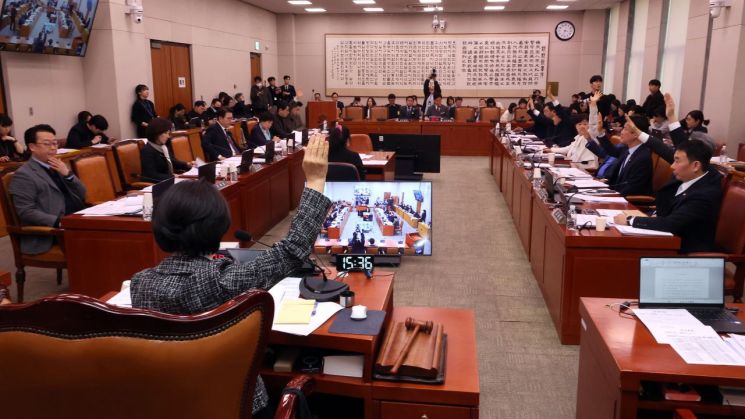 (Seoul=Yonhap News Agency) Bae Jaeman reported: Chu Miae, chair of the National Assembly's Legislation and Judiciary Committee, and lawmakers from the Democratic Party of Korea are casting votes in favor in a show-of-hands vote on the agenda at the plenary session of the Legislation and Judiciary Committee held at the National Assembly on Feb. 23, 2026. scoop@yna.co.kr (End)
If the bill passes the plenary session, an integrated local government head will be elected in the local elections in June, and the integrated special city will be launched on July 1.
Regarding the Daejeon-South Chungcheong Province and Daegu-North Gyeongsang Province Integration Special Acts, which did not pass the committee that day, Chu Miae, chair of the Legislation and Judiciary Committee, said, "The Daegu Metropolitan Council has issued a statement asking that the Daegu-North Gyeongsang Province integration not be pursued, and public support in Daejeon and South Chungcheong Province is also not very high," adding, "It seems necessary to listen to the situation in the regions going forward and to discuss this at a later time."
On this point, Vice Minister of the Interior and Safety Kim Minjae responded, "We would prefer to see integration in all three regions, but we will proceed in line with the decision of the Legislation and Judiciary Committee."
The committee also postponed voting on the Amnesty Prohibition Act, which would restrict presidential amnesty only in cases of insurrection and treason. Chair Chu said, "I have been informed that the presidential office and the party leadership have conveyed the view that more cautious review is needed regarding imposing certain constraints on the president's authority," and added, "I will accept the opinion that it is desirable to take a more cautious approach and hold further discussions in order to eliminate even the slightest concern about placing restrictions on the president's authority."
Meanwhile, the committee was originally scheduled to convene at 10 a.m., but it did not start until after 12 p.m. because the ruling and opposition floor leaders failed to narrow their differences over the agenda for the plenary session.
The amendment to the Amnesty Act being pushed by the Democratic Party of Korea is centered on restricting amnesties for those convicted of insurrection and treason. After former President Yoon Suk Yeol was sentenced on Feb. 19 to life imprisonment rather than the death penalty in the first-instance ruling as ringleader of an insurrection, the committee, led by the Democratic Party of Korea, moved quickly to review the amendment to the Amnesty Act.
However, there has been a persistent argument that, given the perception that the power of amnesty is an inherent constitutional authority of the president, any restriction by statute would be in conflict with the Constitution. The opposition People Power Party maintains its position that the Amnesty Act can only stipulate the types and procedures of amnesty, and that it would be unconstitutional if it were to restrict the crimes or individuals eligible for amnesty.
Democratic Party of Korea lawmaker Kim Gipyo said that day, "It is the wish of all citizens that anyone who has engaged in insurrection should be completely barred from receiving amnesty," but added, "It appears that there is no potential unconstitutionality in the (amendment to the Amnesty Act)." However, he requested that the vote be deferred in light of the party leadership's request for careful consideration.
Chair Chu said, "Public opinion is calling for swift passage of the 'Yoon Suk Yeol Prevention Act' and the 'Yoon Suk Yeol Amnesty Prohibition Act' so that those convicted of insurrection are not released," but added, "I will accept the opinion that it is desirable to take a more cautious approach and hold further discussions in order to eliminate even the slightest concern about placing restrictions on the president's authority."
The Democratic Party of Korea had initially planned to pass the amendment to the Amnesty Act at the plenary session of the provisional National Assembly in February, but for now it has decided to continue additional discussions while monitoring the second-instance trial and final Supreme Court ruling on former President Yoon's charges as ringleader of insurrection.
© The Asia Business Daily(www.asiae.co.kr). All rights reserved.
![Clutching a Stolen Dior Bag, Saying "I Hate Being Poor but Real"... The Grotesque Con of a "Human Knockoff" [Slate]](https://cwcontent.asiae.co.kr/asiaresize/183/2026021902243444107_1771435474.jpg)















