Briefing with the Ministry of Employment and Labor press corps in Sejong
On February 24, Kim Hyunjoong, Chairman of the Korea Occupational Safety and Health Agency, presented this year's key plans for industrial accident prevention projects at a roundtable meeting with reporters covering the Ministry of Employment and Labor, stating, "We will begin in earnest to reduce fatal industrial accidents through customized management of high-risk sites and the establishment of an AI-based smart safety system."
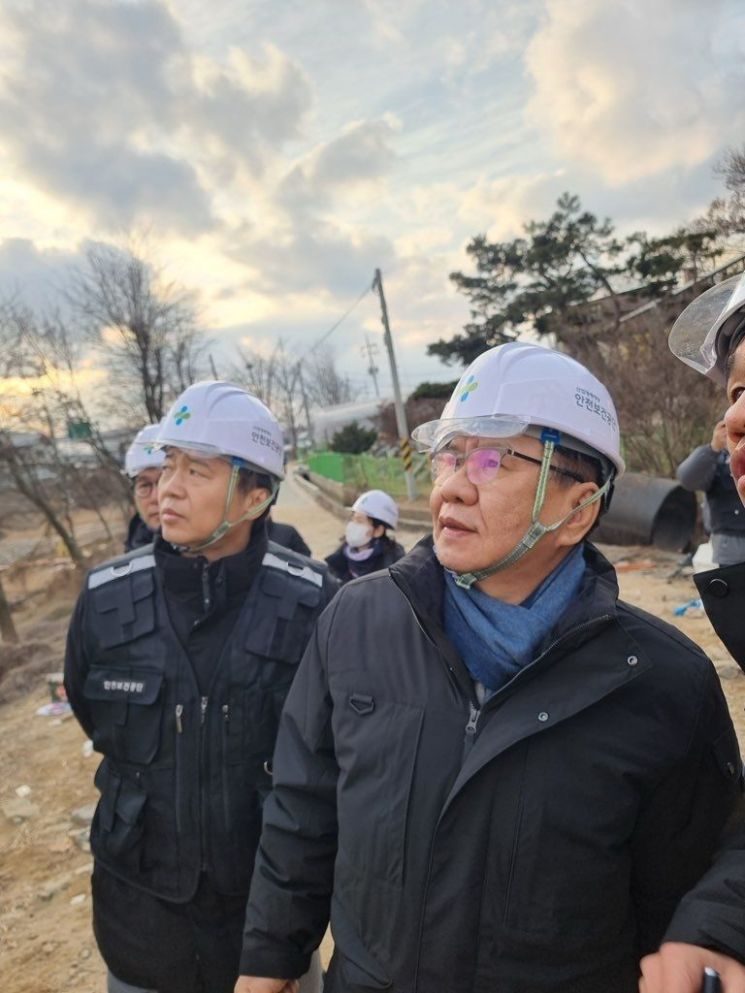 Kim Hyunjung, Chairman of the Korea Occupational Safety and Health Agency, is inspecting the site of the bridge collapse that occurred on February 25 last year at the Cheongyongcheon Bridge construction site in Section 9 of the Cheonan-Anseong segment of the Sejong-Pocheon Expressway (Expressway No. 29). Photo by Korea Occupational Safety and Health Agency
Chairman Kim explained that, in line with the national policy task of creating "a country where all working people are healthy and safe," the agency will actively promote industrial accident prevention policies with the goal of reducing the fatal accident rate to 0.37 per ten thousand workers (0.37 deaths per 10,000 workers), and achieving the Organisation for Economic Co-operation and Development (OECD) average level of 0.29 per ten thousand workers by 2030. Since the Serious Accidents Punishment Act came into effect, the fatal accident rate has been on a downward trend, declining from 0.43 per ten thousand workers in 2022 through 2024, and the agency plans to strengthen on-site strategies to structurally lower this rate.
As a first step, prevention efforts will be focused on high-risk workplaces. For workplaces where serious injuries have occurred, the agency will provide rapid technical support to cut off the chain that can lead to potential fatal accidents. For workplaces where accidents are repeated, it will support the establishment and implementation of improvement plans centered on key safety rules for preventing serious accidents. In addition, it will strengthen unannounced inspections of small-scale workplaces and intensively manage sites with frequent fall accidents through the "Safe Workplace Guardians" program and patrol inspections.
Implementation of basic safety measures will also be further reinforced. Chairman Kim explained that, to prevent fall accidents during high-risk work such as roof construction, the agency will establish an inspection system that links data from relevant institutions with on-site information. To prevent asphyxiation accidents in confined spaces, it will expand inspections of compliance with the three major safety rules: measuring oxygen and harmful gases, ventilation, and wearing protective equipment. The plan also includes strengthening the management system so that only companies with sufficient safety capabilities can participate from the construction ordering stage in the public sector.
Expansion of safety investment and improvement of the risk assessment system were also presented as key tasks. The agency will concentrate financial resources on supporting prevention facilities for major types of accidents such as falls, entrapments, and collisions, and will introduce a new specialized "Safe Workplace Creation" program for small-scale workplaces that can provide support of up to 90%. It will also promote improvements to safety facilities for older workers and the advancement of work environment design.
Policies will also be strengthened to provide equal opportunities for safety and health education to all workers. The agency will expand multilingual education for foreign workers and in-house safety leader training, and will make safety education mandatory in training for construction skilled workers and in courses for re-employment of older workers. In addition, it plans to expand experiential training facilities utilizing advanced technologies to build an effective, field-oriented education system.
Transitioning the industrial accident prevention system through AI-based smart safety management
In particular, the agency presented the establishment of an AI-based occupational safety and health system as a core transition strategy. It will expand the application of AI models that predict high-risk workplaces to all industries, and will promote the scientific advancement of prevention policies by developing an occupational safety and health AI system that automatically provides legal and technical guidelines on risk factors at workplaces. Through data-based research and development, the agency also plans to respond preemptively to future risk factors such as climate change and demographic changes.
At the same time, it will work to strengthen accountability for safety management in public institutions and expand the disclosure of safety and health information. The agency plans to reinforce safety management level evaluations and rating reviews, and to gradually introduce a safety and health disclosure system for companies above a certain size in order to increase corporate responsibility for prevention. It will also build a system for disclosing accident investigation reports, thereby expanding the public's right to know.
The new plan focuses on a full-scale overhaul of the industrial accident prevention system, centered on intensive management of high-risk sites, compliance with basic safety rules, expansion of educational opportunities, and the introduction of smart technologies. The agency intends to firmly establish a structural downward trend in industrial accidents through a comprehensive safety management system that links on-site inspections, financial support, and technological development.
Chairman Kim stressed, "Industrial accident prevention cannot be achieved through regulation alone; it requires a combination of on-site participation and technological innovation," adding, "We will leap to the level of advanced countries in occupational safety and health through an AI- and data-based prevention system."
© The Asia Business Daily(www.asiae.co.kr). All rights reserved.
![Clutching a Stolen Dior Bag, Saying "I Hate Being Poor but Real"... The Grotesque Con of a "Human Knockoff" [Slate]](https://cwcontent.asiae.co.kr/asiaresize/183/2026021902243444107_1771435474.jpg)















