MOIS Releases Results of Living Population Estimates for Population?Declining Areas in Q3 2025
In 20 Population?Declining Cities, Counties, and Districts, Staying Population Accounts for 50% of Card Spending
Contributing to Revitalizing Local Economies
In the third quarter of last year, among the population?declining areas, Yangyang in Gangwon Province recorded the largest number of “staying population” compared with the “registered population” listed as residents.
In 11 areas including Gimje in North Jeolla Province, the revisit rate of the staying population over the past three months exceeded 50%, raising expectations for revitalizing the local economy.
On the 24th, the Ministry of the Interior and Safety and the National Data Office released the “Results of the Living Population Estimates for Population?Declining Areas in the Third Quarter of 2025 (July to September).” The living population is a concept that includes not only the resident population living in the area, but also people who stay there temporarily (at least once a month for three hours or more per visit. Under the “Special Act on Support for Population?Declining Areas,” the living population of 89 population?declining areas has been calculated since 2024.
According to the results, in the third quarter of last year the average living population in population?declining areas was 28.17 million, of which the staying population reached 23.32 million, or about 4.8 times the registered population.
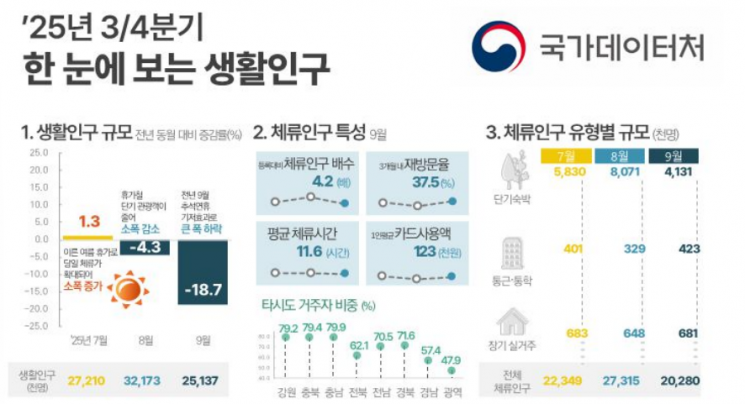
By month, the living population was 27.21 million in July, 32.17 million in August, and 25.14 million in September. July and August were at similar levels to the same months a year earlier, but September saw a sharp decline due to the Chuseok holiday period, so the total for the third quarter was slightly lower than in the previous quarter and the same quarter of the previous year.
The areas with the largest year?on?year increase in living population were Pyeongchang in Gangwon Province (July, 54,000 people), Dong District in Busan (August, 69,000 people), and Geumsan in South Chungcheong Province (September, 18,000 people). Among these, Dong District in Busan was the only population?declining area where the staying population increased every month from January to September 2025 compared with the same month a year earlier.
In terms of the multiple of staying population to registered population, Yangyang in Gangwon Province again recorded the highest figure, following the same quarter a year earlier. The number of staying visitors was up to 27 times higher than the registered population.
In population?declining areas, the average length of stay was 3.2 days and the average time spent per stay was 11.8 hours, while the average number of overnight stays was 3.5 days. Over the past three months, 11 areas, including Gimje in North Jeolla Province; Hwasun and Yeongam in South Jeolla Province; Goryeong, Yeongcheon, and Uiseong in North Gyeongsang Province; and Haman and Changnyeong in South Gyeongsang Province, recorded revisit rates of 50% or higher, indicating potential for expanding the staying population.
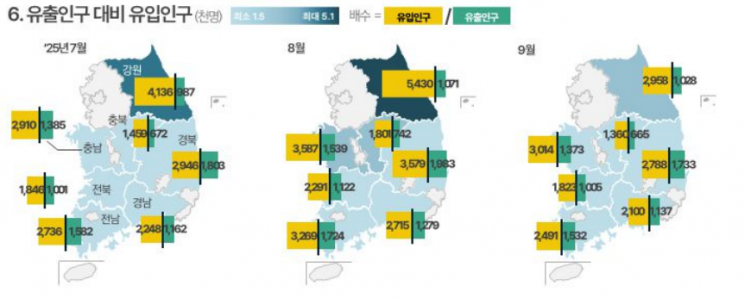
The main destinations for the staying population were Hwacheon-myeon in Hongcheon-gun, Gangwon Province; Okcheon-eup in Okcheon-gun, North Chungcheong Province; Jeongan-myeon in Gongju-si, South Chungcheong Province; Byeonsan-myeon in Buan-gun, North Jeolla Province; Damyang-eup in Damyang-gun, South Jeolla Province; Cheongdo-eup in Cheongdo-gun, North Gyeongsang Province; and Gunbuk-myeon in Haman-gun, South Gyeongsang Province, with most visitors concentrated in specific towns and townships.
Although the size of the staying population decreased compared with the same quarter a year earlier, the average card spending per person among the staying population increased, reaching a quarterly average of 122,000 won.
By metropolitan and provincial government, the share of card spending by the staying population in the total card spending of the living population in each area ranged from 29% to 54% in the third quarter of 2025. An official at the Ministry of the Interior and Safety interpreted this as meaning that “in many areas, the staying population spent almost as much as the registered population and helped support the local economy.”
More detailed living population data, including key characteristics by metropolitan and provincial government, can be found on the “National Data Office Big Data Utilization” website.
Yoon Ho-jung, Minister of the Interior and Safety, said, “We will use the living population as a priming water to open the way for revitalizing local economies and will continue to provide a wide range of policy support so that the economic ripple effects are spread evenly across population?declining areas.”
© The Asia Business Daily(www.asiae.co.kr). All rights reserved.
![Clutching a Stolen Dior Bag, Saying "I Hate Being Poor but Real"... The Grotesque Con of a "Human Knockoff" [Slate]](https://cwcontent.asiae.co.kr/asiaresize/183/2026021902243444107_1771435474.jpg)

















