Ministry of the Environment to subsidize rare-earth extraction from discarded motors and waste printed circuit boards
Japan also launches seabed rare-earth exploration, focusing on restructuring supply chains
The Japanese government will subsidize various costs required to extract rare earth elements contained in discarded motors and other waste. The plan is to diversify rare-earth supply chains that are highly dependent on China, at a time when conflict between China and Japan is intensifying.
Nihon Keizai Shimbun (Nikkei) reported on the 24th that, starting this year, Japan’s Ministry of the Environment will provide financial support for transportation networks and storage facilities needed to extract rare earths from end-of-life motors and other waste, as well as for inspection equipment used after extraction.
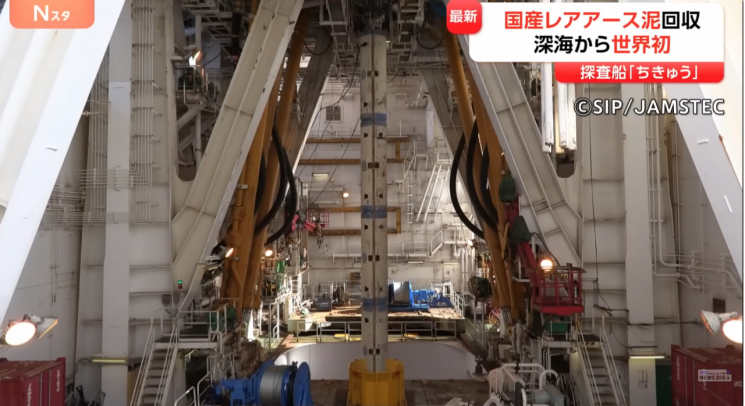 Seabed rare-earth drilling equipment installed by Japan in waters near Minamitoriseom. Tokyo Broadcasting System.
To secure sufficient volumes for recycling, the Ministry of the Environment will cover transportation costs for moving waste from across the country to collection hubs. It will also provide subsidies for warehouse storage facilities. According to Nikkei, the ministry will support projects and facility investments for checking the quality of rare earths extracted from waste to determine whether they can be reused in new products. For this program, the ministry is said to have newly allocated 6 billion yen (560 billion won) in this year’s draft budget. If the budget bill passes during this extraordinary Diet session, demonstration projects and subsidy payments will begin this summer.
The Japanese government is focusing on extracting neodymium contained in discarded motors. Neodymium, which has strong magnetic properties, is an essential material for manufacturing a wide range of products such as electric vehicles (EVs), generators, and smartphones. Nikkei reported that, until now, Japanese companies often exported end-of-life motors overseas as used goods or simply melted them down to recover only the iron due to high costs. The strategy now is to recycle scrapped motors as a resource and thereby increase domestic supplies of rare earths.
The government also plans to recover rare earths not only from discarded motors but also from waste printed circuit boards. Japan is already importing waste printed circuit boards from Europe and other regions for domestic recycling. The Ministry of the Environment intends to significantly expand the scale of this recycling. Its goal is to increase the volume of processed waste printed circuit boards by about 50% from the 2020 level to around 500,000 tons by 2030.
This policy direction by the Ministry of the Environment appears to reflect concerns over the recent escalation of tensions between China and Japan. Neodymium is an area where China accounts for more than 90% of global market share, leaving Japan heavily dependent on imports from China for its rare-earth needs. Nikkei warned, “If the Chinese government imposes export controls, there is a risk that Japanese companies’ supply chains will be severed, severely affecting their production activities.” For Japan, which is seeking a semiconductor revival and other industrial upgrades, this could become a critical risk factor.
Japan is also pushing ahead with seabed rare-earth development as it moves in earnest to restructure its supply chains. Last month, it successfully drilled mud containing rare earths at a depth of 5,700 meters on the seabed near Minamitorishima. Starting in February next year, Japan plans to lift up to 350 tons per day to assess economic viability, with the aim of beginning commercial production after 2030. In a policy speech on the 20th, Prime Minister Sanae Takaichi also targeted China, stating, “We will rebuild our supply chains so that we do not depend on any specific country.”
Nikkei added, “Such policies in Japan will be a major advantage in efforts to secure rare earths without relying on China.”
© The Asia Business Daily(www.asiae.co.kr). All rights reserved.
![Clutching a Stolen Dior Bag, Saying "I Hate Being Poor but Real"... The Grotesque Con of a "Human Knockoff" [Slate]](https://cwcontent.asiae.co.kr/asiaresize/183/2026021902243444107_1771435474.jpg)















