Active M&A to Secure Future Technologies
K-Defense Must Also Prepare... Need to Respond to Global Regulations
 Samil PricewaterhouseCoopers Aerospace and Defense Industry 2026 Report: U.S. M&A Trends and Implications for Korean Companies
As global demand surges for next-generation capabilities such as advanced technology, munitions, and space in the defense industry market, mergers and acquisitions (M&A) in the aerospace and defense (A&D) sector are emerging as a key growth engine for securing technology and accelerating innovation, going beyond simple scale expansion. Experts advise that Korean defense companies should expand their portfolios around defense technologies such as artificial intelligence (AI), autonomous systems, cyber, and space, and build capabilities to proactively respond to global regulatory and security regimes.
Hard to go it alone... securing technology through M&A
On February 24, Samil PricewaterhouseCoopers published a report titled "Samil PricewaterhouseCoopers Aerospace and Defense Industry 2026: U.S. M&A Trends and Implications for Korean Companies."
According to the report, global defense companies have recently been divesting non-core assets and reinvesting the freed-up capital into growth areas such as defense technology and space. In contrast, private equity (PE) funds and new entrants are using carve-out strategies, in which business units are split off and sold, to build dual-use (military and civilian) business platforms and expand their market influence. In addition, spin-offs centered on innovative companies and initial public offerings (IPOs) are also becoming active again.
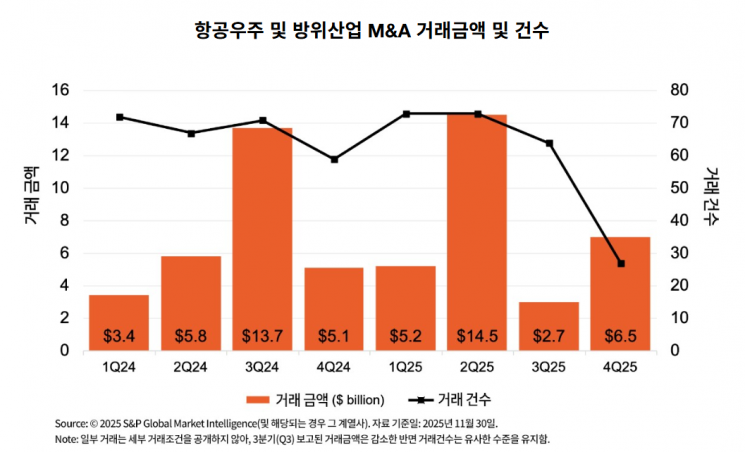
The methods of securing technology are also changing. As collaboration between prime contractors and innovative companies expands in the fields of AI, cyber, autonomous systems, and electronic warfare, agile technology acquisition through small equity investments, joint ventures (JVs), and small-scale strategic M&A is becoming the mainstream, rather than large-scale acquisitions.
The space industry is likewise being reorganized around vertically integrated platforms that encompass both satellites and launch vehicles, while strategic partnerships are being strengthened to build low Earth orbit (LEO) satellite constellations and respond to U.S. defense policy.
Furthermore, as governments shift from cost-plus contracts to performance-based contracts, companies with strong operational capabilities and cost control are becoming increasingly important. The report noted, "M&A is being recognized not merely as a financial transaction, but as a new research and development (R&D) strategy for rapidly securing technology, talent, and market access," adding, "Companies that proactively reshape their portfolios in line with future defense priorities will lead the market."
High-performing K-Defense must expand its portfolio and strengthen security
The report assessed that Korean defense companies have already earned trust by delivering solid performance. It also presented tasks for strengthening competitiveness going forward.
First, it advised that companies should expand their portfolios around defense technologies such as AI, autonomous systems, cyber, and space, and use M&A and strategic investments to make external innovation a core tool of their growth strategies. In a rapidly changing technological environment, relying solely on internal R&D has its limits. The report stressed the importance of agile technology acquisition through small-scale M&A and partnerships.
It argued that companies must proactively prepare for global regulatory and security regimes. It analyzed that the level of readiness for the U.S. Department of Defense's Cybersecurity Maturity Model Certification (CMMC), as well as U.S. export control regimes such as the International Traffic in Arms Regulations (ITAR) and the Export Administration Regulations (EAR), has become a key criterion determining whether deals are completed and how trustworthy companies are perceived to be. The report also called for modernization of operating systems across supply chains, production, and human resources.
More detailed findings of this report are available on the Samil PricewaterhouseCoopers website. Seokhyeong Hong, Partner at the Samil PricewaterhouseCoopers Defense Industry Center, emphasized, "In the global defense market, small-scale strategic deals aimed at securing technology and capabilities, rather than large acquisitions, have become the main trend," adding, "For Korean defense companies, it is urgent to establish medium- to long-term strategies that align with global standards in terms of regulatory compliance."
© The Asia Business Daily(www.asiae.co.kr). All rights reserved.
![Clutching a Stolen Dior Bag, Saying "I Hate Being Poor but Real"... The Grotesque Con of a "Human Knockoff" [Slate]](https://cwcontent.asiae.co.kr/asiaresize/183/2026021902243444107_1771435474.jpg)
















