MAFRA Announces Goat Industry Development Plan
Imports of Goat Meat Surge 35.8% in One Year
Imported Products Account for 59.4% of Total Consumption
Institutional Reforms for Farm Registration, Traceability, and Slaughtering
With the end of dog meat consumption in sight, goat meat is gaining popularity as an alternative health food, leading to a sharp increase in goat meat consumption. However, as demand is being drawn to cheaper imported goat meat, domestic goat farmers are suffering growing damage, including falling farm-gate prices. In response, the government has decided to promote strengthening the competitiveness of the goat industry to improve farm productivity and stabilize income.
On the 24th, the Ministry of Agriculture, Food and Rural Affairs announced the "Goat Industry Development Plan," focused on improving the institutional framework and building infrastructure for the goat industry.
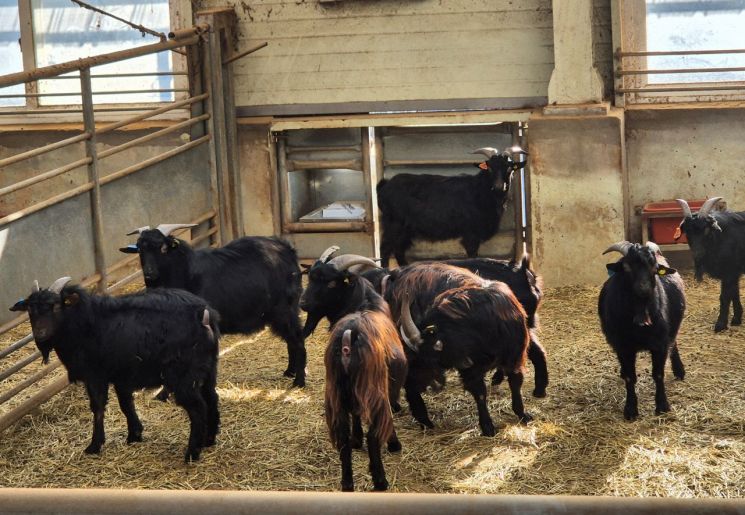
An official from the Ministry of Agriculture, Food and Rural Affairs said, "Recently, demand for goat meat has been increasing, but we drew up this plan by reflecting on-the-ground opinions about damage to farms caused by the continued rise in the market share of cheaper imported goat meat and by falling farm-gate prices," adding, "Compared to other livestock sectors, the goat industry has insufficient systems and infrastructure, so we plan to promote tasks aimed at institutional improvement and infrastructure building in the areas of production, distribution, and disease control."
According to the Ministry of Agriculture, Food and Rural Affairs, in 2024, when the "Dog Meat Consumption Ban Act" was enacted to prohibit dog meat consumption starting in February 2027, estimated goat meat consumption reached 13,708 tons, up 24.8% (2,722 tons) from the previous year's 10,986 tons. Imported goat meat accounted for 80% of the increase in consumption. Imports from Australia, which make up most of the imported volume, surged 37.0%, from 5,931 tons in 2023 to 8,126 tons in 2024. By contrast, the number of goats raised domestically increased only 10.9%, from 423,000 head in 2023 to 469,000 head in 2024. While Australian goat meat retails at around 12,000 won per kilogram, domestic goat meat costs 35,000 won per kilogram, roughly three times more expensive.
The government believes that, for the domestic goat industry to develop, it is necessary to strengthen its competitiveness by improving domestic goat breeds, systematizing distribution, and enhancing disease control. Accordingly, by 2029 it plans to establish an institutional foundation for the goat industry, which currently lags behind other livestock sectors, and to promote consumption by establishing a management system for domestic goat meat in terms of quality and hygiene.
◆ Establishing a foundation for goat production and distribution = First, the government will form a goat improvement network that includes the National Institute of Animal Science under the Rural Development Administration, the National Agricultural Cooperative Federation, and related associations, in order to build purebred and breeding groups by breed and establish a distribution system. By combining the native black goat breed, which has strong environmental and disease resistance, with the Boer breed, which has high meat yield, it plans to develop a new meat-type breed based on native goats by 2029. Through this, it aims to shorten the shipping period from 13-15 months to 12 months and increase shipping weight from 50 kilograms to 55 kilograms.
The ministry will also work to promote registration of goat herds. The current registration rate is only about 38%. An official from the Ministry of Agriculture, Food and Rural Affairs said, "Most goat farms are small-scale, with an average of 41 head, and goats are being raised as a sideline rather than a main business," adding, "We will first conduct on-site inspections of farms raising 100 or more unregistered goats, analyze their actual farming conditions and reasons for non-registration, and then prepare measures to encourage registration by providing incentives such as support for management and operating funds."
The introduction of a goat traceability system is also being pursued. This year, through a research project, the government will prepare a traceability plan suitable for goats and conduct pilot projects in local governments where registration has been completed. In addition, to prevent false labeling of the origin of imported goat meat, it will strengthen online monitoring and on-site inspections, and will work on developing scientific origin-identification methods to improve the efficiency of enforcement.
At the same time, the government will promote pilot projects to build new regional goat slaughter facilities, with support of up to 5 billion won per project, in order to expand the current 23 slaughter facilities (including 11 dedicated exclusively to goats). It will also survey and make public the status of domestic goat slaughtering and goat meat distribution and sales to help ensure transparent price formation.
◆ Strengthening goat disease control and quarantine management = The Ministry of Agriculture, Food and Rural Affairs will develop and distribute a preventive vaccine for cryptosporidiosis, which causes deaths among kids less than one week old due to parasitic infection, and a preventive vaccine for caseous lymphadenitis caused by bacterial infection, in order to minimize damage to farms during the rearing stage. It also plans to establish, by 2028, a self-quarantine system under which farms can independently prevent and manage diseases by integrating disease and feeding management with vaccination programs.
In addition, the ministry plans to revise the "Regulations on the Review of Veterinary Medicinal Products" to simplify marketing authorization for goat medicines, thereby bringing goat pharmaceuticals to market earlier.
Lee Jaesik, Director-General for Livestock Policy at the Ministry of Agriculture, Food and Rural Affairs, said, "We will systematically foster the goat industry to improve farm productivity and stabilize farm income, while supplying safe, high-quality goat meat to the public," adding, "Through communication with farmers and other stakeholders, and by swiftly pushing ahead with key tasks in cooperation with relevant agencies, we will build a solid foundation for the goat industry."
© The Asia Business Daily(www.asiae.co.kr). All rights reserved.

















