Implementing the Ministry of Employment and Labor's Industrial Transition Joint Training Center Project
The Korea Automotive Technology Institute announced on the 24th that it is taking the lead in cultivating and supporting key talent to ease the burden of workforce and technology transition for the parts industry during the shift to future vehicles.
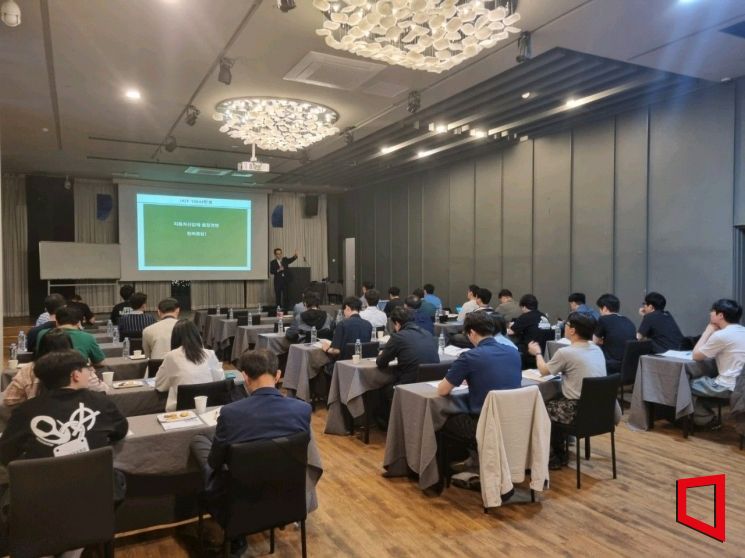 Employees of parts industry partner companies are receiving training at a seminar held as part of the Ministry of Employment and Labor's 'Industry Transition Joint Training Center' project, operated by the Korea Automotive Research Institute. Photo by Korea Automotive Research Institute
Through the "Industrial Transition Joint Training Center" project, overseen by the Human Resources Development Service of Korea under the Ministry of Employment and Labor, the Korea Automotive Technology Institute plans to provide job transition education and training for incumbent workers in the parts industry, which is in the midst of transitioning to future vehicles, as well as consulting support for companies, over a five-year period until 2029. This is a national support program designed to strengthen the capabilities of companies and workers so they can respond to changes in industrial structure, and to support a smooth transition to future vehicle fields such as eco-friendly vehicles and autonomous driving.
In the first year of the project, which was last year, the Korea Automotive Technology Institute signed agreements with 161 companies and operated training courses focused on core future vehicle areas such as fuel cells, electrification, and autonomous driving. It also linked and operated customized diagnostics and technology capability support consulting for 15 companies, generating tangible results such as developing and commercializing new business items, and improving processes and quality.
Reflecting the needs of the industrial field, the Korea Automotive Technology Institute plans to further advance this year's education and training programs and expand its corporate consulting support, beginning full-scale project operations next month. It has expanded and organized practical, work-focused specialized courses such as: vehicle software development based on the future vehicle standard software platform AUTOSAR; battery management system (BMS) software development based on model-based design (MBD); and technologies for applying international certification regulations on future vehicle cybersecurity.
The institute plans to enhance the effectiveness of industrial transition by establishing an "integrated performance management system for training and consulting," which links consulting support to companies where many incumbent workers participate in education and training.
Jin Jonguk, President of the Korea Automotive Technology Institute, said, "The transition of the automotive industry toward future vehicles is not just about acquiring new technologies; it is a key challenge that determines the competitiveness and survival of parts manufacturers," adding, "We will actively support the domestic parts industry in securing new growth engines through a virtuous cycle of immediately applicable, practice-oriented education and training, and customized corporate support consulting."
© The Asia Business Daily(www.asiae.co.kr). All rights reserved.

















