A core technology that can solve the "dendrite" issue, long considered the biggest obstacle to commercializing lithium metal batteries, has been developed in Korea. Lithium metal batteries are attracting attention as next-generation batteries that can go farther and last longer by surpassing the capacity limits of conventional lithium-ion batteries. However, during charging, needle-like crystalline dendrites grow, shortening battery life and increasing fire risk, which has slowed the commercialization of lithium metal batteries.
On the 24th, Korea Advanced Institute of Science and Technology (KAIST) announced that a team led by Professor Choi Namsun of the Department of Chemical and Biomolecular Engineering and a team led by Professor Hong Seungbeom of the Department of Materials Science and Engineering at KAIST, together with a team led by Professor Kwak Sanggyu at Korea University, have jointly developed a technology that addresses the "interfacial instability" of lithium metal batteries at the electronic-structure level.
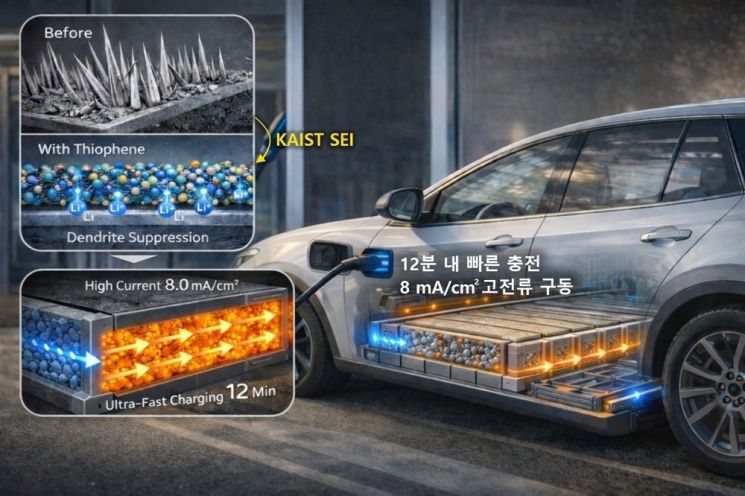
Interfacial instability is a phenomenon that occurs when the boundary between the electrode and the electrolyte, where they come into contact during charging and discharging, fails to remain uniform. This becomes the cause of dendrite formation, in which lithium grows like needles, leading to reduced battery life, internal short circuits, and fire hazards. It is the fundamental reason hindering the commercialization of lithium metal batteries.
To solve the dendrite problem, the joint research team added thiophene to the battery electrolyte to implement an "intelligent protective layer" that enables lithium ions to move stably across the electrode surface. This protective layer is characterized by its ability to spontaneously rearrange its electronic structure.
Like a smart traffic system that adjusts lanes according to traffic volume, the charge distribution inside the protective layer flexibly changes each time lithium ions move, creating an optimal pathway.
The joint research team used density functional theory (DFT) simulations to elucidate this mechanism and confirmed that thiophene exhibits far superior stability compared with existing commercial additives.
As a result, the team explained that when an intelligent protective layer is implemented by adding thiophene, dendrite growth can be effectively suppressed even under fast-charging conditions, making it possible to extend battery life.
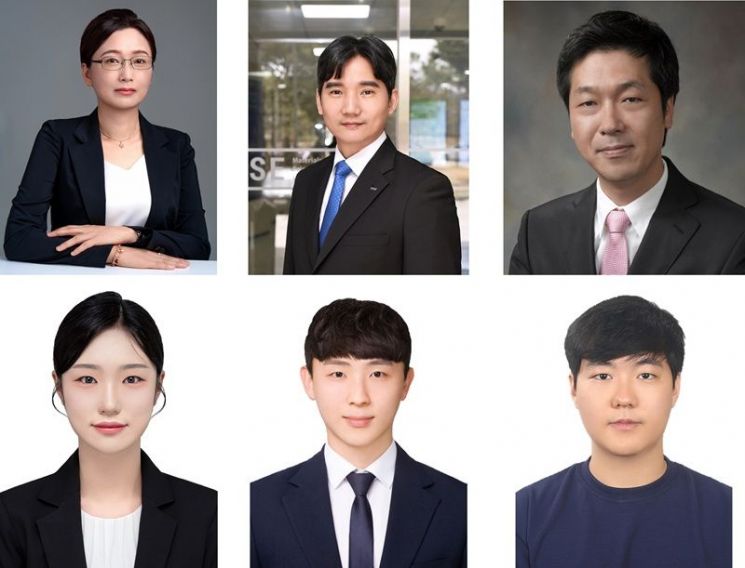 (From top left) KAIST Professors Choi Namsun and Hong Seungbeom, Korea University Professor Kwak Sanggyu, (from bottom left) KAIST researchers Lee Jeonga and Jo Yunhan, Korea University PhD candidate Kwon Sunghyun. KAIST
In particular, real-time in-situ atomic force microscopy (AFM) observations of the battery interior at the nanometer scale showed that lithium was uniformly deposited and stripped from the surface even under high-current conditions, thereby demonstrating mechanical stability as well.
The technology developed by the joint research team can also be applied to various widely used cathode materials such as lithium iron phosphate (LiFePO4), lithium cobalt oxide (LiCoO2), and lithium nickel-cobalt-manganese oxide (LiNixCoyMn1-x-yO2). This means it is not limited to a specific battery type but can be broadly applied across existing electric vehicle battery systems, suggesting it will likely have a significant ripple effect across the industry in the future.
Professor Choi said, "The greatest achievement of this study is that we did not simply improve the material, but resolved a fundamental battery issue by designing the electronic structure," adding, "The technology developed by the joint research team will become a key enabling technology for next-generation electric vehicle batteries that achieve both fast charging and long lifespan."
Meanwhile, this study was jointly authored by Professors Choi Namsun and Hong Seungbeom of KAIST and researchers Lee Jeonga and Cho Yoonhan as co-first authors. The research results (paper) were also recently introduced in InfoMat, an academic journal in the materials and energy field.
© The Asia Business Daily(www.asiae.co.kr). All rights reserved.
![Clutching a Stolen Dior Bag, Saying "I Hate Being Poor but Real"... The Grotesque Con of a "Human Knockoff" [Slate]](https://cwcontent.asiae.co.kr/asiaresize/183/2026021902243444107_1771435474.jpg)
















