Securing 1.3 Million Tons Annually for 20 Years
Covering 3% of Korea's LNG Supply
Liquefied natural gas (LNG) produced at the Barossa gas field in Australia has arrived for the first time at the Boryeong LNG Terminal in South Chungcheong Province. It is the first case in which a domestic private company has independently completed the entire process from overseas gas field exploration to development, production, and import to Korea, and observers say it has set a meaningful milestone in the history of Korea's resource development.
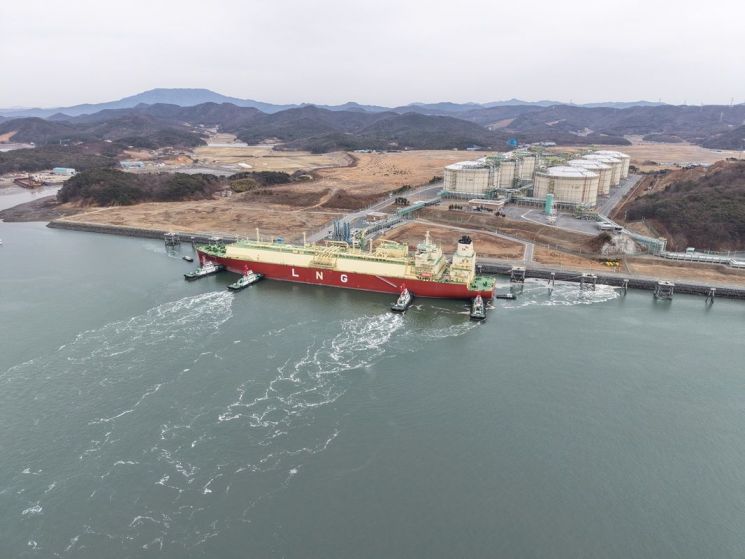 An LNG carrier of SK Innovation E&S arrived at the Boryeong LNG Terminal for the first time on the 23rd after loading LNG produced at the Barossa Gas Field in Australia. Provided by SK Innovation.
SK Innovation Energy & Solutions (SK Innovation E&S) announced on the 24th that the first LNG cargo produced at the Barossa gas field successfully arrived at the Boryeong LNG Terminal on the 23rd. The cargo was produced from natural gas extracted offshore in northwestern Australia, liquefied at the Darwin LNG Terminal, and then shipped to Korea.
This achievement means more than simply bringing in a volume of LNG. It is the first time that a domestic private company has secured an equity stake in an overseas gas field, pushed forward a long-term project, and connected it all the way to commercial production and supply to the domestic market. SK Innovation E&S has taken part since the exploration stage and has borne fruit after about 14 years of conducting the project.
The annual supply volume is around 1.3 million tons. This corresponds to about 3% of Korea's total annual LNG import volume. By securing a volume that can be imported stably over the next 20 years, the company has further strengthened the safety net of the country's energy supply and demand.
In a situation where volatility in international gas prices has increased due to the Russia-Ukraine war and conflicts in the Middle East, the fact that LNG directly produced through overseas assets is being brought in under long-term contracts carries significant meaning for energy security. It is being assessed that the company has enhanced its ability to cushion shocks to external supply chains.
The business model also secures economic feasibility. Instead of building new liquefaction facilities, the company adopted a brownfield development approach that modifies and utilizes the existing Darwin LNG Terminal, thereby reducing initial capital expenditures. In addition, Australia has a relatively short shipping time of about 8 to 10 days compared with the United States or the Middle East, giving it a competitive edge in logistics costs. The industry expects that, with this project, SK Innovation E&S's LNG value chain will be further upgraded.
This achievement is an extension of SK's resource development endeavors that began in the 1980s. After the late former Chairman Choi Jonghyun ventured into oil field development in Indonesia and North Yemen and put forward the vision of a "resource-poor oil-producing country," SK has expanded its business scope to countries such as Vietnam and Peru. Those early challenges, which began with a focus on crude oil, later shifted toward gas and then further to LNG, leading to the company's current global energy portfolio.
SK currently secures approximately 20 million barrels of crude oil and gas per year, as well as about 6 million tons of LNG resources, across 11 countries worldwide. With the success at the Barossa gas field, the company's status as a private integrated energy company in the Asia-Pacific region is expected to become even more solid.
Lee Jongsu, President of SK Innovation E&S, said, "Our challenge of pioneering a path that no one had taken has led to today's achievement," adding, "Even amid an uncertain international energy market, we will continue our resource development efforts and contribute to the national economy and the establishment of a stable energy supply chain."
© The Asia Business Daily(www.asiae.co.kr). All rights reserved.
![Clutching a Stolen Dior Bag, Saying "I Hate Being Poor but Real"... The Grotesque Con of a "Human Knockoff" [Slate]](https://cwcontent.asiae.co.kr/asiaresize/183/2026021902243444107_1771435474.jpg)















