Bank of Korea delivers work report to National Assembly’s Strategy and Finance Committee
Upside risks to growth outlook increase on strong semiconductor performance
Government efforts to stabilize housing market expected to partially mitigate risks
The Bank of Korea assessed on the 23rd that while the likelihood of a structural downward shift in the domestic stock market is limited, close attention must be paid to the possibility of increased stock price volatility stemming from factors such as uncertainty over U.S. tariffs and monetary policy. It also pointed out that although the government’s real estate measures have helped to cool overheating, the recent continued rise in prices is creating instability.
In its work report submitted to the National Assembly that day, the Bank of Korea stated, "Considering the implementation of government policies and expectations of strong earnings in the semiconductor industry, the possibility that stock prices will structurally turn downward going forward is limited."
However, it cited as risk factors the possibility of a global stock price correction triggered by debates over the profitability and overvaluation of artificial intelligence (AI) companies. Bank of Korea Governor Lee Changyong also said in his introductory remarks for the work report, "Volatility is increasing due to excessive investment in artificial intelligence (AI) and concerns about the replacement of existing industries."
Solid global semiconductor cycle expected this year... Upside expansion in growth outlook
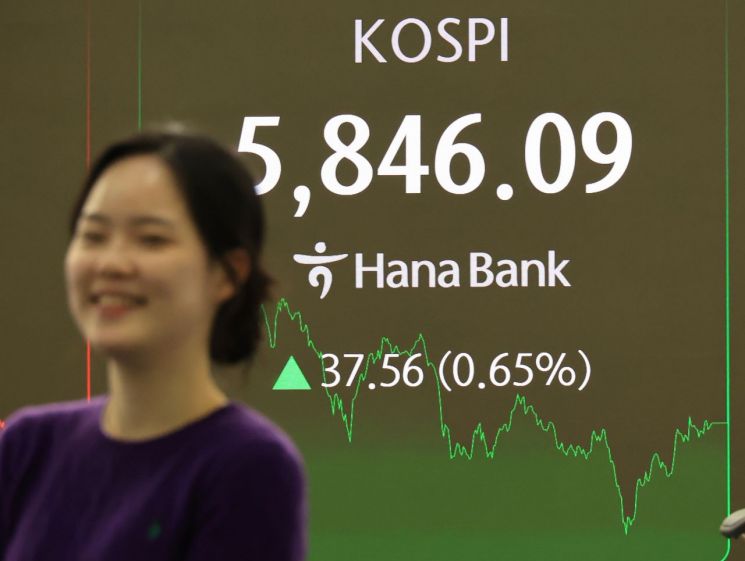
The Bank of Korea gave a positive assessment of the semiconductor-related cycle that is driving the domestic stock market. In the report, it projected, "The global semiconductor cycle is expected to show a solid trend above the long-term trend at least through this year, as robust demand and a supply-side advantage continue." As risk factors, it cited "upside risks such as the rapid spread of physical AI, and downside risks such as adjustments in AI investment and the imposition of U.S. tariffs."
Accordingly, it assessed that upside risks to this year’s growth outlook have increased compared with the 1.8% projection in the revised economic outlook released in November last year. In other words, there is room for actual growth to exceed the Bank of Korea’s previous forecast. The Bank of Korea is scheduled to decide the base rate at the Monetary Policy Board meeting on the 26th and to announce a revised economic outlook.
Draws a line on viewing Korea-U.S. rate gap as a binding constraint... Foreign investor confidence remains solid
The Bank of Korea drew a line at conclusively treating the interest rate gap between Korea and the United States as a binding constraint on monetary policy. Regarding the recent exchange rate movements, it stated, "Since the beginning of this year, the exchange rate has fluctuated with high volatility, influenced by supply-demand factors such as continued overseas stock investment by individuals and net selling of domestic stocks by foreigners, as well as movements in the U.S. dollar and the Japanese yen." It added, however, "Korea’s external borrowing conditions and domestic foreign currency liquidity remain sound, and the government is issuing foreign exchange equalization fund bonds at low spreads, indicating that foreign investors’ confidence in our economy is solid."
Governor Lee also said, "The inversion of the Korea-U.S. interest rate differential is due to the United States rapidly raising rates in the process of responding to inflation," adding, "The interest rate gap between Korea and the United States itself is not in itself a very restrictive factor for conducting monetary policy." He continued, "The impact on the exchange rate is not matched one-to-one, and we must make judgments by looking at domestic conditions, domestic price levels, and financial conditions. Currently, domestic prices are being maintained in a stable manner," he noted.
The Bank of Korea also presented its outlook on exchange rate changes arising from investments in the United States, saying, "We plan to cover them within the scope of investment income generated from our holdings of foreign currency assets," and predicted, "The impact on the foreign exchange market will be limited." It added, "For the Bank of Korea to entrust assets, the law requires that payment of principal and contracted returns by the investment corporation be guaranteed, and if accumulated losses at the investment corporation lead to a shortfall in reserves, the government needs to make up the difference."
Real estate overheating has eased somewhat but remains unstable... Lee Changyong: "Overall cap on real estate lending is necessary"
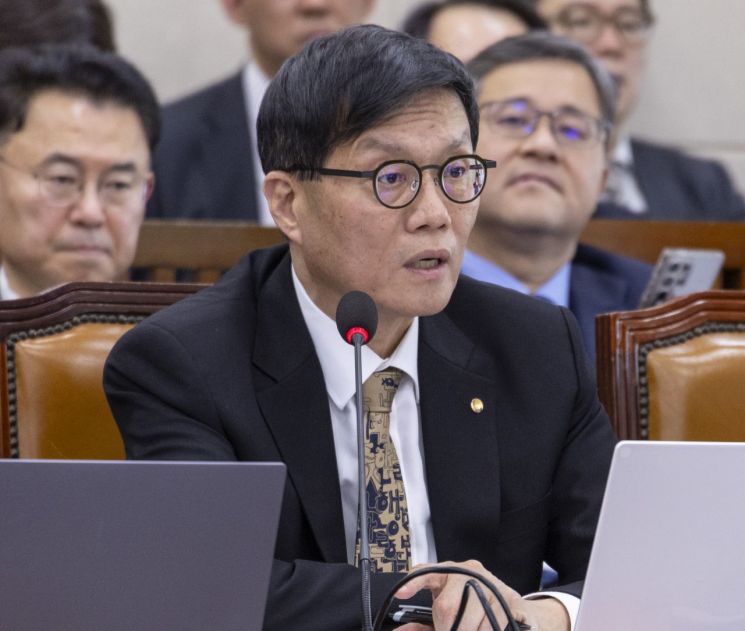 Lee Changyong, Governor of the Bank of Korea, is attending the plenary session of the Finance and Economic Planning Committee at the National Assembly on the 23rd and responding to questions from lawmakers. Yonhap News
Regarding housing market trends in the Seoul metropolitan area, the Bank of Korea assessed, "Since the October 15 measures last year, the overheating has somewhat subsided, but the continued strong upward trend in prices means the situation remains unstable." It went on, "Apartment prices in Seoul continued to rise sharply, exceeding an annualized 10% in January," and diagnosed, "In particular, the increase in prices has expanded more significantly in peripheral areas such as the outskirts of Seoul and Gyeonggi Province than in core areas such as the three Gangnam districts."
On the issue of relocating judicial institutions such as the Supreme Court and the Constitutional Court to regions outside the capital to ease concentration in the Seoul metropolitan area, Governor Lee said, "Speaking in concrete terms would amount to a personal opinion," but added, "In broad terms, I am in agreement."
He also viewed the government’s household loan regulation measures positively. The Bank of Korea stated, "If the housing market overheats again going forward, it is difficult to rule out the possibility that the pace of household loan growth will accelerate with a time lag," and added, "The government’s efforts to stabilize the housing market and manage household debt, along with the recent upward trend in lending rates, are expected to partially mitigate related risks."
It also stressed the need for strong regulations related to real estate lending. Governor Lee said, "At this point, it is not something that can be fixed by changing just one part; the overall system needs to be revamped," adding, "In particular, I believe that an overall cap on real estate lending is necessary, even though such total volume controls have been subject to various criticisms. There is also a need to strengthen regulations on the Debt Service Ratio (DSR)." He emphasized, "Above all, in addition to the government, there must be a macroprudential management committee (consultative body) that allows the Bank of Korea to participate in household debt management."
© The Asia Business Daily(www.asiae.co.kr). All rights reserved.
![Clutching a Stolen Dior Bag, Saying "I Hate Being Poor but Real"... The Grotesque Con of a "Human Knockoff" [Slate]](https://cwcontent.asiae.co.kr/asiaresize/183/2026021902243444107_1771435474.jpg)

















