China to Cut Clinical Trial Approval to 20 Days... Innovative New Drug Approvals Expected to Surge
U.S. Biosecurity Act and Tariff Plans Aim to Curb China’s Bio Supply Chain
Race to Secure Clinical Data... Concerns Over Domestic Pipelines Shifting C
As regulators in the United States and China simultaneously overhaul their new drug approval systems, a "speed race in approvals" is intensifying over global dominance in biotechnology. China is rapidly increasing the volume of approvals by leaning on expedited reviews and conditional authorizations. The United States is moving to shorten development timelines by reducing the requirements for confirmatory clinical trials.

According to the biopharmaceutical industry on the 23rd, the U.S. Food and Drug Administration (FDA) has outlined a policy direction to reduce the basic requirement for confirmatory clinical trials, which ultimately verify the efficacy and safety of a new drug, from the current two trials to one. In a recent article published in the international medical journal The New England Journal of Medicine (NEJM), FDA Director Marty Makary and Vinay Prasad, Director of the Center for Biologics Evaluation and Research (CBER), stated, "In the past, at least two confirmatory clinical trials were required for a new drug application, but going forward, a single 'adequate and well-controlled clinical trial' can serve as the basic requirement."
This move is being interpreted as a measure to reduce development timelines and cost burdens. Since a single confirmatory clinical trial for a new drug alone requires tens of millions of dollars and takes years to complete, cutting the number of trials can directly translate into faster approvals. According to a 2016 study by a research team at Tufts University in the United States, the average time required to develop one new drug, including clinical trials, was analyzed to be more than about 10 years. It was found that the clinical trial phase alone takes an average of 6 to 7 years.
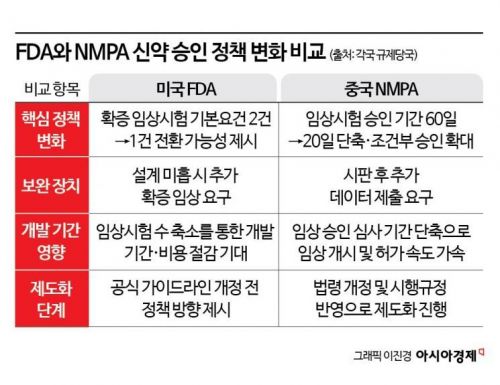
China, by contrast, is moving to rapidly expand the volume of approvals by making its system more flexible. The National Medical Products Administration (NMPA) recently revised the implementing regulations of the Drug Administration Law to shorten the review period for clinical trial applications from 60 days to 30 days, and plans to further reduce it to 20 days starting in May. For innovative new drugs, it has codified into law the systems for breakthrough therapy designation, conditional approval, and priority review so that the launch of new drugs can be accelerated.
The overhaul of China’s new drug approval procedures is translating into a tangible increase in the number of approvals. Innovative new drugs developed by domestic companies and approved by the NMPA rose sharply from 34 in 2023 to 39 in 2024 and 59 in 2025. Over the same period, innovative new drugs developed by U.S. companies and approved by the FDA numbered only 25, 26, and 29, respectively. Until 2021-2022, the scale of approvals in the two countries was similar, but over the past three years China has rapidly pulled ahead.
Analysts say this trend is also linked to the U.S. government’s designation of biotechnology as a strategic industry and its identification of China as a primary competitor. In December 2025, the U.S. Congress finalized the enactment of the Biosecurity Act, included in the National Defense Authorization Act, introducing measures that restrict federal government contracts and research funding for Chinese biotech companies.
The United States is also considering imposing high tariffs on pharmaceuticals and active pharmaceutical ingredients (APIs) imported from China, ratcheting up economic pressure. This is being interpreted as a strategy to restructure the biopharmaceutical supply chain: to check the spread of China’s leadership in new drugs and manufacturing competitiveness into the U.S. market, which has been built through rapid approval procedures, and to reduce global pharmaceutical companies’ dependence on China.
As U.S.-China regulatory competition intensifies, the need for a strategic response from Korea’s biotech industry is also growing. Lee Seungkyu, Vice Chairman of the Korea Biotechnology Industry Organization, assessed, "The recent regulatory competition between the United States and China is a strategy to preempt governance over the new drug value chain through their respective national approval systems." In his view, the core of global competition in new drugs is shifting to how quickly proof-of-concept (PoC) data can be secured in Phase 2 clinical trials, and the situation has clearly entered a race against time.
He added, "Japan, India, and Thailand are also accelerating regulatory easing, while Korea is in the process of supplementing its system, but our speed competitiveness is still not sufficient at the global level," and warned, "If this gap persists, there could be a growing trend of domestic pipelines pursuing clinical trials in the United States or China."
© The Asia Business Daily(www.asiae.co.kr). All rights reserved.


















