Trade Commission Proposes Accepting Five-Year Price Undertakings from Nine Companies
Plans to Impose 28.16% to 33.43% Anti-Dumping Duties on Non-Participating Firms
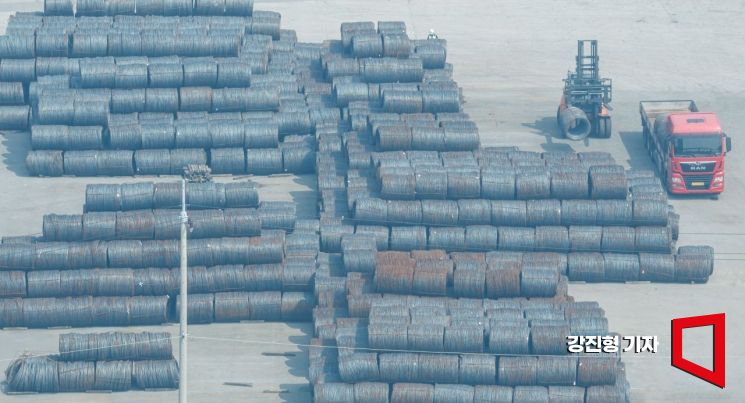 Image of steel products piled up at the export yard of Pyeongtaek Port in Gyeonggi. It is unrelated to the article text.
The Trade Commission of the Ministry of Trade, Industry and Energy has approved a plan to accept price undertakings for Japanese- and Chinese-made hot-rolled products for the next five years, and to impose anti-dumping duties of up to 33% on companies that do not participate in the undertaking.
On February 23, at its 470th meeting, the Trade Commission made its final determination in the anti-dumping investigation on hot-rolled carbon steel and alloy steel products from Japan and China and decided as above.
This measure follows Hyundai Steel's application for an anti-dumping investigation in December 2024. Based on the findings of the main investigation, the Trade Commission issued a final affirmative determination that dumped imports of the products in question have caused material injury to the domestic industry.
Accordingly, it decided to recommend to the Minister of Economy and Finance the imposition of anti-dumping duties of 31.58-33.43% on Japanese products and 28.16-33.10% on Chinese products.
However, the Trade Commission also decided to recommend accepting price undertakings for a total of nine companies: three Japanese companies, including JFE and Nippon Steel, and six Chinese companies, including Baoshan and Benxi Steel, under which they would commit to export price increases over the next five years and quarterly price adjustments. These nine companies accounted for about 81% of South Korea's total hot-rolled product imports over the past three years.
A price undertaking is a trade remedy under which exporters voluntarily commit to setting minimum export prices and making price adjustments. If they violate the undertaking, anti-dumping duties can be imposed on the relevant volumes, and the exporters can be excluded from the scope of the price undertaking.
Hot-rolled products are a key raw material used extensively across the domestic manufacturing sector, including for downstream steel products such as cold-rolled steel and steel pipes, as well as in automobiles, shipbuilding, machinery and heavy equipment, construction, railways, and energy. The domestic market size is approximately 10 trillion won as of 2024.
The Trade Commission expects that this measure will prevent cutthroat competition in the domestic market caused by low-priced imports from Japan and China, and will help normalize market prices, improve the profitability of blast furnace steelmakers, and secure their investment capacity. If the price undertakings are smoothly implemented, it projects that domestic shipment volume will increase by more than about 1 million tons and that market share will rise by around 8.9 percentage points.
It also expects that, by combining price undertakings with tariffs instead of relying solely on rigid duty imposition, the measure will ease cost burdens for domestic user industries and help stabilize both supply-demand conditions and prices.
Meanwhile, the Trade Commission resolved to exclude from the scope of anti-dumping duties certain items such as tool steel that are included in the investigation’s product scope but are not currently produced by domestic manufacturers.
Going forward, the Trade Commission plans to submit these results as a recommendation to the Ministry of Economy and Finance and to notify the governments of the countries concerned and other interested parties.
© The Asia Business Daily(www.asiae.co.kr). All rights reserved.

















