Started at 1,000 in 1996... Still hovering around 1,100
"Too many listed companies and zombie firms kept alive"
Government prepares measures such as tougher delistings and incentives for institutional investors
The KOSDAQ was launched in July 1996 to help small and venture companies raise capital. As its name suggests, it was created by benchmarking the U.S. NASDAQ.
 Although KOSDAQ has more listed companies than KOSPI, their combined market capitalization amounts to only 623 trillion won. It does not even reach SK Hynix's 675 trillion won, let alone Samsung Electronics, whose market capitalization exceeds 1,200 trillion won. Getty Images
Although it was modeled after NASDAQ, KOSDAQ’s performance has been dismal. It started at an index level of 1,000 and briefly climbed to 2,925 points during the IT bubble in 2000. However, when the bubble burst, it plunged to 245 points during the 2008 global financial crisis, just one-tenth of its peak. It has since recovered little by little, but still hovers around 1,100 points. Even after 30 years since its launch, the cumulative gain is just over 10%. This is a poor result compared with the KOSPI, which has risen more than ninefold over the same period.
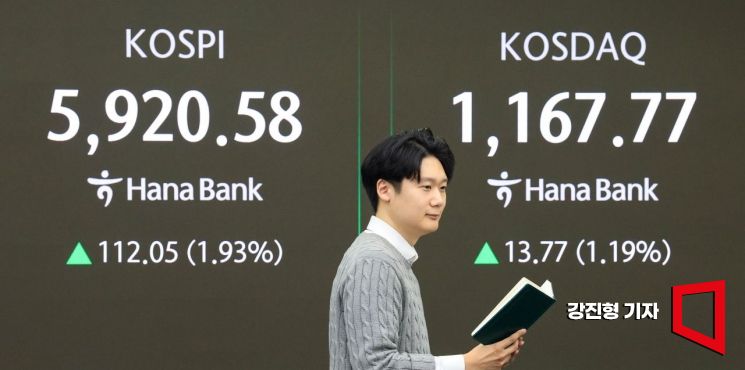 On February 23, the KOSPI surpassed 5,900 for the first time ever, but the KOSDAQ is still hovering in the 1,160-point range. 2026.2.23 Kang Jinhyeong, Reporter
An excessive number of listed companies relative to the market’s capacity and weak earnings are cited as reasons why KOSDAQ has failed to rise. KOSDAQ currently has 1,810 listed companies, more than twice the KOSPI’s 839. Although this is fewer than the roughly 3,300 companies listed on NASDAQ in the United States, securities industry experts view it as an excessive number when considering the size of the Korean economy.
NASDAQ includes many global giants such as Nvidia, Apple, Alphabet, Microsoft, and Meta. In contrast, KOSDAQ does not have a single comparable company. NCSoft, Naver, Kakao, and Celltrion have all left KOSDAQ, and Alteogen, currently the second-largest company on KOSDAQ by market capitalization, also plans to leave KOSDAQ and move its listing to the KOSPI.
KOSDAQ has more listed companies than KOSPI, but their combined market capitalization amounts to only 623 trillion won. That is less than Samsung Electronics, whose market cap exceeds 1,200 trillion won, and even SK Hynix, at 675 trillion won. Kim Hakgyun, Head of Research at Shinyoung Securities, analyzed, “KOSDAQ’s long-term performance has been weak compared with the KOSPI,” adding, “We need to reflect on whether, fundamentally, too many companies are being listed.”
The government, sharing this perception, has moved to improve the fundamentals of the KOSDAQ market. Starting this year, the Financial Services Commission has begun in earnest to overhaul KOSDAQ’s structure by strengthening the delisting of underperforming listed companies, improving conditions for institutional investors to enter the market, and revitalizing initial public offerings (IPOs) of promising companies. From the second half of this year, it also plans to begin delisting so-called “penny stocks” with share prices below 1,000 won.

Kwon Daeyoung, Vice Chairman of the Financial Services Commission, stressed, “For KOSDAQ to make a great leap forward as a market trusted by investors, we need faster and stricter delisting of poorly performing companies.” Jeong Eunbo, Chairman of the Korea Exchange, also said at a press briefing on the 5th, “Removing zombie companies from the stock market is the top priority for the exchange,” adding, “We will promptly delist underperforming listed companies from the market.”
© The Asia Business Daily(www.asiae.co.kr). All rights reserved.
![Clutching a Stolen Dior Bag, Saying "I Hate Being Poor but Real"... The Grotesque Con of a "Human Knockoff" [Slate]](https://cwcontent.asiae.co.kr/asiaresize/183/2026021902243444107_1771435474.jpg)


















