State Media Hint at Retaliation, but Also See China’s Burden Easing
Following the U.S. Supreme Court ruling that the "reciprocal tariffs" were unlawful, U.S. President Donald Trump announced that he would impose a temporary 15% import tariff on the entire world. The Chinese government urged the United States to "cancel its unilateral tariff measures" in response to both the Supreme Court’s decision and President Trump’s remarks about imposing additional across-the-board tariffs.
According to China's Ministry of Commerce, a spokesperson stated in a position paper posted on its website on the 23rd in a Q&A format with reporters, "We are aware of the U.S. Supreme Court’s ruling on the tariff lawsuit and are conducting a comprehensive assessment of its content and impact," adding, "China has consistently opposed unilateral tariff hikes and has repeatedly stressed that there are no winners in a trade war and that there is no way out in protectionism."
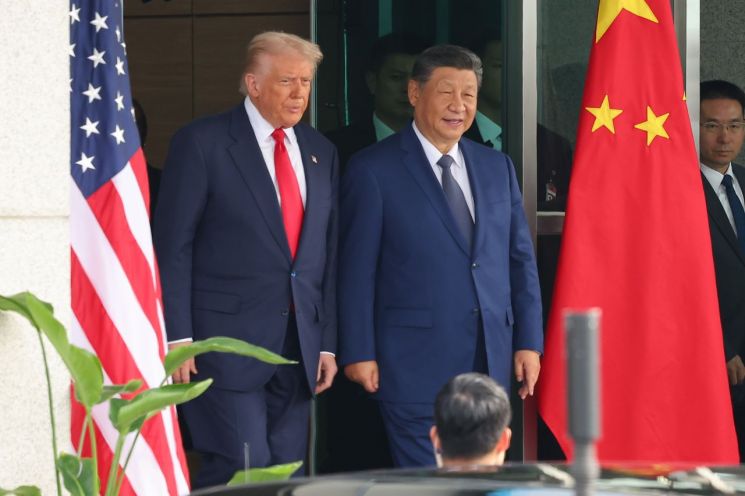 Trump Donald, President of the United States (left), and Xi Jinping, President of China. Yonhap News Agency
The spokesperson for the Ministry of Commerce said, "The United States’ unilateral measures, including the imposition of reciprocal tariffs and the imposition of fentanyl-related tariffs, violate both international trade rules and U.S. domestic law and serve the interests of neither side," and added, "It has already been proven many times that cooperation between China and the United States benefits both sides, whereas confrontation harms both sides."
The spokesperson went on to say, "We urge the United States to cancel its unilateral tariff measures against its trading partners," adding, "We also note that the United States is preparing alternative measures, such as trade investigations, to maintain tariffs. China will monitor this closely and will firmly safeguard China’s interests."
The statement issued that day by China’s Ministry of Commerce was its first message since the U.S. Supreme Court on the 20th (local time) ruled that the reciprocal tariffs imposed by the Trump administration on the basis of national emergency powers were unlawful. While the authorities limited themselves to issuing a principled position, state-run media questioned the Trump administration’s plan to switch from reciprocal tariffs to imposing a 15% global temporary tariff for 150 days by invoking Section 122 of the Trade Act of 1974.
The state-run Global Times on the previous day, citing Gao Lingyun, a researcher at the Chinese Academy of Social Sciences, pointed out that the U.S. tariff decision is highly arbitrary and that the Trump administration is using tariffs as a political weapon. However, it analyzed that China’s nominal tariff burden will decrease, given that it has previously borne tariffs of more than 15%.
The China Central Television (CCTV) social media account "Weiwen Tiantian" stated in a post the previous day, citing an analysis by domestic experts, "If the United States reduces or cancels the relevant measures, China will also make adjustments depending on the situation. However, if the United States imposes new tariffs through other legal means, China will consider whether to take corresponding countermeasures."
Some observers believe that this move could affect trade negotiations ahead of President Trump’s visit to China on the 31st of next month. Ding Shufan, honorary professor at the East Asian Institute of National Chengchi University in Taiwan, told Singapore’s Lianhe Zaobao that China is in a relatively advantageous position, while the Trump administration is in a somewhat confused situation, and under these circumstances it is unlikely that China will make concessions in the negotiations. He noted that the 15% tariff is a temporary measure limited to 150 days and that lawsuits filed by companies would increase complexity, but predicted that the Trump administration would continue imposing tariffs, saying, "The U.S.-China trade war will still continue, and clashes and frictions will also persist."
However, Professor Ding also said that President Trump, ahead of the midterm elections, needs China to expand its purchases of agricultural products and to help curb inflation, while China is hoping for an easing of U.S. export controls on advanced technology, and added, "There is still room for negotiation between the two sides."
© The Asia Business Daily(www.asiae.co.kr). All rights reserved.
![Clutching a Stolen Dior Bag, Saying "I Hate Being Poor but Real"... The Grotesque Con of a "Human Knockoff" [Slate]](https://cwcontent.asiae.co.kr/asiaresize/183/2026021902243444107_1771435474.jpg)
















