Special provisions in the Integrated Special Act... Promotion of Gwangju Songjeong Station as a national transportation and logistics hub
Connection of Jangseong?Gwangju Songjeong?Yeonggwang... Plan to introduce the hydrogen train HTX
Push to establish the Global Tri-Port linking rail, air, and seaports
The introduction of the hydrogen train HTX (Hydrogen Train Express) is being pursued for the Gwangju New Industry Line, which will run from Jangseong in South Jeolla Province through Gwangju Songjeong Station to Yeonggwang. The Gwangju Metropolitan City Government has announced a plan to foster Gwangju Songjeong Station as a national strategic logistics hub connecting rail, air, and seaports, and to establish a metropolitan transportation system for the Honam megacity.
On the 23rd, the Gwangju Metropolitan City Government held a press briefing in the plaza in front of Gwangju Songjeong Station under the theme "United Gwangju and South Jeolla, the Starting Point of the Honam Megacity" regarding the Special Act on the Establishment of the Integrated Metropolitan City of South Jeolla and Gwangju, and announced plans to build a metropolitan transportation system centered on Gwangju Songjeong Station.
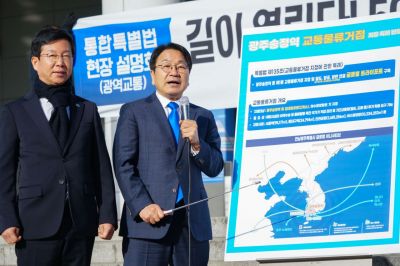 Kang Gijung, mayor of Gwangju Metropolitan City, explained plans to establish a metropolitan transportation system and other measures at an on-site briefing on the Integrated Special Act related to Gwangju Songjeong Station held on the morning of the 23rd at the plaza of Gwangju Songjeong Station. Provided by Gwangju City
This briefing was organized to explain plans to strengthen transportation and logistics functions, focusing on the special provisions related to Gwangju Songjeong Station included in the Integrated Special Act. It proceeded in the following order: key contents of the Integrated Special Act, the Global Tri-Port strategy, the Gwangju New Industry rail line and implementation plan, and a Q&A session.
The Integrated Special Act includes 18 provisions aimed at alleviating transportation inconveniences and revitalizing transportation and logistics. Among them, two special provisions directly related to Gwangju Songjeong Station have been incorporated.
Article 135, "Special Provision on Designation of Transportation and Logistics Hub," allows Gwangju Songjeong Station to be given priority designation as a national transportation and logistics hub. The Gwangju Metropolitan City Government plans to build a "Global Tri-Port" that links Gwangju Songjeong Station (rail), the tentatively named Kim Daejung International Airport (air), and Yeosu Gwangyang Port (seaport). The idea is to connect rail, air, and seaports into a single logistics system and develop the area into the transportation and logistics center of the southwestern region of the country.
Article 120, "Special Provision on Establishing a Transportation Network for Balanced Development," stipulates that the Gwangju New Industry Railway can be given priority inclusion in national plans. The Gwangju New Industry Line will start from the Jangseong Advanced District 3 Research and Development Special Zone and pass through Advanced Districts 1 and 2, Jingok and Hanam Industrial Complexes, and Sinchang, Unnam, Hanam, and Seonun Districts, connecting to Gwangju Songjeong Station, Pyeongdong Industrial Complex, and the Bitgreen and Future Vehicle National Industrial Complexes. It is then planned to continue via Munjung District in Hampyeong and Daema Industrial Complex in Yeonggwang to reach Yeonggwang on the West Coast Railway.
The Gwangju New Industry Line will introduce the hydrogen train HTX, which will utilize eco-friendly hydrogen energy produced in Yeonggwang. The total project cost is about 1.9 trillion won, and the city aims to finance the entire amount with national funds. It is also seeking national funding support for operating costs. The Gwangju Metropolitan City Government has already submitted a request to the Ministry of Land, Infrastructure and Transport for inclusion in the 5th National Rail Network Master Plan.
The city expects that, once Gwangju Songjeong Station is designated as a transportation and logistics hub and connected to the Gwangju New Industry Line, it will be possible to establish an integrated logistics system encompassing rail, air, and seaports.
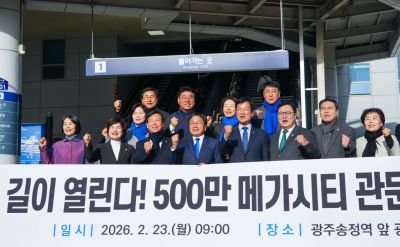 On the morning of the 23rd at the plaza of Gwangju Songjeong Station, Kang Kijeong, mayor of Gwangju Metropolitan City, explained plans to build a metropolitan transportation system at an on-site briefing on the Integrated Special Act concerning Gwangju Songjeong Station, then shouted slogans with attendees including Park Byungkyu, Gwangsan District Mayor, and Park Gyuntaek, Member of the National Assembly. Photo provided by Gwangju City
Mayor Kang Gijung said, "Gwangju Songjeong Station will evolve beyond a simple railway station into a national strategic hub connecting rail, air, and seaports," adding, "Based on the special provisions of the Integrated Special Act, we will promote the establishment of the Global Tri-Port and the inclusion of the Gwangju New Industry Line in national plans."
The Gwangju Metropolitan City Government plans to accelerate the expansion of the metropolitan transportation network and the creation of the Global Tri-Port by strengthening consultations with relevant ministries and advancing follow-up procedures for the Special Act.
© The Asia Business Daily(www.asiae.co.kr). All rights reserved.
![Clutching a Stolen Dior Bag, Saying "I Hate Being Poor but Real"... The Grotesque Con of a "Human Knockoff" [Slate]](https://cwcontent.asiae.co.kr/asiaresize/183/2026021902243444107_1771435474.jpg)
















