Ministry of Health and Welfare, KDCA, and MFDS to formulate the "Plan to Advance the Infectious Disease Crisis Management System"
Social distancing and isolation standards to be clarified based on "scientific evidence"
The government will push for a sweeping overhaul of the system to address shortcomings that emerged in the response to the novel coronavirus infection (COVID-19) pandemic between 2021 and 2024. It plans to establish a preemptive and systematic response system to prepare for potential future emerging infectious diseases and to actively reflect these measures in the currently formulated “Plan to Advance the Infectious Disease Crisis Management System.”
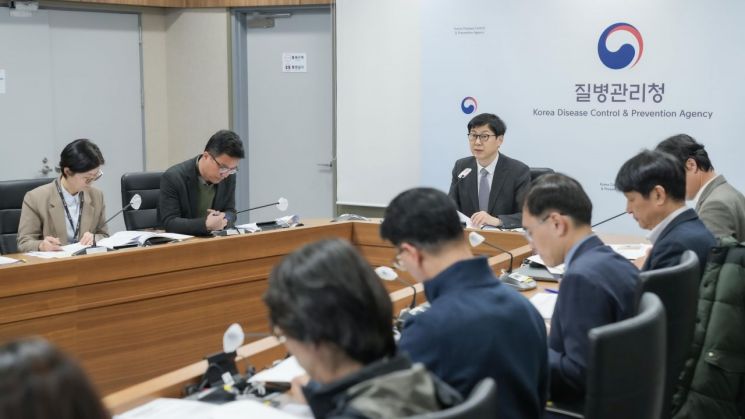 Kim Ginam, Vice Commissioner of the Korea Disease Control and Prevention Agency, is holding an online briefing on the audit results of COVID-18 on the 23rd. Korea Disease Control and Prevention Agency.
The Ministry of Health and Welfare, the Korea Disease Control and Prevention Agency, and the Ministry of Food and Drug Safety announced that they fully accept the Board of Audit and Inspection’s audit findings on the “Status of the COVID-19 Response,” which were released on the 23rd, and that they will swiftly implement remedial measures for the issues identified in each sector. According to the Board of Audit and Inspection, during the COVID-19 period, vaccines were not properly managed, and it was confirmed that some vaccines that might have contained foreign substances or whose expiration dates had passed were administered.
The government will first clearly define a cooperation framework to minimize confusion in work among ministries during crises. The Korea Disease Control and Prevention Agency, in cooperation with the Ministry of Health and Welfare and the Ministry of Food and Drug Safety, established the “Digital and Crisis Communication Task Force” in July last year to deliver unified public messages during infectious disease disasters, and it plans to enact a response manual in the first half of this year to prevent confusion between quarantine authorities and local governments over response measures. A Prime Minister’s directive that supports swift decision-making when introducing vaccines has already been enacted last month, establishing a response framework for each ministry.
The response capacity at the quarantine front line will also be strengthened. The Korea Disease Control and Prevention Agency revised the quarantine work guidelines for managing contacts on aircraft in October last year, and it plans to complete improvements to the Integrated Disease and Health Management System by the third quarter of this year to strengthen collaboration in epidemiological investigations among public health centers. To train and secure epidemiological investigators, it is continuously pushing for revisions to relevant regulations and for incentive support measures, while also thoroughly managing the securing of appropriate sites and the estimation of total project costs to quickly establish regional infectious disease specialized hospitals.
Clearer standards will be established for social distancing and cohort isolation, which have been the subject of controversy. In the first half of this year, the Korea Disease Control and Prevention Agency will clarify social distancing standards based on scientific evidence and enact a “Public Health and Social Response Manual,” and in particular, it will complete revisions to the Enforcement Decree of the Infectious Disease Prevention Act to prevent human rights violations and reduced quarantine effectiveness caused by excessive cohort isolation.
The Ministry of Food and Drug Safety will prepare procedures by May that specify detailed criteria for designating and improving distribution measures for medical devices used to respond to emerging infectious diseases. To prepare for situations similar to the past “mask crisis,” it will also clarify the criteria for designating public sales outlets and setting distribution prices.
The vaccine management system will also be further refined. The government will establish reporting procedures in the event of vaccine quality abnormalities and, in the first half of this year, introduce a manual requiring vaccination only after confirming the results of national lot release approval. In particular, it will establish a legal basis by May to create a quality verification system for vaccines introduced under emergency use authorization.
The Korea Disease Control and Prevention Agency stated, “This audit served as an opportunity to objectively review the COVID-19 response system,” adding, “By reflecting the issues pointed out by the Board of Audit and Inspection, we will strive to protect public health and minimize social and economic damage in the event of future emerging infectious diseases.”
© The Asia Business Daily(www.asiae.co.kr). All rights reserved.
![Clutching a Stolen Dior Bag, Saying "I Hate Being Poor but Real"... The Grotesque Con of a "Human Knockoff" [Slate]](https://cwcontent.asiae.co.kr/asiaresize/183/2026021902243444107_1771435474.jpg)















