Four straight years of growth since the pandemic... 60% increase vs. 2019
Fewer traditional travel agencies, boom in experience- and use-based segments
Conventional travel agencies decline... tourism shifts from an industry to content-driven business
The very structure of the domestic tourism industry is changing. The number of newly opened tourism businesses has surged far beyond the number of closures, and last year the number of tourism business openings hit an all-time high.
According to the Korea Tourism Organization Tourism Data Lab on the 24th, the number of newly opened tourism businesses in 2025 was tallied at 7,019. This is the highest figure since 2017, the first year for which comparable statistics are available. Compared with 2019, before COVID-19, when there were 4,384 openings, the number has increased by about 60%.
The key point is not simply that "tourism demand has returned." What has changed is who is entering the market and in which segments. As experience-oriented and visitor-use segments, rather than traditional travel agencies, have driven the increase in openings, analysts say a clear trend has emerged in which tourism is being reorganized from an industry into small-scale, content-driven businesses.
Four consecutive years of growth off the pandemic bottom... Fewer "travel agencies," more "visitor-use facilities"
The number of tourism business openings hit bottom when the impact of the pandemic fully set in, with 2,581 openings in 2020 and 2,675 in 2021. It then increased for four consecutive years, from 3,829 in 2022 to 4,687 in 2023, 5,767 in 2024, and 7,019 in 2025.
The pre-COVID trend in openings was exactly the opposite. The number fell from 4,948 in 2017 to 4,665 in 2018 and 4,384 in 2019. The trajectory has been completely reversed since the pandemic. Industry insiders interpret this not as a simple cyclical rebound, but as a signal that the very criteria for making decisions about tourism startups have changed.
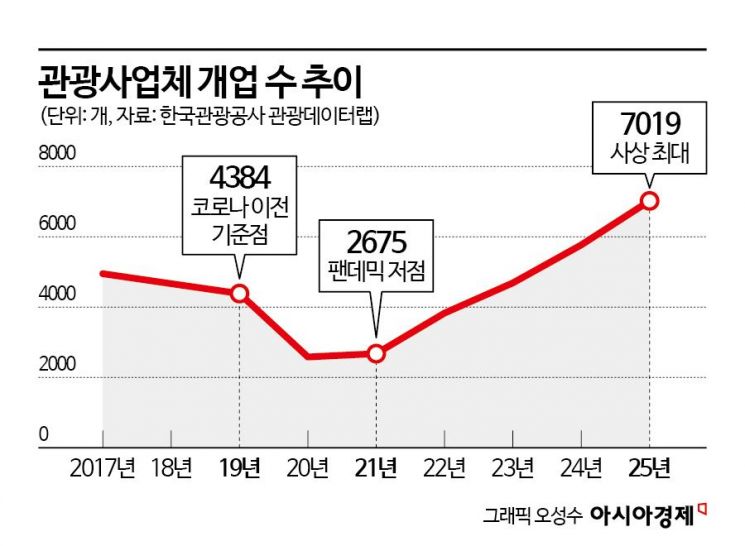 Trends in the number of domestic tourism business openings, 2017-2025. The number increased from 4,384 in 2019 to 7,019 in 2025, marking the highest number of openings since the COVID-19 pandemic. Source: Korea Tourism Organization, Tourism Data Lab.
By business type, the shift is even clearer. Of the 7,019 openings in 2025, 3,781 were in the visitor-use facilities category, accounting for more than half (53.9%). This represents a 285% increase compared with 2019, when there were 982 such openings. In contrast, the number of travel agency openings decreased by 14.8% over the same period, from 2,267 to 1,931. In other words, the center of gravity in the market has shifted away from "tourism" centered on group tours and traditional travel products, and toward experience-oriented and visitor-use segments.
The recovery in foreign tourist arrivals is clearly an important backdrop. However, the industry does not see this as the direct cause of the increase in startups. Many interpret the situation as follows: as foreign visitor spending has grown, a market has first been created in which small-scale products such as experiences and lodging can actually be sold, and on top of that, new startups have entered. A tourism industry official said, "Foreign tourists tend to travel individually rather than in groups and spend more on experiences, which stimulates startups in small-scale lodging, experience programs, and tours," adding, "Foreign tourism functions more as an amplifier than as a root cause of the increase in startups." Some in the industry also analyze that if the number of inbound visitors not only recovers but moves into a phase of setting new record highs, it will become difficult to respond on the supply side using the old model.
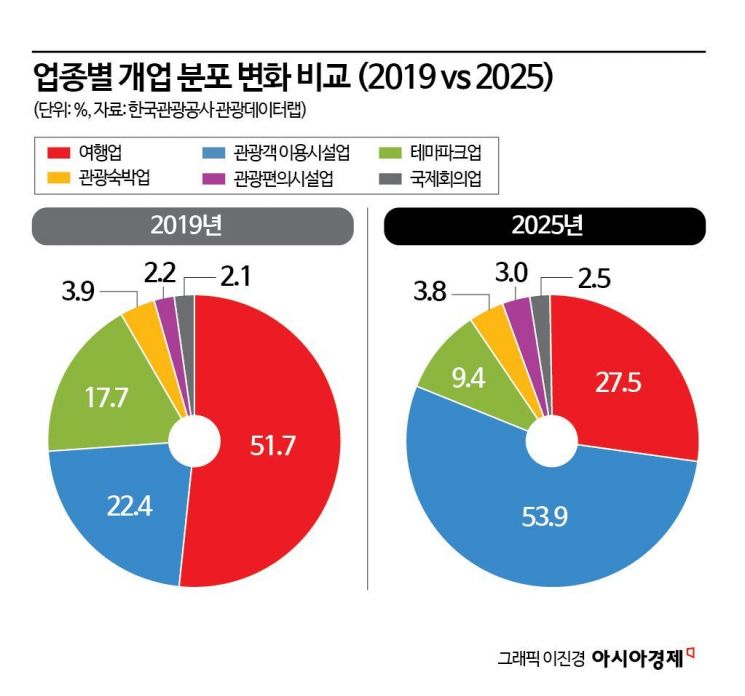 Comparison of new openings by industry (2019 vs 2025). In 2025, 53.9% of tourism businesses that opened were in the tourist facilities sector, a 285% increase compared with 2019. The focus of tourism startups has shifted from travel services to experience-and-use-oriented businesses. Source: Korea Tourism Organization, Tourism Data Lab.
The core of the startup boom lies in the growing perception of tourism not as an "industry" but as a "content business." As more segments emerge in which planning and operational capabilities, rather than large-scale capital, determine success or failure, observers say the market has shifted into one that individuals can enter. Jeong Ji-hye (29), who is preparing to launch an experience-based tour business in Seoul, said, "In the past, it felt difficult unless you were a travel agency, but now I think individuals can consider starting a business as long as they have the right content."
The same shift is evident on the ground. Rihan Culture, an experience-based tourism company that combines hanok lodging with performance content, is an example of designing tourism not as a lodging business but as a content operation business. Rihan Culture CEO Choi Yuri said, "Instead of building a hotel with tens of billions of won as in the past, you can fully enter the market through a combination of leasing, operational strategy, and content," adding, "Tourism should be approached not as an end in itself, but as a channel for expanding content." She added, "What matters more than initial capital is how you structure your team, how you leverage platforms, and what kind of experience you provide."
Rihan Culture is experimenting with an operating and revenue model that differs from traditional lodging businesses by combining unmanned, long-stay-focused operations using platforms such as Airbnb with performance content. It is one of the cases that show how tourism is no longer a large-capital-intensive industry, but a business that can be entered based on content planning and operational capabilities.
Heo Jun, a professor at the College of Culture and Arts Convergence at Dongduk Women's University, assessed, "The recent increase in tourism startups should be seen not as a by-product of economic recovery or a rise in visitor numbers, but as a signal that the supply structure and modes of entry in the tourism industry are being redesigned."
Professor Heo explained, "In the past, the focus was on areas such as lodging and transportation, which required large initial capital outlays and involved heavy licensing burdens, but now that startups can be launched at the level of individual experiences, content, and planning units, the barriers to entry for individuals and small operators have fallen significantly," adding, "Tourism is in the process of being reorganized into a content-based business rather than a single industrial sector."
However, he added, "As entry has become easier, issues such as excessive concentration in specific regions or segments, overlapping content, and quality control have emerged as challenges that must be addressed in parallel."
© The Asia Business Daily(www.asiae.co.kr). All rights reserved.
![Clutching a Stolen Dior Bag, Saying "I Hate Being Poor but Real"... The Grotesque Con of a "Human Knockoff" [Slate]](https://cwcontent.asiae.co.kr/asiaresize/183/2026021902243444107_1771435474.jpg)


















