Establishment of the Revised 6th Gyeonggi-do Regional Forest Plan
in Accordance with the Forest Basic Act and Related Regulations
On February 23, Gyeonggi Province announced that it has newly established a mid- to long-term forest policy strategy that includes fostering future-oriented new forest industries and strengthening data-based responses to forest disasters.
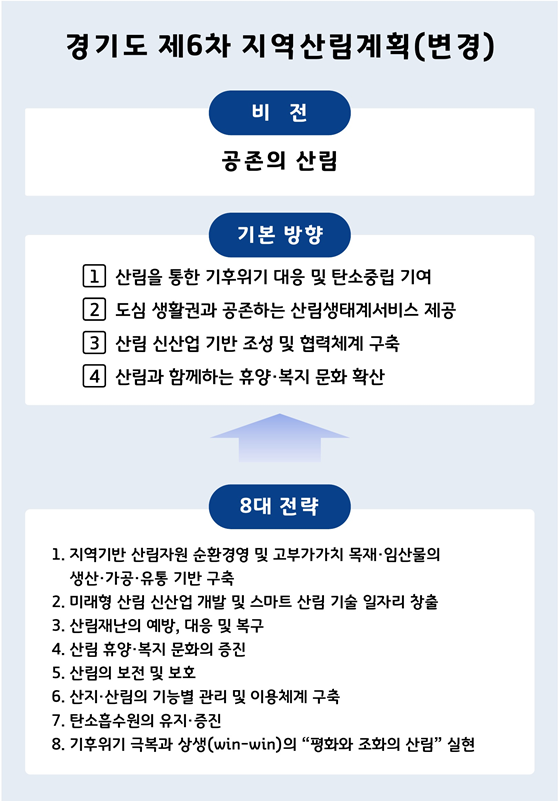 Gyeonggi Province establishes revisions to the 6th Regional Forest Plan. Provided by Gyeonggi Province
Established in accordance with the Forest Basic Act and the Gyeonggi-do Forest Basic Ordinance, the Regional Forest Plan is a statutory plan that presents the overall direction of forest policy and is drawn up on a 20-year basis in connection with the Korea Forest Service's Forest Basic Plan. Following the formulation of the 6th plan in 2018, this revision was pursued to reflect changes in higher-level plans and shifts in the conditions surrounding forest policy.
The revised plan maintains the vision of the existing plan, "Forests of Coexistence," and has been restructured into 8 key strategies and 35 tasks, focusing on four main directions: responding to the climate crisis and contributing to carbon neutrality through forests; providing forest ecosystem services that coexist with urban living areas; establishing a foundation for new forest industries and building cooperative systems; and spreading a culture of recreation and welfare in harmony with forests.
The scope of application of the plan is forests within the administrative boundaries of Gyeonggi Province, excluding national forests under the jurisdiction of the Korea Forest Service. The time frame remains the same as before, spanning 20 years from 2018 to 2037. During the process of formulating the revised plan, expert consultations and the gathering of internal and external opinions were used to secure feasibility and policy coherence.
A key feature of the revised plan is that strategies and tasks have been comprehensively restructured to reflect changing policy demands in six areas: forest management, forest disasters, forest culture, green space management, forest carbon, and international (inter-Korean) cooperation.
The province has maintained and integrated elements of the existing plan while strengthening measures related to forest disasters, forest conservation and protection, and international forest cooperation, including inter-Korean cooperation. It has also introduced new tasks such as fostering future-oriented new forest industries, building a foundation for forest leisure sports and interconnected forest trails, and expanding the recognition of carbon absorption through wood products and forest bioenergy.
In particular, notable elements include advanced forest policies that are linked with climate satellites and the Gyeonggi Climate Platform. As the climate crisis makes it increasingly difficult to predict and respond to forest disasters, and as Gyeonggi Province's spatial characteristics, such as the rapid loss of mountainous areas, become more pronounced, there is a growing need for a more precise policy shift.
In response, the province will actively introduce recently developed digital technologies into the forest sector and implement policies based on scientific decision-making. It will conduct comprehensive analyses of data related to forest disasters such as wildfires, landslides, and forest pests and diseases, identify vulnerable areas in depth, and use this information to build an early response system.
In addition, by conducting integrated analyses of aggregated disaster information and various spatial data such as urban ecological status maps, the province will prioritize areas with high restoration potential, thereby enhancing the efficiency of forest conservation and restoration. At the same time, it will promote the introduction of management models tailored to the functions of mountainous areas and forests for each spatial type by utilizing tools such as ecological connectivity maps and carbon emission and absorption maps. This policy direction will be gradually specified through implementation plans by sector and by year.
Kim Ilgon, head of the Forest and Greenery Division of Gyeonggi Province, said, "This revision of the Regional Forest Plan is a new starting point for sustainable forests shared with residents," adding, "We will continue to identify forest policies that make a tangible contribution to the lives of provincial residents."
© The Asia Business Daily(www.asiae.co.kr). All rights reserved.
![Clutching a Stolen Dior Bag, Saying "I Hate Being Poor but Real"... The Grotesque Con of a "Human Knockoff" [Slate]](https://cwcontent.asiae.co.kr/asiaresize/183/2026021902243444107_1771435474.jpg)















