Integration into Guri Sewage Treatment Facility
Securing Economic Feasibility and Operational Efficiency
Guri City in Gyeonggi Province (Mayor Baek Kyunghyun) announced on the 23rd that it held a briefing session on the 20th in the mayor's office regarding a feasibility study service to improve the efficiency of the Uminae sewage treatment facility, and that it will pursue a plan to shut down the facility and integrate and connect it to the Guri Sewage Treatment Facility.
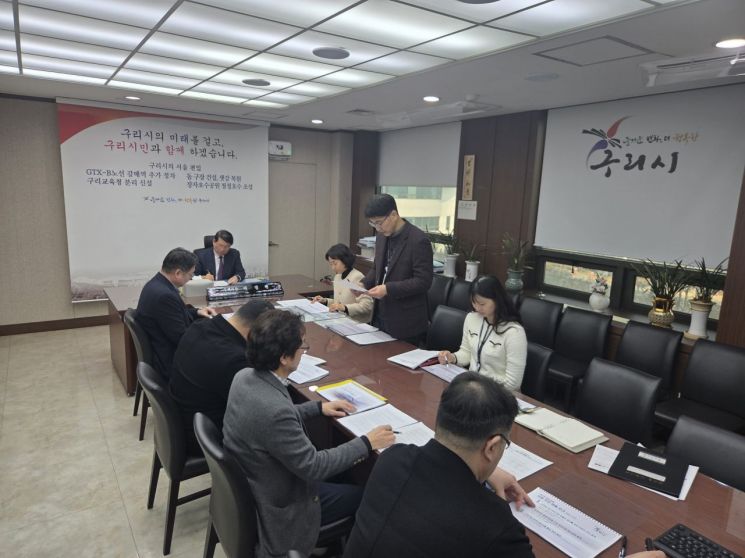 Guri City (Mayor Paek Gyeonghyun) held a report meeting in the mayor’s office on the 20th on a feasibility study to improve the efficiency of the Uminae wastewater treatment facility. Provided by Guri City.
The plan to integrate and connect to the Guri Sewage Treatment Facility was prepared to enhance the operational efficiency of the small-scale Uminae Sewage Treatment Facility and to ensure stable water quality management.
The Uminae Sewage Treatment Facility, which has been in operation since 2005, is an aging facility of more than 20 years. Following a technical diagnosis in 2025, the need for facility improvement was raised as the operational burden increased due to a rise in inflows of high-concentration sewage. In addition, if the facility were to be upgraded, it would require a massive budget as well as ongoing maintenance and management costs.
After comparing and reviewing the options of upgrading the facility and implementing an integrated connection treatment plan, Guri City analyzed that the integrated connection treatment method is more advantageous in terms of economic feasibility and maintenance and management.
According to the economic feasibility analysis, upgrading the existing facility would cost about 2.7 billion won, whereas connecting and treating the sewage at the Guri Sewage Treatment Facility would cost about 1.8 billion won, resulting in an expected cost saving of more than approximately 900 million won.
The integrated connection will be implemented by shutting down the Uminae Sewage Treatment Facility, newly installing approximately 1.5 km of pressure pipeline and a sewage pumping station, and transferring the generated sewage to the Guri Sewage Treatment Facility. The Guri Sewage Treatment Facility has secured sufficient spare treatment capacity, so it has been confirmed that there will be no issues with treatment capacity even after integration.
Through this integration, Guri City expects to alleviate the operational burden of the aging small-scale sewage treatment facility, and to achieve benefits such as stable water quality management, environmental improvement, enhanced maintenance and management efficiency, and budget savings.
Mayor Baek Kyunghyun of Guri City stated, "The integration of the Uminae Sewage Treatment Facility is an important project to alleviate the operational burden of aging small-scale facilities and to establish a more stable and efficient sewage treatment system," adding, "We will actively pursue this project so that we can secure both economic feasibility and maintenance and management efficiency, and provide citizens with a safer and more pleasant living environment."
A Guri City official also said, "We are currently consulting with relevant agencies regarding a minor amendment to the Basic Sewerage Maintenance Plan, and once consultations are completed, we plan to promptly carry out the administrative procedures," adding, "Through future detailed design and construction, we will review and promote the shutdown of the Uminae Sewage Treatment Facility, and integrate and operate it with the Guri Sewage Treatment Facility to further strengthen sewage treatment efficiency."
© The Asia Business Daily(www.asiae.co.kr). All rights reserved.
![Clutching a Stolen Dior Bag, Saying "I Hate Being Poor but Real"... The Grotesque Con of a "Human Knockoff" [Slate]](https://cwcontent.asiae.co.kr/asiaresize/183/2026021902243444107_1771435474.jpg)















