Follow-up Measures to Reciprocal Tariff Ruling Accelerate
Uncertainty Grows for Semiconductors and Automobiles
The U.S. government has abruptly launched investigations under Section 301 of the Trade Act against China and Brazil as a follow-up measure to a ruling that reciprocal tariffs are illegal, heightening tension in Korean industry. Although this move is ostensibly aimed at countries such as China, there is growing concern that the scope of the investigation could be expanded to major trading partners including Korea, further increasing uncertainty for Korea's key export sectors such as semiconductors and automobiles.
According to industry sources on the 23rd, the U.S. government is reviewing Sections 122 and 301 of the Trade Act and Section 232 of the Trade Expansion Act as the most likely alternative tools to fill the trade-policy vacuum created by the ruling against reciprocal tariffs.
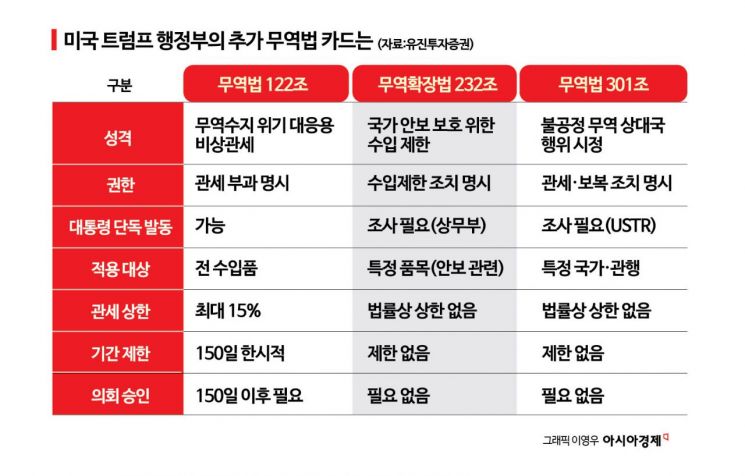
The United States has already designated China and Brazil as priority targets for investigation and has begun practical procedures to apply Section 301 of the Trade Act. This is seen as the United States putting aside the previous reciprocal tariffs, whose legal basis has been weakened, and instead pulling out an "all-out pressure card" that directly targets unfair trade practices of counterpart countries, thereby entering a full-fledged offensive to protect its own industries. Trade experts view this investigation as a preparatory stage to build justification for imposing high tariffs in the future, and analyze it as a strategic move by U.S. authorities to rebuild tariff powers that have been effectively neutralized.
They are concerned that similar measures could be extended to Asian countries including Korea. An official at the Korea International Trade Association said, "Most major trading partners are likely to be included in the USTR's unfair practice investigations based on Section 301, so it does not look easy for Korea to be excluded given the size of our trade," adding, "In particular, investors in Coupang in the United States have petitioned for the launch of a Section 301 investigation, claiming that the Korean government is unfairly discriminating against U.S. companies, so Korea also needs to respond."
However, some point out that it takes a considerable amount of time to move from the launch of an investigation under Section 301 to the actual imposition of tariffs, leaving President Trump with limited room to use the Section 301 card aggressively ahead of the midterm elections in November.
Along with Section 301, Section 232 of the Trade Expansion Act is being cited as an alternative U.S. tool that could have repercussions for Korean industry. Section 232 is a provision that allows the president to impose tariffs or import restrictions (quotas) on imported items that threaten U.S. national security. It enables trade to be restricted on national security grounds.
However, unlike the International Emergency Economic Powers Act (IEEPA), which takes effect immediately, Section 232 is based on an investigation. The investigation period, led by the Department of Commerce, is typically within 270 days. Previously, during the first Trump administration in 2018, the United States imposed tariffs of 25% on steel and 10% on aluminum on major countries under this law.
An official in the electronics industry said, "In the case of semiconductors, the first guideline on tariff measures was issued last month, but the White House has already announced that this is not the final measure and that it is preparing a second-stage measure," adding, "The range of items subject to tariffs is likely to expand, and tariff rates are also likely to rise above the current 25% range, so we need to pay close attention to the content of the second-stage measures."
Kang Sungjin, a professor of economics at Korea University, said, "It does not appear that the tariff pressure cards President Trump is pulling out are specifically aimed at Korea," adding, "From the U.S. perspective, Korea is the country with the seventh-largest trade deficit, but the biggest target will likely be China." He continued, "Since steel and automobiles are already subject to separate item-specific tariffs, and negotiations on semiconductors have not yet been concluded, uncertainty has increased further for Korea's key export industries."
© The Asia Business Daily(www.asiae.co.kr). All rights reserved.
![Clutching a Stolen Dior Bag, Saying "I Hate Being Poor but Real"... The Grotesque Con of a "Human Knockoff" [Slate]](https://cwcontent.asiae.co.kr/asiaresize/183/2026021902243444107_1771435474.jpg)

















