BOK reports to National Assembly’s Strategy and Finance Committee
Domestic demand recovering and exports rising, with consumer prices remaining stable
Exchange rate gains have narrowed, but volatility remains high
Credit risks persist in vulnerab
Bank of Korea Governor Rhee Changyong said on the 23rd that, "Despite uncertainty related to U.S. tariff policy, our economy is expected to post a growth rate significantly higher than last year, as domestic demand is recovering on the back of solid consumer sentiment and exports are continuing to increase thanks to favorable conditions in the semiconductor sector."
After saying this in a work report to the National Assembly Planning and Finance Committee held on the afternoon of the same day, Governor Rhee added, "The consumer price inflation rate is expected to remain on a stable trajectory near the target level, but developments in international oil prices and the exchange rate remain potential risk factors."
The Bank of Korea is scheduled to decide the base rate at the Monetary Policy Board meeting on the 26th and to release its revised economic outlook for this year. In its revised economic outlook published in November last year, the Bank of Korea projected this year's economic growth rate at 1.8%.
The exchange rate is affected by movements in the dollar and yen... Financial imbalances are building up due to rising housing prices in the Seoul metropolitan area
Regarding conditions in the foreign exchange market, Governor Rhee said, "The won-dollar exchange rate climbed to the 1,480-won range after October last year, but the magnitude of the increase narrowed toward year-end thanks to measures to stabilize foreign exchange supply and demand," and added, "However, it is still showing high volatility, being affected by movements in the U.S. dollar and the Japanese yen."
On the capital market, he noted, "Stock prices have risen sharply, supported by favorable conditions in key sectors such as semiconductors, but more recently we are seeing heightened volatility due to concerns over excessive investment in artificial intelligence (AI) and the potential displacement of existing industries." He went on to say, "Yields on government bonds have risen considerably due to changes in expectations regarding domestic and overseas monetary policy, supply-demand pressures stemming from 'money move' phenomena, and external uncertainty."
With respect to financial stability, Governor Rhee assessed, "The domestic financial system as a whole continues to remain stable, but it is necessary to pay attention to the fact that credit risks in vulnerable segments such as the self-employed persist, while concerns are continuing to build over financial imbalances driven by rising housing prices in the Seoul metropolitan area."
Rhee: "We will expand the range of eligible institutions and collateral for standing lending facilities... The base rate will be set based on a comprehensive consideration of inflation, financial stability, and other factors"
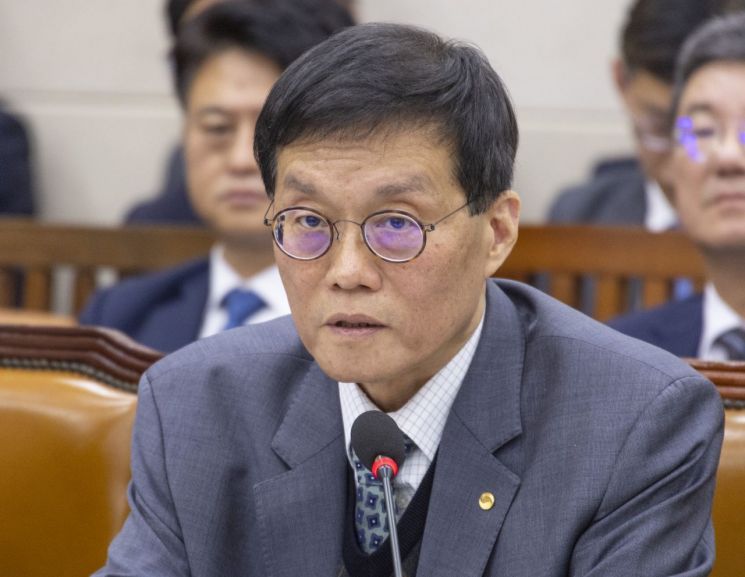
Governor Rhee explained, "To strengthen the financial stability function of our lending facilities, the Bank of Korea introduced in January this year a scheme under the emergency lending framework that allows banks' loan claims to be used as collateral, and going forward we plan to work on improving the system by expanding both the range of institutions eligible for standing lending facilities and the scope of eligible collateral."
To support vulnerable sectors, the Bank of Korea cut the interest rate on its Bank Intermediated Lending Support Facility by 1.0 percentage point in May last year and has maintained that rate through this year, and it has also further extended the maturity of the temporary special support program for small and medium-sized enterprises, which is being operated with a ceiling of 14 trillion won. In addition, to stabilize the foreign exchange market and improve supply and demand conditions, it decided to extend the foreign exchange swap arrangement with the National Pension Service and to temporarily pay interest on foreign currency reserve requirements.
He added, "In response to the accelerating digital transformation of finance and the economy, we are also making multifaceted efforts to build a stable and efficient ecosystem for digital payment instruments, and within the Bank of Korea we are pursuing the establishment of Sovereign AI."
On the future direction of monetary policy, he said, "Taking these economic conditions into comprehensive consideration, we have kept the base rate at around 2.5% since July last year," and added, "As for the conduct of monetary policy going forward, given that internal and external uncertainties remain high, we will determine the policy stance by comprehensively assessing economic activity, inflation, and financial stability conditions."
© The Asia Business Daily(www.asiae.co.kr). All rights reserved.
![Clutching a Stolen Dior Bag, Saying "I Hate Being Poor but Real"... The Grotesque Con of a "Human Knockoff" [Slate]](https://cwcontent.asiae.co.kr/asiaresize/183/2026021902243444107_1771435474.jpg)











