Ministry to revise National Cemetery Act within this year, begin development next year
The government of President Lee Jaemyung will complete Hyochang Park as the National Hyochang Independence Park within his term of office.
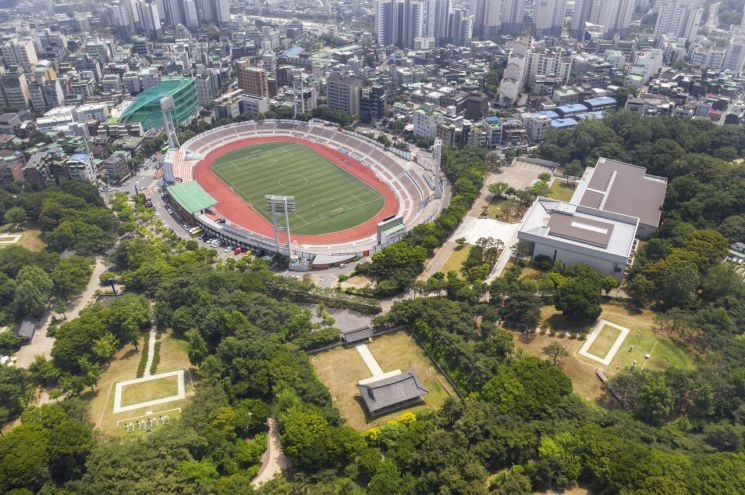
According to the plan reported by the Ministry of Patriots and Veterans Affairs to the National Assembly’s Public Administration and Security Committee on the 23rd, taking the designation of the 150th anniversary of the birth of Baekbeom Kim Gu as a “UNESCO Anniversary” as an opportunity, the ministry will establish a master plan for creating the National Hyochang Independence Park, revise the National Cemetery Act within this year, begin developing the park from next year, and aim to complete it by 2030.
Hyochang Park, which covers about 51,800 pyeong in the Hyochang-dong area of Yongsan-gu, is a historic site that began as a royal burial ground in the Joseon Dynasty and later became a burial site for independence activists after Liberation. Alongside the graves of major independence patriots such as Baekbeom Kim Gu, Lee Bongchang, and Yun Bonggil, the area also houses various facilities including Hyochang International Football Stadium and the Baekbeom Memorial Hall. However, the facilities have become old, and the management bodies are all different, so orderly maintenance has not been carried out.
The ministry plans to revise the National Cemetery Act to upgrade the graves of major independence patriots such as Baekbeom Kim Gu, Lee Bongchang, and Yun Bonggil to national cemeteries and manage them accordingly. It also plans to designate as a national cemetery the cenotaph that will enshrine Ahn Junggeun, thereby clearly expressing its commitment to recovering his remains.
In addition, the ministry intends to restructure the entire park into a space that combines rest and remembrance. It will remove the walls around the graves, greatly expand landscaping and exhibition areas, and rebuild the entrances and visitor routes so that visitors can naturally pay their respects at the graves. As for Hyochang Stadium, whose future use has been the subject of debate, the plan is to demolish the stands and lighting towers and convert it into an open, multi-purpose sports facility.
However, consultation with related institutions such as the Seoul Metropolitan Government remains a task for the future. Although there had been several discussions about turning Hyochang Park into a national park since the 2000s, the nationalization project for Hyochang Park had fallen through due to residents’ concerns about development restrictions. The project regained momentum last month when President Lee Jaemyung ordered it during a cabinet meeting. At the time, President Lee said, “I sometimes visit there, and it feels too gloomy,” adding, “The political situation may have some influence, but please make sure that it does not prevent us from turning it into a national park.”
In addition, the Ministry of Patriots and Veterans Affairs reported to the National Assembly a plan to create a “patriots belt” of seven nearby historic independence sites centered on the Provisional Government of the Republic of Korea building in Shanghai, including the Yun Bonggil Memorial Hall, the residences of key provisional government figures (Yeonggyeongbang), and the International Cemetery, as well as a plan for a public verification process of candidates for the board of directors of the Independence Hall of Korea.
© The Asia Business Daily(www.asiae.co.kr). All rights reserved.
![Clutching a Stolen Dior Bag, Saying "I Hate Being Poor but Real"... The Grotesque Con of a "Human Knockoff" [Slate]](https://cwcontent.asiae.co.kr/asiaresize/183/2026021902243444107_1771435474.jpg)















