Trump Administration Shifts to Section 122 After IEEPA Invalidated
Government Reviews Export Impact and Discusses Countermeasures
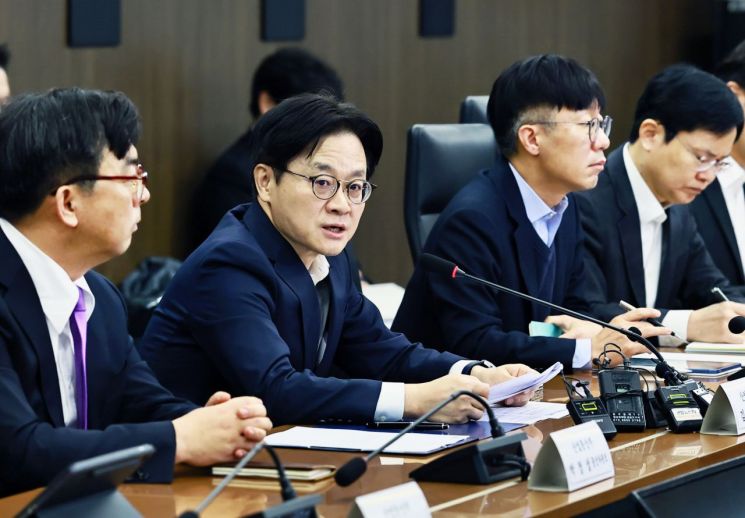 Kim Jeonggwan, Minister of Trade, Industry and Energy, is delivering opening remarks at the "Public-Private Joint Countermeasure Meeting on the U.S. International Emergency Economic Powers Act (IEEPA) ruling and additional tariff measures" held on the morning of the 23rd at the main conference hall of the Korea Chamber of Commerce and Industry in Jung-gu, Seoul. Ministry of Trade, Industry and Energy.
Kim Jungkwan, Minister of Trade, Industry and Energy, stated in connection with the U.S. Supreme Court ruling that tariffs imposed under the International Emergency Economic Powers Act (IEEPA) were unlawful, "Under the principle of maximizing the national interest, we will continue friendly consultations with the United States so that the balance of interests secured through the Korea-U.S. tariff agreement and the conditions for exports to the U.S. are not undermined."
Minister Kim made these remarks at the "Public-Private Joint Countermeasure Meeting on the U.S. IEEPA Ruling and Additional Tariff Measures" held at the Korea Chamber of Commerce and Industry in Seoul on the morning of the 23rd, adding, "In preparation for possible changes in export conditions, we will tenaciously push ahead with policies to strengthen the competitiveness of our companies and diversify export markets."
This meeting was convened to assess the impact on Korean industry and exports and to discuss response directions after the Trump administration in the United States announced alternative means of imposing tariffs and follow-up measures immediately after the Supreme Court ruling. Business organizations, major industry-specific associations, related institutions, and relevant ministries attended.
Earlier, on the 20th (local time), the U.S. Supreme Court ruled that it is difficult to view the IEEPA as directly granting the president broad authority to impose tariffs, and therefore found that the reciprocal tariff measures implemented on that basis lacked sufficient legal grounds. As a result, existing tariffs based on the IEEPA have lost their effect, but the U.S. administration immediately signaled measures using other legal instruments, leading to a spread of trade uncertainty.
In particular, as the Trump administration announced its intention to impose a uniform global 15% tariff using Section 122 of the Trade Act and to initiate investigations under Section 301, questions have been raised about the possibility that tariff policy could be reorganized under a new legal framework. In addition, tariffs on items such as steel and automobiles imposed under Section 232 of the Trade Expansion Act remain in place, leaving Korea's key export industries simultaneously exposed to multiple institutional variables.
Representatives from the business community and industry-specific associations are concerned that changes in U.S. tariff policy after the IEEPA ruling could translate into new burdens for Korean companies. Section 122 of the Trade Act is a provision that allows the president to impose tariffs on a temporary basis for up to 150 days in response to imbalances in the balance of payments and similar situations. Accordingly, although reciprocal tariffs based on the IEEPA have become invalid, there are concerns that as the legal basis shifts to the Section 122 framework, the detailed operational rules, including the application period, the scope of recognized exemptions, and refund procedures, could be newly defined.
Section 301 is a provision that allows the United States to take retaliatory measures, such as tariffs, after conducting an investigation if it determines that the other country engages in unfair trade practices, and it served as the basis for large-scale high tariffs during the 2018 U.S.-China trade dispute. While Section 122 is a comprehensive and temporary measure, Section 301 differs in nature in that it is a targeted measure aimed at specific countries or items. Korea has already been subject to tariffs at around the 15% level under the Korea-U.S. tariff agreement, but analysts note that if the legal framework for tariff imposition changes, the burden on companies could vary depending on how the system is operated and on the future scope of investigation targets.
For now, the Korean government takes the position that maintaining the basic framework of the Korea-U.S. tariff agreement is of paramount importance. Minister Kim said, "We will mobilize all diplomatic and trade channels to ensure that the hard-won balance of interests between Korea and the United States is not shaken," adding, "We will closely consult with the U.S. side to ensure that any additional measures minimize the impact on our industries." The government plans to closely monitor developments in the U.S. Congress and administration through its diplomatic mission in the United States and trade channels, and to continuously convey Korea's position.
At the same time, the government announced that it will pursue medium- to long-term structural improvements alongside short-term responses. To ease the high dependence on exports to the U.S., it plans to step up efforts to develop emerging markets and to make greater use of the free trade agreement (FTA) network, while accelerating the shift from a price-competitiveness-centered structure to a technology- and quality-centered structure by diversifying supply chains and moving into higher value-added products. The government also decided to strengthen support for companies on practical issues such as tariff refunds, customs clearance procedures, and rules of origin management in cooperation with relevant agencies. Minister Kim said, "Regarding uncertainties such as tariff refunds, we will work with related institutions and industry associations and organizations to provide sufficient information so that companies can respond in a timely manner."
Going forward, the government plans to develop step-by-step response strategies based on a comprehensive analysis of the specific content and implementation schedule of the U.S. follow-up measures, as well as the responses of other major trading partners. If necessary, it will hold industry-specific meetings and additional public-private consultations from time to time to identify on-the-ground difficulties and reflect them in policy.
© The Asia Business Daily(www.asiae.co.kr). All rights reserved.
![Clutching a Stolen Dior Bag, Saying "I Hate Being Poor but Real"... The Grotesque Con of a "Human Knockoff" [Slate]](https://cwcontent.asiae.co.kr/asiaresize/183/2026021902243444107_1771435474.jpg)











