Equipped with automatic determination of administrative procedures
and step-by-step implementation guidance
Directly developed by a curator
based on practical experience and legal expertise
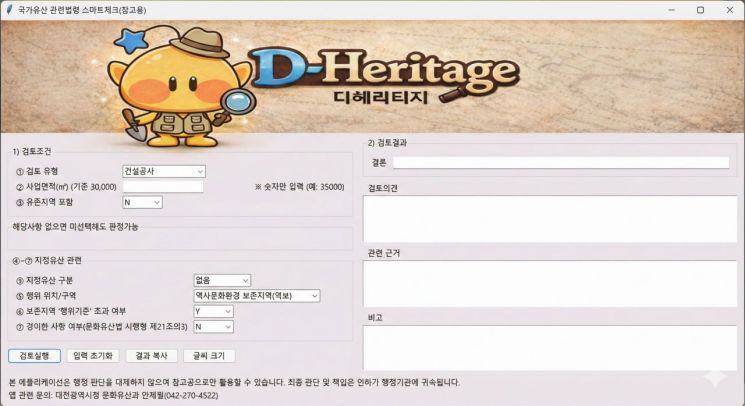
Daejeon City has developed an artificial intelligence (AI) guide application called "D-Heritage," which automatically determines applicable laws and administrative procedures related to buried heritage and provides step-by-step guidance on required actions.
This application was directly developed by a working-level curator, who applied generative AI based on practical experience and legal expertise. The current beta version has been distributed to Daejeon City and its five autonomous districts, where it is being used to support the work of cultural heritage officials.
Buried heritage refers to cultural heritage buried underground. It includes not only artifacts such as earthenware, but also traces of past human activity such as old building sites, tombs, and drainage channels.
However, because it is not visible, buried heritage is often discovered belatedly during construction or large-scale development projects, leading to frequent cases where work is halted or projects are delayed due to excavation surveys and related procedures.
To address this, the Act on the Protection and Investigation of Buried Cultural Heritage requires prior reviews, such as national heritage impact assessments, and investigations by specialized institutions starting from the development planning stage.
In reality, however, determining whether the law applies and carrying out the required procedures is complex, so not only ordinary citizens but also working-level public officials have faced considerable difficulties in applying the law and handling administrative processes.
The buried heritage administrative guide AI app "D-Heritage" was developed to help solve these problems. When users enter key information such as project stage, project area, and the status of surrounding cultural heritage, the application automatically determines the administrative procedures required for the project based on relevant laws and regulations, including the National Heritage Impact Assessment Act, and provides guidance on the steps to be taken at each stage.
Ahn Jaepil, a curator at Daejeon City, said, "National heritage officers in the autonomous districts frequently change positions, so they have difficulty learning the complex network of related laws, and the unique characteristics of cultural heritage are also not easy to understand," adding, "We developed the app to reduce the burden on front-line administration and to support more accurate decision-making."
In practice, work related to buried heritage is often directly connected to the exercise of property rights, leading frequently to administrative litigation, and has therefore been regarded as an area of work that public officials tend to avoid.
In addition, in regulatory administration related to cultural heritage, even in identical cases, differences in the experience level of the person in charge can create discrepancies in decisions, procedures, and cost burdens. According to Ahn, standardized guidance based on AI can enhance the objectivity and reliability of administration.
An official from Daejeon City explained, "The development of D-Heritage is significant not only because it improves work efficiency for front-line public officials, but also because it allows us to provide citizens with more predictable and consistent administrative services."
The app is currently being piloted by the city and its autonomous districts, and its functions will be continuously improved and supplemented by incorporating on-site feedback and potential error cases collected during actual use.
Furthermore, beyond the field of buried heritage, the city plans to gradually expand its application scope to various national heritage administrative areas, such as the designation and recognition of intangible heritage and permits for changes to the current state of designated cultural heritage, and to sequentially review the development of lightweight, specialized AI models.
© The Asia Business Daily(www.asiae.co.kr). All rights reserved.
![Clutching a Stolen Dior Bag, Saying "I Hate Being Poor but Real"... The Grotesque Con of a "Human Knockoff" [Slate]](https://cwcontent.asiae.co.kr/asiaresize/183/2026021902243444107_1771435474.jpg)
















