Trump Announces Flat 15% Tariff on All Countries
UK Exporters Expected to Face 5 Trillion Won in Added Costs
"China, India and Others Stand to Benefit Instead"
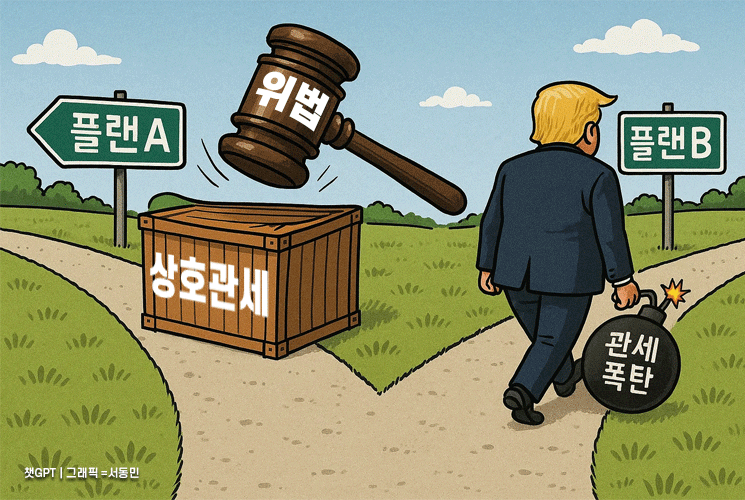
The United States’ reversal on tariffs has put its long-standing ally, the United Kingdom, at risk of becoming the biggest victim. After President Donald Trump of the United States agreed with the UK on a 10% reciprocal tariff, London was seen as having secured a more advantageous position than other countries. However, the likelihood that this agreement will be nullified has risen sharply after the U.S. Supreme Court ruled that the administration’s tariff deal was unlawful. Following the ruling, President Trump announced that he would impose a flat 15% tariff on all countries, which will in fact raise the applicable tariff rate.
Major foreign media outlets such as Bloomberg reported on the 22nd (local time), citing analysis from the trade-monitoring body Global Trade Alert, that the country facing the largest increase in tariff burdens under the new measure is the United Kingdom. Italy and Singapore are also expected to see their burdens rise. In contrast, China, Brazil, and India, which had previously been subject to high tariffs, are now expected to see their burdens decrease compared with before.
Sam Lowe, a trade expert at Flint Global, said, “It is unclear whether the existing agreement on 10% tariffs will remain in place,” adding, “Until the United States issues clear guidelines, British companies will in effect have no other choice but to treat a 15% tariff as a given.”
The British Chambers of Commerce (BCC) projected that, if this tariff hike becomes a reality, the cost of exports to the United States will increase by up to 3 billion pounds (about 5.85 trillion won). The number of British companies that would be directly hit is estimated at around 40,000. However, the previously agreed tariff exemptions between the United Kingdom and the United States in the sectors of steel, pharmaceuticals, and automobiles are expected to remain in place, meaning that the UK’s key industries have avoided the worst-case scenario.
Bridget Phillipson, the UK cabinet minister, said in an interview with the Sunday News, “We are engaging in close consultations through the highest-level channels to ensure that our national interests are fully conveyed to the U.S. side,” adding, “We are doing everything we can to resolve the extreme uncertainty facing British businesses.”
President Trump is pushing ahead with the 15% tariff on the basis of Section 122 of the Trade Act. Under Section 122 of the Trade Act, the measure can be applied for a maximum of 150 days unless extended by the U.S. Congress.
Crawford Falconer, former chief trade negotiator for the United Kingdom, pointed out, “Companies exporting other products such as Scotch whisky or toys are now facing high tariff rates comparable to those previously experienced by the European Union (EU),” adding, “In effect, the United Kingdom and Australia are the biggest victims of this measure.”
Meanwhile, with the U.S. tariff policy being readjusted following the ruling that reciprocal tariffs are unlawful, some analysts say that the competitiveness of Korean products in the U.S. market could be strengthened, given that Korea has a free trade agreement (FTA) with the United States. In a reference report released the previous day, the Korea International Trade Association stated, “Under the United States’ new tariff structure, there is room for Korea to regain part of its price competitiveness advantage equivalent to the most-favored-nation (MFN) tariff exemption effect stemming from the Korea-U.S. FTA,” adding, “Since MFN applied rates are exempted only for products that meet the Korea-U.S. FTA rules of origin, thorough management of preferential origin is crucial.”
© The Asia Business Daily(www.asiae.co.kr). All rights reserved.
![Clutching a Stolen Dior Bag, Saying "I Hate Being Poor but Real"... The Grotesque Con of a "Human Knockoff" [Slate]](https://cwcontent.asiae.co.kr/asiaresize/183/2026021902243444107_1771435474.jpg)











