Hosting the Defense Startup Challenge
Providing preferential benefits in win-win growth evaluations for participating companies
Supplying data through Defense AX Hubs
Linking major projects to commercialization support
As weapons incorporating advanced technologies such as artificial intelligence (AI) have recently emerged as the core of the defense industry, the government has rolled up its sleeves to foster innovative defense startups. Its goal is to nurture 100 innovative defense startups and 30 defense venture companies with annual sales of 100 billion won by 2030. To this end, the government plans to strengthen support for data and infrastructure, which are cited as key entry barriers for startups seeking to enter the defense sector, and to focus on supporting research and development.
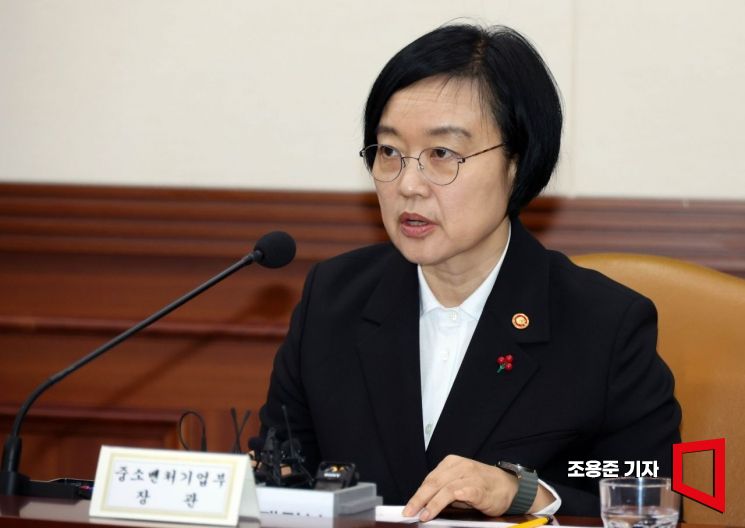 Han Seongsuk, Minister of SMEs and Startups, is speaking about win-win growth strategies for large corporations and small and medium-sized enterprises while attending the Economic Ministers' Meeting held at the Government Complex Seoul in Jongno-gu, Seoul on the 21st of last month. Photo by Jo Yongjun
On the 23rd, the Ministry of SMEs and Startups announced a "Defense Startup Fostering Plan" built around these measures and stated that it had signed a business agreement involving six related organizations, including the Ministry of SMEs and Startups and the Defense Acquisition Program Administration. This plan was prepared in response to the growing need to foster innovative defense startups as weapons incorporating cutting-edge technologies have been reshaping modern warfare.
Making it easier for startups to enter the defense sector
First, the Ministry of SMEs and Startups and other relevant ministries will hold a "Defense Startup Challenge" to promote the entry of startups into the defense sector. Participating companies will receive preferential treatment in win-win growth evaluations, and products developed through the challenge will be linked to military demonstration tests so that feedback from the armed forces can be reflected.
In addition, through the "Defense AX Hubs," the government will provide military requirements and data to support AI Transformation (AX) projects and will connect major projects to commercialization support. The "K-Startup Integrated Portal," the largest startup platform in Korea, will integrate and provide information on the use of defense infrastructure and defense technology planning documents, thereby strengthening support for security infrastructure, which is a major entry barrier in the defense industry.
A "startup-centered university" dedicated to revitalizing entrepreneurship in the defense sector will also be newly established. Through collaboration between the Youth Startup Academy and specialized defense schools, the government plans to offer linked education programs that combine defense and startup training.
Support from R&D through to growth
The government will also focus on supporting research and development for defense startups. From the initial development stage, it will provide package support that covers technology verification, R&D, and mass production through collaboration with the military and system integrators. In addition, one of the Centers for Creative Economy and Innovation will be designated as the "K-Defense Startup Hub" (tentative name), which will serve as an offline base for defense and startup support.
The "Next Unicorn Project Fund" will be strengthened to attract investment for defense startups, and the "GVC30 Project," which supports companies matched to the needs of global defense firms, will also be operated. The government will newly designate clusters linked to regional specialized industries and the shipbuilding industry to expand "Defense Innovation Clusters" nationwide, and this year it plans to promote a cluster in the naval vessel MRO (maintenance, repair, and overhaul) field to strengthen cooperation between Korea and the United States in shipbuilding, as well as in advanced areas such as semiconductors and AI.
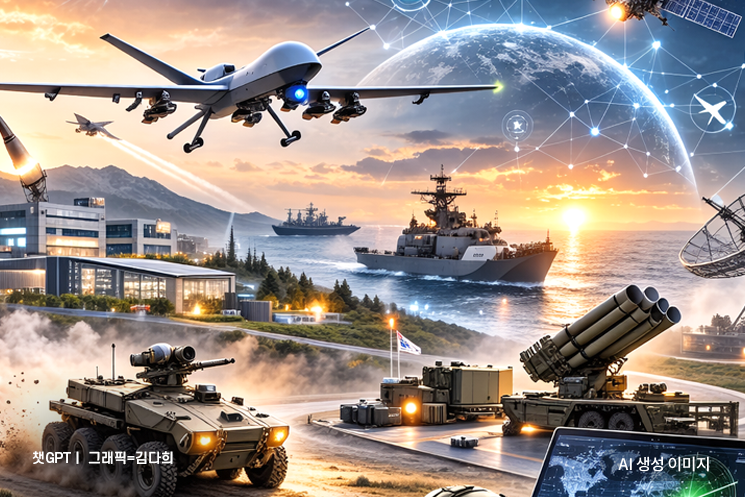
Promoting win-win cooperation in the defense sector
The government also intends to promote a culture of win-win cooperation between large, medium-sized, and small defense companies. It will conduct win-win cooperation level assessments and surveys on subcontracting practices in the defense sector. For the subcontracting survey, it plans this year to examine the defense-related performance of 15 defense system integrators, and to grant incentives related to cost calculation and offset trade for exports to outstanding companies.
In addition, the government will improve defense acquisition-related systems so that small and medium-sized enterprises and startups participating in the defense sector can take part in defense projects on an equal footing with large corporations. It will also build an integrated database (DB) of domestically produced parts and improve the system so that these parts can be given priority for application in weapon systems.
Minister of SMEs and Startups Han Seongsuk said, "Now is a critical time to lay the foundation for the growth of defense unicorns that can lead military requirements and compete on the global stage," adding, "We will actively push for a leap toward a strong defense ecosystem in which new industries and startups can thrive, moving beyond a defense ecosystem centered on manufacturing and large corporations."
Defense Acquisition Program Administration Commissioner Lee Yongcheol said, "By adding the government's policy-level priming water to the innovative ideas of defense startups, we will make active efforts so that our K-Defense can achieve even greater results."
© The Asia Business Daily(www.asiae.co.kr). All rights reserved.
![Clutching a Stolen Dior Bag, Saying "I Hate Being Poor but Real"... The Grotesque Con of a "Human Knockoff" [Slate]](https://cwcontent.asiae.co.kr/asiaresize/183/2026021902243444107_1771435474.jpg)












