On Monday the 23rd, most parts of the country are expected to come under the influence of yellow dust.
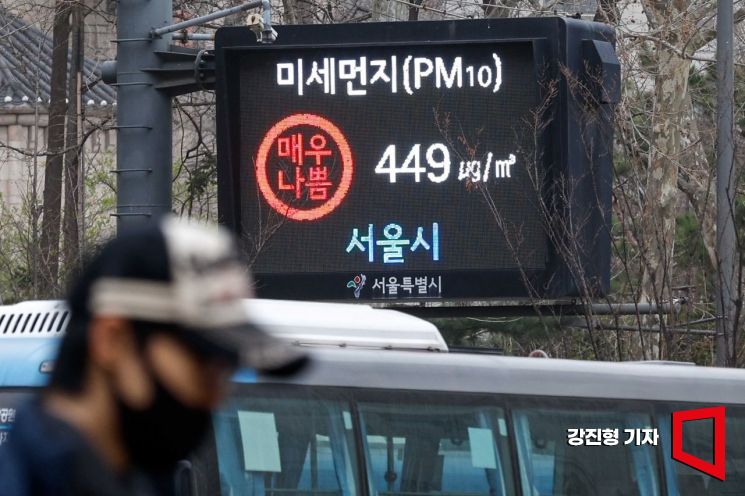 On the 29th, yellow dust originating in Inner Mongolia, China was carried by northwesterly winds to South Korea, prompting fine dust warnings for most of the central region. A digital display board installed on Sejong-daero in Jung-gu, Seoul showed the fine dust concentrations. Photo by Kang Jinhyeong
According to the Korea Meteorological Administration on the 22nd, yellow dust that originated the previous day near the Gobi Desert and the Inner Mongolia Plateau is being carried in by northwesterly winds and is forecast to affect most regions nationwide the following day. Fine dust concentrations are expected to be high, and extra caution is advised for health management.
At the same time, strong winds are forecast for most areas nationwide, and the dry atmospheric conditions are expected to increase the risk of wildfires and other fires. In North Chungcheong Province, Busan, and Ulsan, very strong winds of around 70 km/h (around 110 km/h in mountainous areas) are expected to blow through the morning.
The weather will be mostly clear across the country, but temperatures are expected to fall sharply by about 5 to 10 degrees compared with the previous day. With strong winds added, the perceived temperature is expected to be even lower.
Morning lows are forecast to range from -7 to 3 degrees, and daytime highs from 3 to 13 degrees. By region, the morning low is expected to be -2 degrees in Seoul, Daejeon, and Jeonju; -6 degrees in Chuncheon; -1 degree in Gwangju and Daegu; 3 degrees in Busan; and 4 degrees in Jeju.
As temperatures rise during the day, ice on rivers, lakes, and reservoirs may melt and thin, so attention is needed to prevent safety accidents. In addition, as frozen ground thaws due to the temperature increase, the ground may weaken, raising the risk of ground subsidence on roads or at construction sites, and the risk of earth and sand outflow, landslides, or falling rocks in mountainous areas and cut slopes.
© The Asia Business Daily(www.asiae.co.kr). All rights reserved.
![Clutching a Stolen Dior Bag, Saying "I Hate Being Poor but Real"... The Grotesque Con of a "Human Knockoff" [Slate]](https://cwcontent.asiae.co.kr/asiaresize/183/2026021902243444107_1771435474.jpg)















