Determined to Maintain Tariff Policy Despite Supreme Court Ruling
The United States is expected to raise the newly announced "global tariff" that it plans to impose worldwide from 10% to 15%, following the U.S. Supreme Court ruling that cross tariffs are illegal.
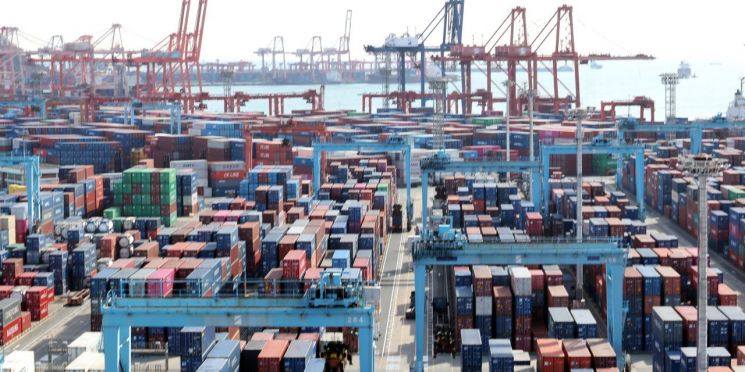 On the 28th of last month, containers were piled up at Singamman Pier and Gamman Pier at Busan Port. Yonhap News
On the 21st (local time), U.S. President Donald Trump said on the social media platform Truth Social, "As a measure that takes effect immediately, I will raise the 10% Worldwide Tariff to 15%, which is the maximum allowed and has been legally validated," adding that many countries around the world have "been 'ripping off' the United States for decades without any retaliation (until I came along!)."
This announcement is seen as signaling his intention to maintain his tariff policy despite the Supreme Court's intervention.
President Trump explained that he made this decision "based on a thorough, detailed, and complete review of yesterday's Supreme Court tariff decision, which was absurd, poorly written, and extremely anti-American."
He went on to say, "In the coming months, the Trump administration will determine and announce new, legally permissible tariffs," adding, "This will allow us to continue our amazingly successful process of 'Making America Great Again.'"
Earlier, the U.S. Supreme Court had ruled the previous day that President Trump's cross-tariff measures imposed on countries around the world, based on the International Emergency Economic Powers Act (IEEPA), were illegal.
In response, President Trump signed an executive order imposing a "10% global tariff" on the world under Section 122 of the Trade Act, saying he would maintain his tariff policy by using alternative tools. Section 122 of the Trade Act authorizes the president to impose tariffs of up to 15% for up to 150 days to address balance-of-payments problems. If approved by Congress, the measures can continue beyond the 150 days.
In addition, Section 232 of the Trade Expansion Act and Section 301 of the Trade Act are also expected to be used. Section 232 of the Trade Expansion Act grants the president tariff authority if, after an investigation by the relevant departments, imports of certain items are deemed to threaten national security. Section 301 of the Trade Act allows the president to take retaliatory measures such as tariffs against trading partners that engage in unfair and discriminatory trade practices against the United States, after a period of notification and public comment.
© The Asia Business Daily(www.asiae.co.kr). All rights reserved.
![Clutching a Stolen Dior Bag, Saying "I Hate Being Poor but Real"... The Grotesque Con of a "Human Knockoff" [Slate]](https://cwcontent.asiae.co.kr/asiaresize/183/2026021902243444107_1771435474.jpg)















