A plant once regarded as a weed has been transformed into a "raw material factory" that produces ingredients for hormone drugs. The star is Solanum nigrum, an annual herb in the Solanaceae family. Commonly found along roadsides and in vacant lots, this plant was named "Kkamajung" in Korean because its black berries resemble a crow's eyes. Its transformation into a raw material factory was made possible by redesigning the plant's metabolic pathways through gene-editing technology.
KAIST announced on the 22nd that a research team led by Professor Kim Sangkyu in the Department of Biological Sciences at KAIST and a research team led by Professor Park Sunju at Gyeongsang National University have successfully produced diosgenin, an essential raw material for corticosteroids (anti-inflammatory and immune-modulating therapeutics) and sex hormones (oral contraceptives and hormone therapies), by controlling the genes of Solanum nigrum.
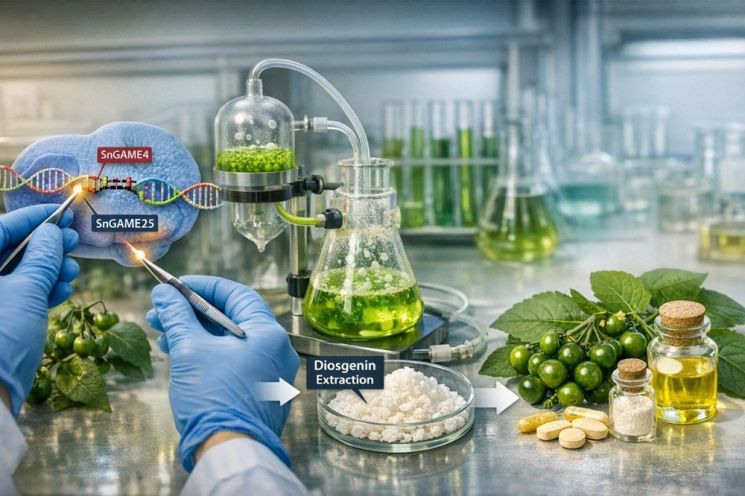
Diosgenin is a key starting material in modern pharmacology. It is used as a synthetic precursor for steroid hormone drugs such as anti-inflammatory agents and antipruritic agents. This substance has mainly been extracted from the roots of yam (Dioscorea). However, yams take several years to harvest and are difficult to genetically modify, which has limited efforts to increase production volume.
The joint research team focused on the characteristics of Solanum nigrum to overcome these limitations. They devised an approach that takes advantage of three features: its short generation time of around three months, its amenability to genetic manipulation, and the fact that solasodine, a toxic steroid compound produced by Solanum nigrum, is structurally very similar to diosgenin.
First, using CRISPR-Cas9 gene-editing technology, the team edited a specific Solanum nigrum gene called SnGAME4. By doing so, they blocked the metabolic pathway leading to toxic components and redirected the metabolic flux so that diosgenin could be produced instead.
They then further suppressed another Solanum nigrum gene, SnGAME25, which regulates reactions in leaf tissues, thereby maximizing diosgenin accumulation in both the fruits and leaves.
In particular, they integrated a "natural fermentation" process that uses SaF26G, a beta-glucosidase enzyme inherently present in Solanum nigrum, to convert compounds into a form that is easier to extract. According to the joint research team, this enabled them to obtain diosgenin from the green fruits of Solanum nigrum at levels comparable to those in yam, the conventional industrial source plant.
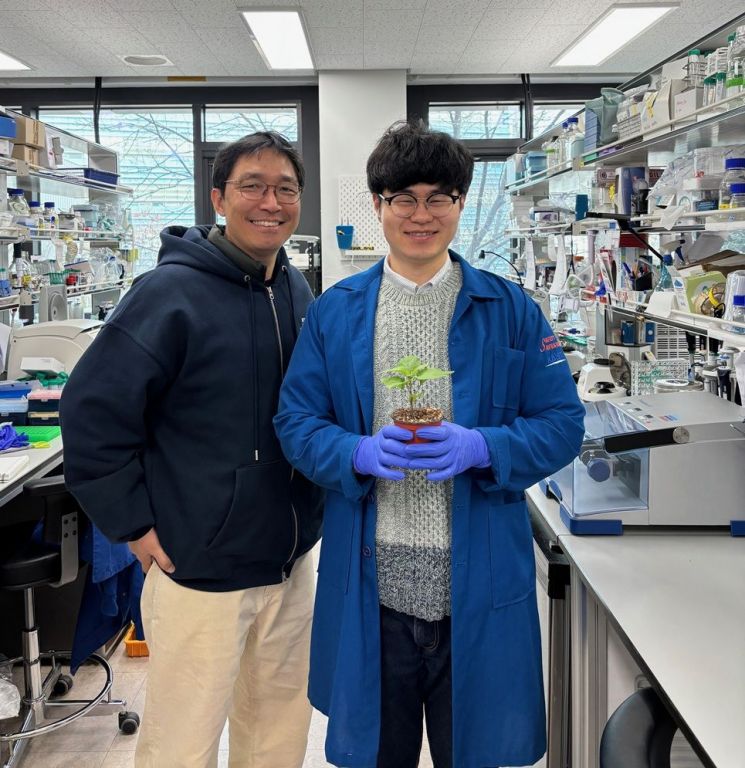
In addition, the study is noteworthy for applying a "fruit yield enhancement technology (S gene mutation)" developed by the Gyeongsang National University team, which dramatically increased the fruit yield per plant. Through this, the joint research team established an industrial foundation that allows more pharmaceutical raw materials to be produced from the same cultivation area.
The S gene mutation involves a gene that regulates the formation of inflorescences; by controlling its expression level, it increases the fruit yield per individual plant.
Professor Kim said, "This study is a case where we precisely redesigned the unique metabolic pathways of a weed to enable the production of high value-added medicinal compounds," adding, "Based on this research, the joint team expects to contribute to securing raw materials for steroid pharmaceuticals in a more stable and environmentally friendly manner going forward."
Meanwhile, this research was jointly led by Dr. Im Jongbu at KAIST and Dr. Kim Geunhwa and Dr. Heo Jeong at Gyeongsang National University as co-first authors. The research findings (paper) were recently published online in Plant Biotechnology Journal, an international academic journal in the field of plant science.
© The Asia Business Daily(www.asiae.co.kr). All rights reserved.


















