Deployment Extended Twice, Far Exceeding the Usual Six-Month Period
Some Consider Leaving the Navy...Maintenance Problems and Morale Decline Raise Concerns
Following President Donald Trump's decision to deploy an aircraft carrier to the Middle East, it has been reported that crew members and their families are struggling with the difficulties of a long-term deployment.
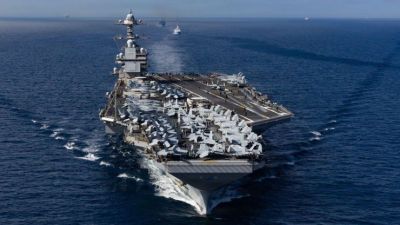
Citing a report by the Wall Street Journal (WSJ) on the 21st (local time), Yonhap News reported that the prolonged deployment of the USS Gerald R. Ford aircraft carrier is heightening fatigue and discontent among its roughly 5,000 crew members.
According to the report, carrier deployment periods are typically six months, but the Gerald R. Ford has already exceeded eight months. It departed in June last year for a cruise mission in Europe, was then assigned to operations in the Caribbean in October of the same year, and earlier this year received orders to move to the Middle East for operations against Iran. As a result, its return is expected at the earliest in late April or early May, and the total deployment period is projected to reach 11 months. This is being regarded as one of the longest continuous deployments on record.
Jamie Prosser, who lives in Pennsylvania, told the WSJ in an interview that, due to the Gerald R. Ford’s return schedule being extended twice, her son on active duty was unable to attend his great-grandfather’s funeral.
One crew member said, "Not being able to see my family is hard, but the most painful part is not knowing when I will be able to see them again." Another crew member is reportedly considering leaving the Navy after being separated from his young daughter for nearly a year.
The psychological burden on waiting families is also heavy. Charlene Poston, who has been waiting for her son’s return, said she burst into tears upon hearing last month’s news of another extension, adding, "I am desperately hoping for my son to come home."
The U.S. Navy acknowledged the difficulties caused by the extended deployment in a statement, saying it is making support for service members and their families its top priority. In a letter to families, the Gerald R. Ford’s commanding officer, David Skarosi, said he had not anticipated the second extension, but stressed, "When our country calls, we answer."
There are also issues such as maintenance problems inside the ship. Former Rear Admiral Mark Montgomery pointed out, "Once you are at sea for more than eight months, equipment failures start to occur, and if maintenance falls behind, it creates a chain reaction that affects the training cycles of other ships." A Navy official said that, due to problems with the Gerald R. Ford’s toilet drainage system, an average of one maintenance request per day is being filed.
Concerns have also been raised that the excessive operational burden could expand into a broader problem across the Navy. In fact, an incident last spring in which the USS Harry S. Truman carrier strike group, operating in the Red Sea, lost several fighter jets was also cited as having high operational intensity as one of its causes.
© The Asia Business Daily(www.asiae.co.kr). All rights reserved.
![Clutching a Stolen Dior Bag, Saying "I Hate Being Poor but Real"... The Grotesque Con of a "Human Knockoff" [Slate]](https://cwcontent.asiae.co.kr/asiaresize/183/2026021902243444107_1771435474.jpg)
















