Governor Kim Jintae: "We Will Make Gangwon a Happier Place for Companion Animals"
24 Animal Protection Centers for Abandoned Animals to Be Established by 2032
Now a "Pet-Friendly" Mecca... Full-Scale Launch of Animal Welfare
Building an Integrated Animal Welfare Model Linking Medical Care, Industry, and Tourism
On February 20, Gangwon Special Self-Governing Province (Governor Kim Jintae) announced the "Gangwon-style Animal Welfare Policy" at the provincial Companion Animal Support Center located in Gangneung, and stated that it will begin full-scale implementation of four major strategies encompassing welfare, medical care, industry, and tourism.
 Kim Jintae, Governor of Gangwon Province, is announcing animal welfare policies at the Gangneung Companion Animal Support Center on the 20th. Photo by Gangwon Province
This policy was prepared to strengthen the public sector's role in response to social changes in which raising companion animals has become part of everyday life. Currently, there are 5.91 million households with companion animals nationwide, accounting for more than 25% of all households, and the number of companion animals (dogs and cats) is estimated at around 8 million.
Governor Kim Jintae, as well as representatives from the Gangwon Economic Promotion Agency, the Gangwon Tourism Organization, the provincial veterinary association, the dean of the College of Veterinary Medicine at Kangwon National University, an instructor from a military dog training center, residents of Gangneung, and the head of the Gangneung Animal Protection Center, among others, attended the event. Participants shared the policy direction and discussed a wide range of opinions, including the need to expand the space of the Companion Animal Support Center and ways to strengthen education and management support for both guardians and abandoned dogs after adoption.
Governor Kim stated, "We intend to pursue animal welfare more systematically by making it a single policy agenda," adding, "To this end, cooperation among institutions and experts is absolutely essential."
He continued, "We must also steadily improve areas that require supplementation, such as changing the name of this Companion Animal Support Center or expanding outdoor spaces," and added, "Since the province has already achieved zero euthanasia except in unavoidable cases such as disease, we plan to improve the quality of policies so that animals can be protected in an even more pleasant environment going forward."
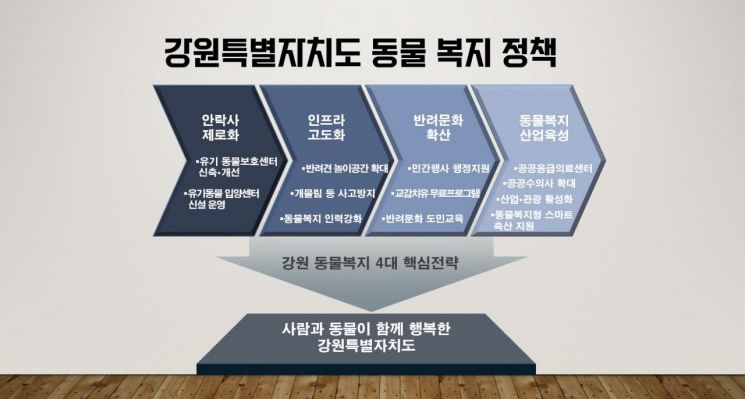
The province will concretize this policy into four major strategies and implement them step by step: expanding zero euthanasia for abandoned animals; advancing animal welfare infrastructure; spreading a companion animal culture based on public-private cooperation; and advancing animal medical care while fostering a welfare industry that integrates industry and tourism.

First, the province will further strengthen its zero euthanasia policy for abandoned animals. Municipal and county animal protection centers for abandoned animals will be newly built or modernized to improve protection environments, and adoption centers for abandoned dogs will be established and operated in areas with high floating populations. Dedicated adoption centers for abandoned cats will be expanded through cooperative models to broaden the adoption base. The number of municipal and county protection centers increased from 8 in 2022 to 17 in 2025, and the province plans to expand this to 24 centers by 2032.
The province will build a safe and responsible animal welfare infrastructure. It will improve the name and functions of the Companion Animal Support Center, reinforce its facilities, and thereby strengthen its role as a hub. The province will overhaul the management system for dangerous dogs and establish a support system for behavioral correction of problem dogs, while also expanding organizations and personnel dedicated to animal welfare and related industries.
In addition, the province will promote a mature companion animal culture based on public-private cooperation. It will link administrative and medical support to privately led companion animal culture events and institutionalize animal interaction and healing programs. Through the "Companion Animal Provincial School," the province also plans to expand education on responsible companion animal culture.
Furthermore, the province will foster the welfare industry by advancing animal medical care and linking it with industry and tourism. It will designate public animal hospitals to establish an emergency medical system for nights and holidays and increase the number of public veterinarians specializing in companion animals. In collaboration with the Gangwon Tourism Organization, the province will introduce a "Pet-Friendly Certification System" that certifies accommodations, cafes, restaurants, and other facilities that allow companion animals, and it will discover premium snack manufacturers that utilize Gangwon specialty products to strengthen the competitiveness of a locally rooted pet industry.
Going forward, the province plans to enhance policy implementation by establishing an "Animal Welfare Triangular Cooperation System" in which the public sector, related institutions, and the private sector share roles. Under this structure, the province will oversee policy formulation and administrative and medical support; related institutions will be responsible for linking with industry and tourism; and the private sector will handle on-site implementation such as adoption, education, and cultural dissemination.
© The Asia Business Daily(www.asiae.co.kr). All rights reserved.
![Clutching a Stolen Dior Bag, Saying "I Hate Being Poor but Real"... The Grotesque Con of a "Human Knockoff" [Slate]](https://cwcontent.asiae.co.kr/asiaresize/183/2026021902243444107_1771435474.jpg)

















