Since the beginning of this year, the pace of consumer price increases has somewhat slowed, but service prices have remained relatively high. Public service prices have continued to rise since August last year, building up inflationary pressure, and personal service prices have persistently outpaced the overall consumer price inflation rate, which is cited as a factor increasing the burden of perceived inflation.
Public service prices rose in 21 out of 30 items
According to the National Data Office on the 20th, public service prices last month rose 1.6% year-on-year, with 21 out of a total of 30 detailed items (70.0%) recording increases. After a 3.6% decline in August last year, they turned to an upward trend with increases of 1.2% in September and October, and 1.4% in November and December.
By item, the transportation and medical sectors led the increase. Last month, sewerage charges (10.0%) recorded a double-digit rise, and public transportation fares such as urban rail (7.0%), city bus (3.7%), and taxi (1.0%) all went up. International airfares (4.2%) also increased. In the medical sector, prescription dispensing fees at pharmacies (3.3%), outpatient treatment fees (2.0%), dental treatment fees (2.0%), and inpatient treatment fees (2.0%) all rose. Septic tank cleaning fees (3.4%) also showed a high rate of increase. In contrast, only three items, including road tolls (-1.5%) and internet service fees (0.0%), recorded declines, and six items were unchanged.
The rise in public service prices is largely driven by the policy of "bringing fees in line with actual costs." Public utility charges that had been suppressed are now being adjusted to reflect higher costs, and the accumulated expenses of maintaining transportation and environmental infrastructure have added to upward pressure. Because it is difficult to reverse public utility charges once they are adjusted, they are likely to act as a persistent upside factor in the inflation path.
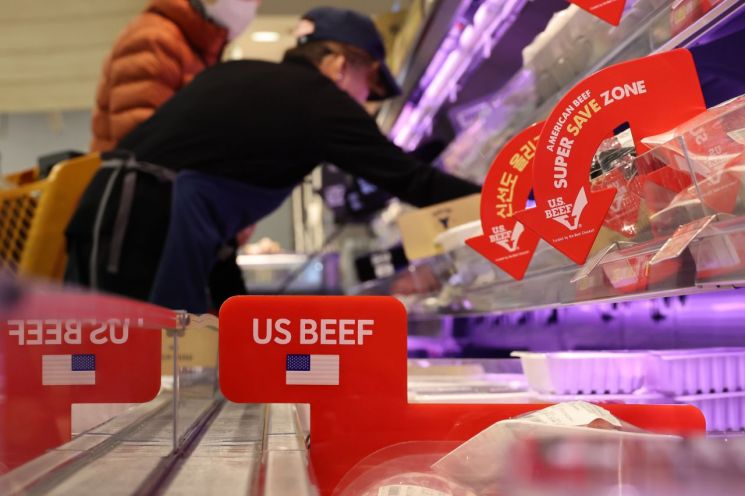 A shopper is selecting items at the meat counter of a large supermarket in downtown Seoul. Yonhap News.
Accumulated costs and downward rigidity... structural rise in service prices
During the same period, personal service prices rose 2.8%, with 62 out of 77 items (80.5%) increasing. Everyday, close-to-home expenses such as dining out, lodging, education, and care services all went up broadly. Insurance service fees (15.3%) and home appliance repair charges (14.0%) posted double-digit increases, while college admission application fees (9.0%), laundry charges (7.8%), sports event admission fees (5.9%), and postpartum care center fees (5.0%) also rose by more than 5%.
Labor costs are cited as the key driver behind the rise in personal service prices. The service industry has a labor-intensive structure, so increases in the minimum wage and in overall wage levels are directly reflected in costs. On top of this, rent, energy costs, insurance premiums, and raw material costs accumulate, sustaining pressure to "pass on costs" to consumers. Unlike goods, services have relatively limited room to reduce costs through productivity gains, which makes it easier for higher costs to translate directly into higher prices.
Another characteristic is downward rigidity. Once prices such as restaurant bills, private academy tuition, and maintenance fees are raised, they are rarely cut as long as demand remains at a certain level. Although there is consumer resistance to price hikes, when the entire industry adjusts prices simultaneously, they tend to become fixed at a new baseline. Given that 70% to 80% of service items recorded price increases last month, it is interpreted that higher costs are being passed on to consumers.
The concern is that if the upward trend in service prices continues, it could intensify core inflationary pressure and further increase the burden of perceived inflation. Unlike highly volatile items such as agricultural products and energy, service prices move within a narrower range but are more persistent. This creates a challenge for monetary policy management. In addition, because spending on dining out, education, housing management, and insurance is largely essential, higher prices in these areas constrain households' ability to consume by reducing real income.
Kang Sungjin, a professor of economics at Korea University, said, "Rising service prices can also be seen as an indicator that our domestic demand is recovering to some extent," but added, "It also reflects accumulated costs such as past labor expenses, and if this trend continues for a long time, it could affect core inflation as well."
© The Asia Business Daily(www.asiae.co.kr). All rights reserved.
![Clutching a Stolen Dior Bag, Saying "I Hate Being Poor but Real"... The Grotesque Con of a "Human Knockoff" [Slate]](https://cwcontent.asiae.co.kr/asiaresize/183/2026021902243444107_1771435474.jpg)















