AI Era: Directions for Advancement in the Field of Helical Polymer Synthesis
 Lee Jaeseok, Professor Emeritus, Department of Materials Science and Engineering, GIST. Photo by GIST
Gwangju Institute of Science and Technology (GIST) announced on the 19th that Emeritus Professor Lee Jaeseok of the Department of Materials Science and Engineering has published a policy proposal report titled "AI Era: Directions for Advancement in the Field of Helical Polymer Synthesis" as part of the "Career Decisions of Eminent Scientists" project organized by the Korean Academy of Science and Technology (hereinafter referred to as "KAST").
"Career Decisions of Eminent Scientists" is a lecture and policy program in which top-tier researchers in Korea share the experience and insights accumulated over their research careers to provide direction and inspiration to future scientists and engineers. Professor Lee's report was published in December 2025.
Focusing on the convergent vision of "AI and polymer synthesis," the report presents key national-level policy directions, including AI-based materials design strategies, data-driven synthesis research systems, and plans for training specialized personnel. In particular, it analyzes the structure and limitations of the petrochemical and polymer industries that have driven Korea's economic growth, and systematically organizes the scientific principles and development process of polymer synthesis technology so that it can be used as basic material for policy discussions.
Using peptide, a representative biomolecule that forms a helical structure, as a case study, the report explains the concept and characteristics of helical polymers and emphasizes that research on helical polymers is well suited for convergence with AI, as fields in which research data have been sufficiently accumulated are more advantageous for AI-based analysis and design.
It also evaluates "living anionic polymerization," which has been developed over several decades, as a representative technology in polymer science, and forecasts that, because it enables precise design of polymers with desired properties, it will play an important role in the future development of AI-based polymer design and synthesis technologies.
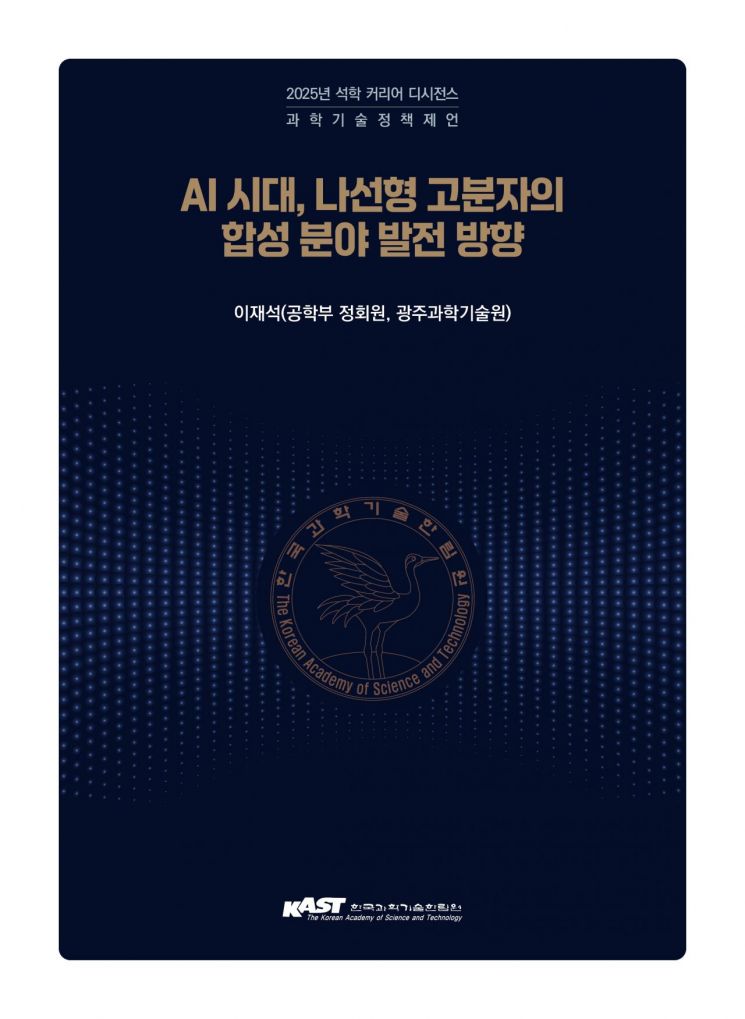 Book cover: 'Directions for Advancement in Helical Polymer Synthesis in the AI Era'. Provided by Gwangju Institute of Science and Technology
Drawing on insights gained from his long research career, Professor Lee suggests that in the AI era, research on "physical AI," which combines polymer synthesis with real physical environments, will become increasingly important, and he proposes new research strategies to the next generation of researchers.
The report presents "domain knowledge" as a core requirement for scientific and technological innovation in the AI era. Domain knowledge refers to the specialized knowledge and experience that researchers have accumulated over a long period in a specific field.
Using new materials, polymer materials, polymer synthesis, and in particular research on helical polymers as examples, Professor Lee explains that the more such expertise is accumulated in a field, the more reliable the data that can be secured, and on this basis AI can perform more accurate analysis and design. This explanation is meaningful in that it shows AI is not a technology that replaces research, but a complementary tool that extends and strengthens the knowledge built up by human researchers.
A full member of the Korean Academy of Science and Technology, Professor Lee is an authority in the field of polymer synthesis who has made major contributions to the advancement of polymer science by being the first in the world to elucidate the core principles that enable the precise design of new polymers. In particular, he was the first in the world to discover the "living polymerization characteristics" in the anionic polymerization process of isocyanates, opening the way to freely control polymer length and structure.
After retiring from GIST, he published "My Education, Research, and Community Service," which reflects his experiences in education, research, and community service, and has continued to share his research philosophy and experience through "Career Decisions of Eminent Scientists" lectures. In particular, he presents to his junior colleagues the fundamental question, "Is it possible to control polymer stereoregularity?" and emphasizes the importance of continuous challenges to unresolved problems.
Regarding the publication of this report, Professor Lee suggested, "If Korea combines manufacturing competitiveness at the level of the world's top five nations with AI technological capabilities at the level of the world's top three nations, it can overcome the structural limitations of the petrochemical industry and secure a new advantage in global competition."
© The Asia Business Daily(www.asiae.co.kr). All rights reserved.
![Clutching a Stolen Dior Bag, Saying "I Hate Being Poor but Real"... The Grotesque Con of a "Human Knockoff" [Slate]](https://cwcontent.asiae.co.kr/asiaresize/183/2026021902243444107_1771435474.jpg)
















